
Article
Supply chain management: Strategy, core processes & optimization guide


Most organizations can map their supply chain on a whiteboard. However, even fewer can explain why deliveries were delayed, where three weeks of safety stock went missing, or how a failed shipment from a supplier affects their production schedule. The difference between understanding supply chain management (SCM) as a concept and executing it as a daily operational discipline is where performance is won or lost.
SCM encompasses the entire process of planning, sourcing, manufacturing, delivering, and returning products, from raw materials to end customers. Organizations that effectively synchronize these activities across functions, partners, and geographies convert their supply chain into a margin lever, a revenue protector, and a resilience asset. Those that do not absorb the cost of failure quietly across every line of the P&L.
This article covers the core SCM processes, the strategies that connect them to business outcomes, and the optimization approaches that transform functioning supply chains into competitive advantages, as well as risk management, digital integration, sustainability, and supply chain performance measurement. These principles apply whether operations remain siloed or evolve toward a fully demand-driven network; however, their implementation varies by the organization’s current stage of development.
What is supply chain management?
The supply chain management meaning, as applied in practice, extends beyond textbook definitions: it is the integrated oversight of all activities that take a product from concept to the customer. It encompasses demand planning, procurement and sourcing, production, warehousing, transportation, order fulfillment, and the handling of returns and after-sales service. SCM connects suppliers, manufacturers, distributors, retailers, and customers into a single coordinated flow of materials, information, and money.
The distinction between supply chain management and logistics management is worth clarifying because the terms are often used interchangeably. Logistics is a subset of SCM, focused specifically on the movement and storage of goods. Supply chain management is broader: it includes logistics but also governs procurement decisions, production planning, demand forecasting, supplier relationships, and the information systems that tie these functions together.
What makes SCM a strategic discipline rather than a purely operational one is its direct impact on cost structure, revenue protection, and capital efficiency. A well-managed supply chain reduces the total cost of goods sold by eliminating waste across handoffs, holding the right inventory in the right locations, and minimizing expediting costs. It protects revenue by ensuring product availability when and where customers need it. And it improves capital efficiency by shortening the cash-to-cash cycle, i.e., the time between paying suppliers and collecting from customers. The scope of SCM now extends to supply chain resilience, sustainability obligations, and digital integration across networks that span dozens of countries.
Explore how a well-structured SCM can positively influence your business
Why is supply chain management important?
Supply chain costs typically represent 50 to 70% of a manufacturing company’s total cost of goods sold. In the retail sector, logistics and distribution alone can account for 20 to 30% of operating costs. These are not back-office expenses – they are the primary lever for margin improvement in asset-intensive industries.
Why is supply chain management important in the current environment? Three converging pressures make it more critical than at any point in the past two decades. First, customer expectations for speed and reliability have increased permanently: same-day and next-day delivery are no longer differentiators but baseline expectations in many sectors. Second, supply chain disruptions have become more frequent and severe, driven by geopolitical tensions, trade policy shifts, and climate events. Third, regulatory requirements around supply chain sustainability, particularly Scope 3 emissions reporting, are turning transparency into a compliance obligation.
Organizations that treat SCM as a transactional function absorb these pressures at a cost, while those who treat it as a strategic capability convert it into a competitive advantage. The difference is not technology or talent; it is the daily operating discipline that connects strategy to execution at every node in the chain. Logistics in retail, for example, has become the single largest determinant of customer loyalty in e-commerce, and the companies winning in that space are those with supply chain operations precise enough to make reliable delivery promises and disciplined enough to keep them.
The core supply chain management process
The supply chain management process is commonly described through five interconnected stages: Plan, Source, Make, Deliver, and Return. This framework, derived from the Supply Chain Operations Reference (SCOR) model, provides a useful structure, but only when you understand what each stage demands in practice.
Plan: The stage where most supply chains break
Planning is the orchestration layer that synchronizes demand signals with supply capacity. It includes demand forecasting, supply planning, production scheduling, inventory policy setting, and Sales and Operations Planning (S&OP). In mature organizations, this evolves into Integrated Business Planning (IBP), which connects financial planning with operational plans.
Errors in planning cascade everywhere: the demand forecast that is off by 15% does not create a 15% problem; it creates excess inventory in some locations, stockouts in others, expedited shipments to fill gaps, overtime in production, and strained supplier relationships. The bullwhip effect, in which small demand fluctuations become increasingly amplified upstream, typically stems from insufficient coordination in planning. The organizations that forecast best are not the ones with the most sophisticated algorithms, but the ones with the most disciplined planning process: regular cadence, cross-functional participation, clear decision rights, and accountability for forecast accuracy.
Source: Procurement as strategic capability
Sourcing encompasses supplier identification, qualification, negotiation, contracting, and ongoing supplier relationship management. A sound procurement strategy balances cost, quality, reliability, and risk across the supply base, meaning understanding the total cost of ownership: not just unit price, but also freight, tariffs, quality costs, lead time variability, and the administrative complexity of managing the relationship.
Strategic sourcing decisions shape the supply chain for years to come. For example, single sourcing reduces cost through volume leverage but concentrates risk, while dual sourcing improves resilience but adds complexity.
Make: Where value is physically created
Manufacturing converts sourced materials into finished goods. The operating model (make-to-stock, make-to-order, assemble-to-order, or engineer-to-order) has profound implications for the entire supply chain, as it determines inventory strategy, lead time commitments, and production flow design. Production flow – the physical sequence, layout, and timing of manufacturing operations – is where lean principles deliver their most visible impact. Reducing changeover times, balancing workstations, implementing pull systems, and standardizing work all reduce lead time, improve quality, and lower unit cost simultaneously.
Deliver: The promise to the customer
Delivery encompasses order management, warehouse operations, transportation, and last-mile fulfillment. This stage is where the supply chain’s performance becomes visible to the customer and where failures are felt most immediately. Warehouse operations drive a disproportionate share of delivery performance – picking accuracy, put-away efficiency, slotting optimization, and labor planning directly determine whether the right product leaves the facility on time. Logistics process optimization in this stage requires treating the entire order-to-delivery cycle as a value stream, identifying every handoff, delay, and information gap, and systematically eliminating non-value-adding steps.
Return: The neglected profit lever
Reverse logistics, the handling of returns, repairs, remanufacturing, recycling, and disposal, is the stage most organizations under-invest in. Returns processing costs run between 8% and 15% of total supply chain cost in consumer-facing industries, yet many companies still treat returns as an afterthought. Effective reverse logistics depends on clear return policies embedded in operational processes, efficient inspection and disposition workflows, and integration with inventory systems so returned goods can be promptly returned to available stock when appropriate.
Building a supply chain strategy
A supply chain strategy answers the following question: how will our supply chain create and protect value for the business over the next three to five years? The answer should define the target operating model, the required capabilities, the needed investments, and the sequence in which changes will be made.
The most common failure in supply chain strategy is disconnection from execution. Organizations produce sophisticated strategy documents that describe the desired future state without defining the specific operational changes, daily routines, and capability-building programs required to get there. The result is a strategy that sounds strong in the boardroom but has little impact on day-to-day execution on the shop floor or in planning meetings.
Connecting strategy to daily operations requires translating strategic objectives into KPIs at each level of the organization, defining improvement initiatives to move each KPI, assigning accountability, and establishing review cadences to track progress and surface obstacles. Monthly operational reviews that feed into quarterly business reviews, which in turn feed into annual strategic planning, create a closed loop between intent and reality.
Supply chain optimization at the strategic level means making deliberate trade-offs, as it is not possible to simultaneously optimize for the lowest cost, the fastest speed, the highest flexibility, and maximum resilience. Segmentation resolves many of these trade-offs: not every product, customer, or channel requires the same supply chain. For instance, high-margin, high-volume products might warrant an agile, responsive supply chain with premium logistics, while low-margin, predictable-demand products can run through an efficient, cost-optimized chain.
The organizations that sustain supply chain performance over time are those that build improvement into the operating rhythm, not as a periodic project but as a daily discipline. This means standard work for planning processes, regular gemba walks through logistics operations, structured problem-solving when exceptions occur, and visible performance management at every node.
Elevate warehouse operations to support consistent supply chain performance
Supply chain optimization: From incremental gains to systemic performance
Supply chain optimization is often framed as a technology problem, but the largest gains consistently come from process redesign, waste elimination, and capability building – areas where technology enables and accelerates improvement without being its source. A lean supply chain applies these principles across the entire value stream, reframing it not as a logistical function but as a system of interconnected activities, each of which can harbor waste. The seven classical waste categories (overproduction, waiting, transport, over-processing, inventory, motion, and defects) apply as directly to supply chain operations as they do to a production line, and identifying them requires the same discipline: going to where the work happens, mapping what occurs, and measuring what it costs.
Value Stream Mapping (VSM), a technique that visualizes the full flow of materials and information from supplier to customer, is the starting tool for identifying where time, cost, and quality are being lost. In most supply chains, actual processing and transit time account for only 5 to 10% of total lead time. The remaining 90 to 95% is waiting: in queues, in warehouses, in approval cycles, in batching processes; reducing that waiting time is where the largest lead-time and working-capital improvements lie.
Logistics optimization spans three interconnected domains: network design, which determines the number and location of facilities and the customer segments each serves; transportation optimization, covering mode selection, routing, and load consolidation; and warehouse process improvement, addressing layout, slotting, picking methods, and inbound and outbound flow. Sustaining these gains over time requires more than a one-off redesign – It depends on embedding continuous improvement into daily operating routines. In practice, this means structured habits at every cadence: daily team huddles to review performance, weekly root-cause analysis of exceptions, and regular value stream reviews that keep the broader system in view.
Inventory management deserves specific attention because inventory is the single largest working-capital item in most supply chains and the most common symptom of upstream dysfunction. Excess inventory usually signals poor demand forecasting, unreliable suppliers, long lead times, or large batch sizes. ABC/XYZ segmentation, i.e., classifying items by value and demand variability, provides the foundation for differentiated inventory policies. Applying a single inventory rule across all SKUs is a common and costly mistake.
Supply chain risk management and resilience
Supply chain risk management identifies, assesses, and mitigates threats that could disrupt the flow of goods, information, or funds. These range from operational risks (supplier quality failures, equipment breakdowns, demand volatility) to systemic ones (geopolitical disruption, natural disasters, pandemics, cyberattacks). The challenge is to quantify exposure, prioritize investment, and build response capability before the disruption arrives.
Supply chain resilience is the ability to absorb disruption, adapt quickly, and recover without disproportionate loss of performance or cost. The most effective approach is targeted resilience: investing in redundancy and flexibility where disruption is most likely and most costly, while maintaining lean operations everywhere else. For example, nearshoring and regionalization of supply networks are structural resilience moves that many organizations now pursue, bringing production closer to end markets to reduce transportation risk and lead time.
Technology and the digital supply chain
The digital supply chain integrates sensors, platforms, analytics, and automation to create real-time visibility and faster decision-making across the network. The foundational capability underlying this is supply chain visibility, i.e., the ability to track inventory positions, shipment status, and demand signals as they change. Control towers take this further by aggregating visibility across functions and partners into a single operating picture, moving supply chain management from reactive problem-solving to exception management and proactive intervention.
Supply chain analytics converts visibility data into decision support: descriptive (what happened), diagnostic (why), predictive (what next), and prescriptive (what to do). Most organizations are still in the descriptive-to-diagnostic range. The barrier to advancement is usually data quality, not algorithmic sophistication.
AI in the supply chain is accelerating across several use cases: demand sensing (using external signals such as weather, events, and social data to improve short-term forecasts), dynamic pricing and allocation, autonomous planning, predictive maintenance for logistics assets, and automated exception resolution. Organizations that generate the most value from AI are those with clean, integrated data foundations and clear decision-making processes designed for AI to augment rather than replace human judgment.
One pattern separates successful digital supply chain initiatives from costly failures: process stability. Technology amplifies existing conditions. Where planning processes are disciplined and standardized, digital tools accelerate performance; where they are not, they amplify inefficiencies. The sequence matters: stabilize and standardize first, then digitize and optimize.
Sustainable supply chain management
Sustainable supply chain management incorporates environmental and social responsibility considerations into all stages of sourcing, production, distribution, and product disposal and reuse. Scope 3 emissions (indirect emissions from the supply chain, both upstream and downstream) typically account for 70 to 90% of a company’s total carbon footprint. Measuring and reducing Scope 3 requires visibility into supplier operations, transportation modes, energy sources, and product lifecycle impacts.
A sustainable supply chain starts with procurement: supplier qualification criteria that include environmental performance, sourcing materials with lower embedded carbon, and designing products for recyclability. It extends through logistics (modal shift from road to rail, route optimization to reduce empty miles, and adoption of alternative-fuel fleets) and into reverse logistics and circular-economy practices. The operational discipline required for sustainable supply chain management is the same discipline required for any form of operational excellence: standard processes, measured performance, visible management, and continuous improvement.
Supply chain best practices
Most articles on supply chain best practices present a list: implement S&OP, invest in visibility, build strategic supplier relationships, adopt lean principles, and use data analytics. These practices are valid, but also incomplete without context. Best practices are maturity dependent. An organization without reliable basic planning processes will not benefit from AI-driven demand sensing. Skipping maturity stages does not accelerate transformation; instead, it creates expensive technological deployments that underperform because the operational foundation is not in place. The table below outlines what each stage looks like in practice.
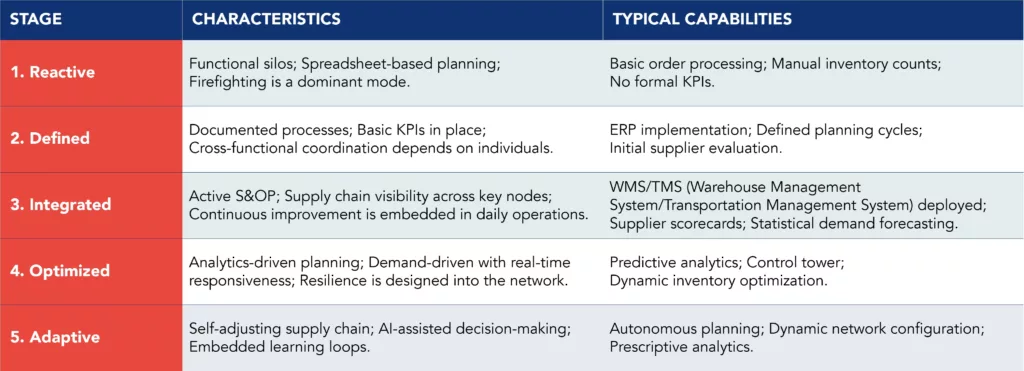
Before implementing any best practice, diagnose your current maturity level. Then build the capabilities for the next stage. For practitioners who want to optimize their supply chain management skills, the most valuable competency is the ability to see across functions, identify where the value stream breaks down, and lead to operational-level improvement.
Measuring supply chain performance
Regardless of where an organization sits on the maturity curve, performance only improves when it is measured at the right level of granularity to surface the right problems.
Supply chain KPIs serve one purpose: to trigger the right conversation about the right problem at the right time. The discipline of daily, weekly, and monthly performance reviews converts measurement into improvement.
Core supply chain metrics:
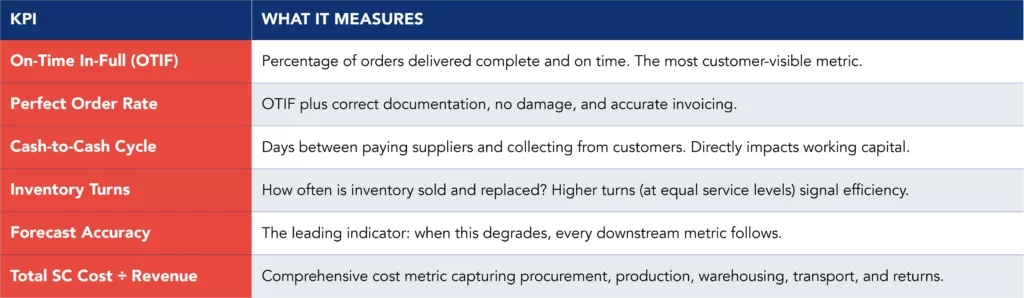
Each KPI should have an owner, a target, a visible display, and a defined escalation path when performance deviates from the target.
From process to performance: Where improvement begins
Supply chain management is not a diagram or a department. It is an organizational capability that either generates a competitive advantage or quietly erodes margins.
The organizations that consistently outperform their peers share a pattern: they do not wait for the perfect strategy, the perfect technology, or the perfect data. They start with the process in front of them. They stabilize it. They standardize it. They improve it every day, at every node. Technology comes after, not before, that foundation is in place.
This is where continuous improvement becomes more than a philosophy. Applied systematically across the supply chain, from the planning room to the loading dock, it creates the compounding gains that no single project or platform can replicate. Small, daily improvements in forecast accuracy, picking efficiency, supplier lead times, and planning discipline accumulate into structural performance advantages that competitors cannot close with a software purchase.
The path forward is not a reorganization or a transformation program with a fixed end date. It is a commitment to building capability, step by step, grounded in the operational reality of your specific value stream. That commitment, sustained over time, is what separates reactive supply chains from leading ones.
Frequently asked questions about supply chain management
What is supply chain management in simple terms?
Supply chain management is the coordination of all activities required to move a product from raw materials to the customer’s hands, including planning, purchasing, manufacturing, storage, transportation, and handling returns. It aims to deliver the right product, at the right place and time, at the lowest total cost.
What is the difference between supply chain management and logistics?
Logistics is one component of supply chain management, focused on the movement, storage, and delivery of goods. Supply chain management is broader: it also encompasses demand planning, procurement, manufacturing, supplier management, and the information systems connecting all these functions.
How does AI improve supply chain management?
AI improves supply chain performance through better predictions and faster decisions: demand sensing with external signals, real-time routing and load optimization in logistics, and dynamic safety stock calculations in inventory management. The prerequisite is clean, integrated data.
What are the biggest risks to supply chains today?
The most significant risks include supplier concentration, geopolitical instability affecting trade routes and tariffs, cyber threats targeting supply chain systems, climate-related disruptions, and demand volatility driven by shifting consumer behavior. Effective supply chain risk management addresses these through network diversification, scenario planning, and operational resilience built into daily processes.
How to start improving supply chain performance?
As a departure point, map the current state: document the actual process (not the intended one), measure baseline performance against core KPIs, and identify the constraint, the single point that most limits overall performance. Improve that constraint first, then move to the next. This focused, sequential approach delivers faster results than broad, simultaneous initiatives.
See more on Warehousing and Distribution
Find out more about improving this business area
See more on Manufacturing Operations
Find out more about improving this business area