
Article
OTIF: an essential supply chain performance indicator


In an increasingly competitive and customer-focused market, keeping delivery promises has become a key strategic differentiator. This is where OTIF (On Time In Full) emerges as one of the most critical supply chain performance indicators. OTIF clearly reflects the customer’s perception of quality and reliability by measuring whether orders are delivered on time and in full.
This article explores the OTIF concept, presenting its definition and calculation formula, while also highlighting the differences from other similar metrics. In addition, it emphasizes its relevance within the supply chain by analyzing practical examples and strategies for improving delivery performance.
What is OTIF?
OTIF (On Time In Full) is one of the most widely used indicators for measuring delivery reliability and efficiency. This supply chain KPI assesses whether an order was delivered within the agreed time frame (On Time) and complete, without any missing items or errors (In Full).
It is considered one of the best reflections of customer experience because it combines two critical factors: punctuality and delivery integrity.
OTIF definition and calculation formula
The meaning of OTIF may vary slightly across sectors, but it generally refers to the percentage of perfect orders, i.e., those delivered exactly as the customer expected: on the agreed date and with the correct quantities and specifications.
The most common formula used to calculate OTIF is:
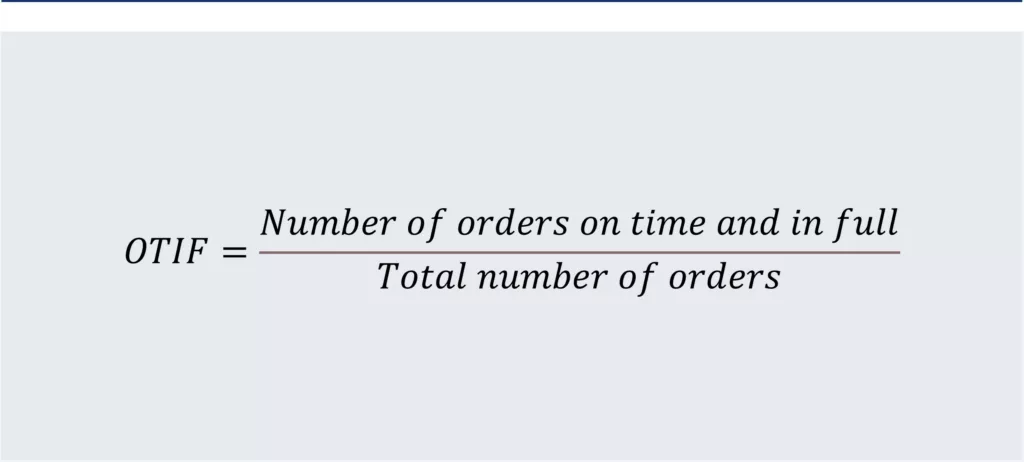
This formula only considers deliveries that meet both criteria for the numerator. In other words, if the delivery is on time but incomplete, or complete but late, the result is not considered in the OTIF.
Difference between OTIF, DIFOT, OTD, and Fill Rate
In practice, OTIF (On Time In Full) and DIFOT (Delivery In Full, On Time) are often used as synonyms. Both measure the percentage of deliveries that arrive on time and in full, without faults or errors. However, the use of these terms can vary slightly depending on the industry or region, so it’s essential to confirm the specific definition applied in each context.
There are other, however, similar indicators, but with significant differences:
- OTD (On Time Delivery) measures only whether the delivery arrived on the agreed date or time, regardless of order completeness.
- Fill Rate focuses on the percentage of order lines or quantities fulfilled in the first delivery. An order may have a high Fill Rate but still fail the OTIF/DIFOT measure if it doesn’t arrive on time.
While OTD and Fill Rate assess isolated aspects of the delivery process, OTIF/DIFOT provides a more comprehensive view.
Make your logistics operations more efficient
The importance of OTIF in the supply chain
OTIF is a key indicator for assessing efficiency and driving supply chain optimization, as it objectively measures an organization’s ability to keep its delivery promises to customers.
OTIF as a supply chain indicator
In the supply chain, the OTIF KPI is an essential metric for simultaneously assessing process reliability. A high OTIF value reflects the company’s ability to align planning, production, warehousing, and transportation, ensuring customer satisfaction. On the other hand, a low OTIF value points to weaknesses in key areas such as demand forecasting, inventory management, production capacity, or carrier performance.
As such, OTIF functions as a strategic KPI for measuring supply chain efficiency. It acts as a benchmark for identifying improvement opportunities and supports the implementation of Kaizen practices aimed at eliminating waste and reducing delays. Its monitoring and improvement can directly impact several dimensions:
- Customer satisfaction: Ensures complete and on-time deliveries, reinforcing trust, loyalty, and reputation.
- Operational visibility: Highlights bottlenecks and increases transparency across the chain.
- Efficiency and costs: Encourages waste reduction and contributes to leaner operations.
- Supplier relationships: Promotes continuous evaluation of partners and strengthens collaboration.
- Responsiveness: Enhances the organization’s agility in responding to demand fluctuations or market disruptions.
Unlike more restrictive metrics, OTIF offers a holistic view of supply chain performance, serving as a true reflection of overall system reliability.
Relationship between OTIF and other indicators
OTIF should not be evaluated in isolation but rather in conjunction with other critical supply chain indicators, such as order cycle time and stock coverage.
Order cycle time refers to the period from when a customer places an order to when it is received. This metric covers all stages of the process: order receipt and registration, planning, production or picking, shipping, transportation, and final delivery. The more stable and predictable this timeframe is, the higher the likelihood of meeting customer commitments and achieving a high OTIF. The goal should be to progressively reduce cycle time, enabling companies to offer increasingly shorter and more competitive lead times without compromising delivery reliability.
In parallel, days of stock coverage represent the number of days that current inventory levels can meet expected demand. Adequate stock coverage acts as a buffer against demand fluctuations or supply disruptions, increasing the chances of delivering complete and on-time orders. However, excess stock translates into additional costs and waste.
Therefore, maintaining a high OTIF at the expense of uncompetitive cycle times or inflated stock levels is not enough. The real goal is to strike a healthy balance among these indicators: ensuring high OTIF, continuously improving delivery lead times, and optimizing stock levels to avoid both excess and shortages. An integrated approach to monitoring these metrics serves as a powerful lever for optimizing the entire supply chain.
OTIF use cases
OTIF is widely used across various sectors of the economy as a benchmark metric for assessing operational efficiency and customer service levels. Beyond serving as an internal performance indicator, it is also a tool for contractual alignment between suppliers, distributors, and customers, and is often included in service level agreements (SLAs).
Practical examples of OTIF application
In the retail industry, OTIF is used to measure the reliability of suppliers and retail logistics operations that supply major supermarket chains. A high rate ensures that shelves remain fully stocked, helping prevent shortages that could compromise customer satisfaction. In e-commerce, OTIF becomes even more critical, as customers expect fast, complete deliveries within the promised time window.
In the pharmaceutical industry, where delivery times and quantity integrity are critical, OTIF helps ensure that medicines and medical devices reach their destination on time and in compliance with regulatory requirements.
In the automotive industry, OTIF plays a vital role in managing suppliers in Just-in-Time systems. Any delay or incomplete delivery can halt an assembly line, leading to significant financial impacts.
These examples illustrate that OTIF is a versatile and cross-functional indicator, applicable in any context where reliable and complete deliveries are essential to business success.
Common limitations and pitfalls in measurement
Despite its importance, OTIF has certain limitations that must be considered:
- Definition variability: Different companies may calculate OTIF differently, including or excluding factors such as delivery tolerances, time windows, or substituted items. This makes it difficult to compare OTIF performance across organizations.
- Excessive focus on a single indicator: Focusing exclusively on OTIF can mask underlying problems. For example, strong performance can be achieved by overstocking, which ultimately reduces overall operational efficiency.
- Dependence on accurate data: Proper OTIF measurement requires a robust information system. Errors in data entry or lack of traceability can distort results.
- Doesn’t distinguish the severity of the fault: The indicator considers a delivery delayed by one day or one week, or an order incomplete by one unit or half the order, equally.
Want to improve your company’s OTIF and ensure more reliable deliveries?
How to improve OTIF
Improving OTIF performance requires an integrated approach that combines rigorous planning, operational efficiency, supplier collaboration, technology adoption, and a strong customer-centric internal culture.
Key improvement areas include:
- Stabilizing processes: Standardizing activities across the supply chain to reduce variability, increase predictability, and ensure consistent lead times.
- Improving flow and operational efficiency: Improving logistics and production operations by eliminating process waste, ensuring continuous flow, reducing errors, and shortening lead times.
- Optimizing inventory management and demand forecasting: Applying pull systems to align production and inventory with real demand and improving forecast accuracy to optimize capacity planning.
- Strengthening supplier relationships: Enhancing sourcing and procurement processes through regular communication channels, sharing information about potential delays, and developing contingency plans to minimize disruptions.
- Using technology for real-time tracking: Implementing tracking systems and route optimization software to ensure end-to-end visibility and greater delivery reliability.
- Training and empowering teams: Building supply chain management skills, raising awareness of OTIF’s impact on customer satisfaction, and fostering a culture of rigor, urgency, and alignment with the organization’s strategic goals.
- Continuously monitoring and reviewing performance: Regularly analyzing OTIF results to identify trends, implement improvements, and ensure processes evolve in line with market demands.
By acting in these areas, companies can not only increase their OTIF compliance rate but also reduce costs, strengthen customer trust, and boost their market competitiveness.
The role of OTIF in operational excellence
OTIF is a true reflection of an organization’s ability to fulfill its delivery commitments, ensuring orders are shipped complete and on time. Systematic monitoring helps identify failures, align processes, and strengthen collaboration across the supply chain. Kaizen initiatives that target improvements in logistics, warehouse and inventory management, and production flow directly enhance OTIF performance while simultaneously reducing waste, increasing predictability, and reinforcing market competitiveness. In a business environment where customer experience is crucial, investing in continuous OTIF improvement means investing in trust, sustainability, and long-term growth.
Still have some questions about OTIF?
What is the benchmark value for the OTIF?
The benchmark value for OTIF varies according to the sector and the level of customer demand. Generally, an OTIF above 95% is considered excellent performance, indicating that nearly all orders are delivered on time and in full. In more critical industries, targets are usually higher, often reaching 98–100%.
More important than reaching an absolute value is ensuring consistency and continuous improvement. Therefore, each company should set internal benchmarks, compare them with industry best practices, and set realistic but ambitious goals for continuous improvement.
What’s the difference between supplier OTIF and internal OTIF?
Supplier OTIF measures the reliability and efficiency of external partners that supply the organization, assessing whether they deliver raw materials, components, or products on time and in full quantity. Internal OTIF, on the other hand, focuses on the company’s own ability to meet delivery commitments to its customers—whether they are distributors, retailers, or end consumers. Both are essential and should be monitored together, as failures in supplier OTIF typically impact internal OTIF. Managing both levels simultaneously helps pinpoint the root causes of delivery issues and supports structural improvements throughout the supply chain.
How can digital transformation help monitor and improve OTIF?
Digital transformation has a direct role in enhancing OTIF by providing end-to-end visibility over order status and supply chain flows. Technologies such as advanced traceability systems (IoT, RFID, sensors), predictive analytics platforms, and route optimization algorithms allow companies to anticipate delays and respond proactively. By integrating real-time data from suppliers, warehouses, carriers, and customers, companies can predict disruptions, quickly adjust planning, and reduce lead times. In addition, dashboards and automated reports facilitate KPI monitoring, making OTIF a live indicator that guides strategic and operational decisions on a daily basis.
See more on Operations
Find out more about improving this business area
See more on Logistics
Find out more about transformation in this sector