
Article
Logistics optimization: how to create efficient flows


In an increasingly complex supply chain context, logistics plays a decisive role in organizational operational efficiency and competitiveness. Simultaneous pressure on costs, service levels, and responsiveness requires a structured approach to logistics flow management, driven by logistics excellence from planning to execution.
In this article, we explore how creating flow, designing logistics processes appropriately, integrating with suppliers and customers, and judiciously using new technologies can transform logistics into a true driver of sustained operational performance.
The role of logistics in operational performance
Logistics has evolved from a purely operational function to assuming a strategic role in organizations’ overall performance. How materials, information, and physical flows are planned and executed directly influences costs, market responsiveness, and customer service reliability. Optimizing logistics therefore becomes a decisive factor in ensuring operational efficiency and sustained competitive advantage.
Why logistics optimization is critical for cost, service, and agility
Logistics is one of the main components of the operational cost structure, encompassing warehousing and distribution, inventory management, and related administrative activities. Inefficiencies across logistics flows directly result in higher unit costs, misaligned inventory levels, long lead times, and degradation of customer service levels, often reflected in indicators such as OTIF (On Time In Full).
Optimizing the logistics network makes it possible to act simultaneously on efficiency and reliability by reducing waste, improving physical and information flows, and synchronizing supply and demand. By redesigning processes based on flow principles, organizations can increase operational predictability, reduce variability, and gain responsiveness to changes in demand without relying on excessive inventory or capacity buffers. In this way, logistics comes to support not only cost reduction, but also operational agility and the sustainability of business performance.
Key challenges in modern logistics
Modern logistics faces structural challenges arising from the increasing complexity of supply chains and the globalization of flows, with a direct impact on operational efficiency and service levels:
- Increase in the number of transactions with smaller quantities and greater product variety, raising operational complexity.
- Growing demand for customization, value-added services, and returns management, introducing greater process variability.
- Intensification of international flows, with greater coordination complexity, variable lead times, and regulatory requirements.
- Continuous pressure to reduce processing and delivery times while maintaining high levels of reliability and quality.
- Limitations on available resources, including labor, space, and transportation capacity, increase pressure on costs and productivity.
- Lack of end-to-end visibility and dependence on traditional planning models, which hinder control and amplify variability.
Addressing these challenges requires a structured approach focused on flow creation, systematic waste reduction, and process standardization aligned with the operational strategy and business objectives.
Turn your logistics into a performance driver
Warehouse design as a lever for efficiency
Warehouse design is one of the main determinants of logistics efficiency. Decisions related to layout, storage principles, and racking systems have a direct impact on physical flows, team productivity, lead time, and inventory levels. A warehouse designed without a flow logic tends to amplify waste and create operational rigidity. By contrast, a flow-oriented design supports variable volumes, improves operational visibility, and sustains high service levels with a lower structural cost. Warehouse performance must also be analyzed in the context of the logistics network footprint, ensuring that its location, size, and function are aligned with the supply and distribution flows it supports.
Warehouse layout: from traditional configuration to flow layout
Traditional warehouse layouts are often conceived as a “one-size-fits-all” solution for storage, with little differentiation by flow type or product profile. This approach tends to generate long travel distances, unnecessary crossings, low operational visibility, and difficulty controlling productivity and lead time.
A flow layout, on the other hand, is designed based on logistics value streams, promoting simple, direct, and predictable paths between receiving, storage, picking, and shipping. This configuration reduces movements, standardizes work, increases operational flexibility, and significantly improves productivity, supporting low inventory levels and high customer service levels.
Storage principles to support flow and standardization
Creating a flow-oriented warehouse requires the consistent application of storage principles that promote simplicity, predictability, and operational control:
- Organization by value streams, ensuring that products with similar flows share dedicated spaces and equipment.
- Flow layout, minimizing crossings, returns, and unnecessary movements between receiving, storage, picking, and shipping.
- Location by rotation, positioning higher-frequency items in zones closest to picking and shipping areas.
- Location optimization, defining criteria for establishing storage zones.
- Standardization of storage processes, ensuring consistent and easily replicable work methods.
- Visual management of operations, facilitating the identification of deviations, occupancy levels, and operational priorities.
- Standardization of packaging quantities, optimizing handling and picking activities.
- Error control mechanisms, preventing location, picking, and shipping failures.
- Focus on safety and ergonomics, ensuring stable, productive, and sustainable operations over time.
Selection of the storage system: technical and operational criteria
Selecting the storage system should result from a technical analysis of outbound flows, product profiles, and operational requirements. Criteria such as safety, picking productivity, batch storage, operational simplicity, and efficient use of available floor space are essential to avoid overly complex or underutilized solutions.
Additionally, factors such as pallet orientation, required investment, and specific equipment needs must be assessed in an integrated manner. The choice of racking system should support the flow layout and the warehouse’s operational objectives, avoiding rigid solutions that limit future adaptability.
Receiving and storage: optimizing inbound flows
Inbound flows have a direct impact on the stability of logistics operations, influencing inventory levels, lead time, resource utilization, and service quality. Poorly structured receiving tends to concentrate variability, generate congestion, and create non-value-added activities at the warehouse entry point. Optimizing receiving and storage involves transitioning from traditional models, based on large batches and low frequency, to more frequent, synchronized, and pull-driven flows, supported by greater integration with suppliers. They should also consider optimizing reverse logistics, ensuring that the flow of returns, refunds, and reusable packaging is integrated in a structured manner, without introducing variability or congestion into the main operation.
Traditional inbound vs. flow-based inbound
When comparing traditional inbound processes with flow-based inbound processes, clear differences emerge in how supply is planned and executed. In the traditional model, inbound is characterized by large-batch receipts, long order lead times, and low frequency, typically weekly. This logic requires maintaining large inventory buffers to ensure availability, frequently relies on disposable packaging such as cardboard boxes, and requires incoming quality inspection. As a result, inbound flows accumulate multiple types of waste, including waiting, additional movements, and rework.
In flow-based inbound, supply is supported by pull planning with reduced order lead times. High receiving frequency enables operation with low inventory levels and systematic use of returnable containers. In this model, quality control is ensured upstream, eliminating the need for incoming inspection. The inbound flow becomes simpler, more stable, and more predictable, with leveled entries aligned with actual consumption.
Optimizing receiving, sorting, and storage steps
Improving inbound flows requires an integrated approach to the main operational steps. The following are examples of improvements that can be implemented, depending on the operational context and the organization’s maturity level:
Receiving:
- Side loading/unloading to reduce operation times.
- Leveling receipts over time.
- Direct transport to the point of use whenever possible.
Sorting:
- Strengthening quality control at the source (supplier).
- Eliminating redundant incoming inspections.
- Implementing cross-docking.
Storage:
- Eliminating repacking activities.
- Clear separation between replenishment and picking areas.
- Applying standardized work to ensure stability and predictability.
Inbound optimization also depends on collaboration with suppliers to optimize the supply chain, by increasing transportation frequency with regular and predictable cycles, reducing waiting times and supply variability, defining joint sourcing strategies, sharing information, and integrating quality control at the source.
Picking and shipping: optimizing outbound flows
Outbound flows play a critical role in the overall performance of the distribution center, directly influencing customer service levels, operational stability, and logistics costs. Poorly structured order preparation and shipping operations tend to concentrate variability at the end of the chain, generating workload peaks, high inventory, and difficulties in operational control. This relevance is even more evident in the last mile, where small inefficiencies quickly translate into service failures, higher costs, and negative impacts on customer experience. Outbound optimization involves transitioning from traditional models oriented toward large work waves to leveled, frequent flows synchronized with actual customer demand.
Traditional outbound vs. flow-based outbound
In the traditional outbound model, work release typically occurs at the start of the day or the previous day, concentrating in a short period the workload corresponding to an entire day. This model is associated with large order lead times, low shipping frequency, and the use of disposable packaging. As a result, it becomes necessary to maintain high inventory levels, large flow fluctuations are observed, and operational control is often performed only at the end of the day or the following day.
In flow-based outbound, work is released in small time intervals aligned with actual consumption. Order lead time is reduced, enabling high shipping frequency, daily or multiple times per day. The use of returnable flow containers, elimination or strong reduction of inventory, and levelling of outbound flows contribute to a more stable operation. Operational control is performed in short cycles, with standard times per task, enabling greater visibility, predictability, and responsiveness.
Optimizing picking, quality, and loading steps
Improving outbound flows requires an integrated approach to the main operational steps. The following are examples of improvements that can be implemented to ensure stability, predictability, and efficiency:
Picking:
- Clear separation between replenishment and picking areas.
- Reduction of interference between replenishment and preparation flows.
- Selection of the best picking strategy.
- Process optimization and application of standardized work to increase productivity and reliability.
Quality control and repacking:
- Elimination of redundant quality controls.
- Implementation of cross-docking whenever applicable.
- Elimination of repacking activities to reduce waste and lead time.
Loading:
- Side loading to reduce operation times.
- Levelling shipping activities over time.
Outbound optimization also strongly depends on collaboration with customers, through increased transportation frequency with regular and predictable cycles, reduced variability in outbound flows, aligned sourcing strategies, information and knowledge sharing, and integration of quality control along the chain, ensuring stability and high service levels.
Milk run and the standardization of external logistics
The Milk run is an external logistics model oriented toward flow creation, designed to increase transportation frequency, reduce inventory levels, and improve supply and distribution predictability. By organizing logistics movements through standardized and repetitive routes, the Milk run enables more efficient use of transportation resources and contributes to operational stability across the logistics chain.
Concept and operation of the Milk run
In the Milk run model, the logistics operator assumes responsibility for all external logistics movements, with the truck as the main operational resource. Instead of direct and isolated shipments, pickups and deliveries are carried out sequentially, following dedicated routes and reliable schedules. Waste elimination results from the standardization of logistics work, applied consistently, as in internal supply flows, ensuring process predictability and control. The Milk run model must be adapted to each organization’s reality by adjusting routes, frequencies, and consolidation points, while maintaining the fundamental principles of flow, standardization, and predictability that characterize the model.
From an operational perspective, the Milk run directly contributes to reducing inventory levels, enabling operation with lower average and maximum stocks without compromising service levels. Predictable cycle times facilitate daily operations management and improve inventory visibility throughout the day. In addition, route and schedule standardization promotes more structured communication with suppliers, strengthening coordination across the supply chain.
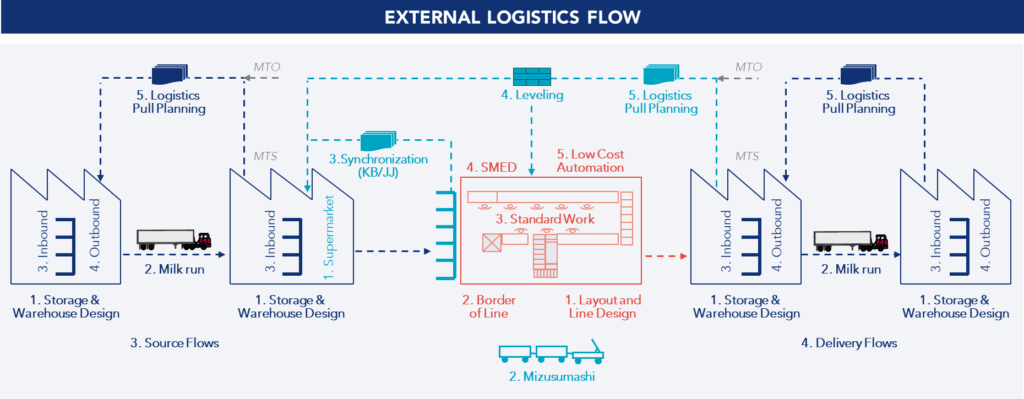
Figure 1 – Example of external logistics flow with standardized routes and integration of inbound and outbound flows
Key principles for implementing the Milk run
Effective implementation of the Milk run requires compliance with several fundamental principles. High delivery frequency presupposes the availability of dedicated resources. Whenever possible, solutions that reduce loading and unloading times should be prioritized, such as side-loaded trailers. The use of cross-docking makes it possible to gain scale and speed, especially in contexts with multiple suppliers or customers. Defining the minimum shipping unit must be aligned with consumption patterns, using single or shared pallets depending on the volume between deliveries.
Full pull planning
Pull planning is a central element in stabilizing the logistics chain and reducing waste across the supply chain. Unlike traditional planning based on forecasts and push logic, pull starts from actual customer consumption and synchronizes all upstream logistics loops. This approach enables variability reduction, inventory optimization, and the creation of more predictable and controllable flows.
Traditional planning vs. full pull planning
In traditional planning models, the supply chain is typically managed based on forecast data, MRP stock, and push logic. The need to protect against uncertainty leads to high safety stocks and replenishment decisions based on unreliable quantities, heavily dependent on system parameters. This approach tends to amplify variability along the chain and distance planning from actual customer demand.
Full pull planning is based on a different logic. Replenishment is triggered by physical supermarkets and actual consumption, based on real orders rather than forecasts. The focus shifts from local optimization to flow optimization, with strict adherence to defined standards. The result is a more stable logistics chain, with lower inventory and greater alignment between demand and replenishment.
The bullwhip effect and its impact on the logistics chain
The bullwhip effect is one of the main sources of waste in supply chains. Small variations in end-customer demand tend to generate increasingly larger variations as one moves upstream in the chain, from the customer to raw material suppliers. This phenomenon leads to excess inventory, overproduction, and inefficient use of capacity.
The main causes of the bullwhip effect include order batching to increase lot sizes, overreactions to small demand variations, use of intermediate information instead of actual end-customer demand, advance purchasing of seasonal products, and capacity imbalances. In many cases, ERP systems themselves, through their contingency planning rules, contribute to amplifying this effect.
Effective reduction of the bullwhip effect is only possible through consistent application of pull planning and flow levelling. Reducing total lead time, accelerating and making information flow reliable, and harmonizing plans internally are essential steps. End-to-end supply chain visibility and collaboration among the different stakeholders enable decisions to be aligned with actual demand. In this context, it becomes essential to clearly distinguish between real end-customer demand and artificial demand created by the logistics chain itself.
Supermarket sizing
Proper supermarket sizing is a critical element for the functioning of pull planning. This process requires an integrated analysis of replenishment on the supplier side and demand on the customer side. From the supplier’s perspective, factors such as order frequency, visibility of inventory levels, minimum lot size, process lead time, transportation, and the replenishment process itself must be considered.
From the customer side, the analysis should focus on the consumption profile, including volume, frequency, and variability over time, as well as the characteristics of the operational process. Balancing consumption and replenishment makes it possible to define appropriate inventory levels, ensuring flow, stability, and high service levels with the minimum necessary inventory.
Want to take your logistics efficiency to the next level?
The role of new technologies in logistics optimization
The adoption of new technologies has been transforming how logistics operations are planned, executed, and controlled. However, the true value of technology in logistics does not lie in the isolated automation of activities, but in its ability to support stable flows, data-driven decisions, and pull-oriented operating models. When correctly integrated, technologies become enablers of operational efficiency, end-to-end visibility, and continuous improvement.
In many contexts, technological solutions are implemented before processes are simplified and stabilized, resulting in complex systems that perpetuate existing inefficiencies. In a flow-oriented approach, technology should be introduced after process design.
New technologies: current solutions and emerging trends
Logistics has been one of the areas most impacted by technological evolution, driven by the need for greater efficiency, visibility, and responsiveness.
Among widely adopted technologies are logistics optimization software such as Warehouse Management Systems (WMS) and Transportation Management Systems (TMS), which support location management, picking, shipping, route planning, and transport monitoring. These platforms increase operational reliability, reduce errors, and improve visibility of physical and information flows. Complementarily, real-time shipment traceability solutions based on RFID, advanced barcodes, or IoT (Internet of Things) sensors facilitate tracking of materials, containers, and transportation assets across the entire chain.
In the automation domain, technologies such as assisted picking systems (pick-to-light, pick-by-voice), automated conveyors and shuttles, and dynamic storage systems are now widely used to increase productivity, reduce lead times, and improve ergonomics. More recently, adoption of AGV (Automated Guided Vehicle) and AMR (Autonomous Mobile Robot) has been growing, enabling more flexible internal transport and reducing dependence on labor for repetitive tasks.
At the planning and control level, there is a shift toward solutions based on advanced analytics, real-time operational dashboards, and decision-support tools. These technologies provide supply chain visibility and enable more dynamic management of inventories, transportation frequencies, and logistics capacity. In this context, digital twins applied to logistics are also gaining relevance, enabling the creation of virtual representations of warehouses, transportation flows, and logistics networks. These solutions make it possible to simulate scenarios, test layout changes, evaluate the impact of demand or capacity variations, and support decisions before implementation in the real system.
Among emerging trends, artificial intelligence and machine learning are beginning to be applied to demand forecasting, route optimization, capacity planning, and early detection of operational deviations. In parallel, increasing system integration, including collaborative platforms among customers, logistics operators, and suppliers, is enabling greater supply chain synchronization. These emerging technologies point toward an increasingly connected, autonomous, and data-driven logistics environment, provided they are applied on well-designed and stabilized processes.
Conclusion: logistics as a strategic pillar of operational excellence
Improving logistics performance is a critical factor for organizations’ operational performance, with a direct impact on costs, service levels, and business agility. Sustainable results are not achieved through isolated initiatives, but through an integrated approach to managing end-to-end logistics flows.
Flow-oriented warehouse design, optimization of inbound and outbound processes, adoption of models such as the Milk run, and consistent implementation of pull planning make it possible to reduce variability, lower inventory levels, and increase operational predictability. When aligned, these elements create a more stable, controllable logistics chain that is responsive to actual customer demand. New technologies play a relevant role in this context, provided they are applied as support for well-designed and standardized processes.
Ultimately, logistics ceases to be merely a support function and becomes a strategic pillar of operational excellence. Organizations that adopt this perspective will be better prepared to respond to market volatility and sustain competitive advantages over the long term.
See more on Warehousing and Distribution
Find out more about improving this business area
See more on Logistics
Find out more about transformation in this sector