
Article
From strategic planning to operational planning: how Hoshin Kanri turns strategy into action


The effective execution of a strategy depends not only on its formulation but also on the ability to transform it into clear, measurable operational plans aligned with the organization’s priorities. The Hoshin Kanri method is a structured approach that links strategic thinking with practical action.
Hoshin Kanri involves all levels of the organization in the strategy deployment process, ensuring that long-term goals are translated into tangible results and driving organizational excellence.
This article examines how operational planning, as the bridge between strategy and execution, becomes a crucial tool for the success of any organization.
What is operational planning?
A well-defined strategy only becomes effective when translated into tangible actions. This is where the definition of operational planning plays a decisive role: transforming the strategic vision into clear, executable plans that are aligned with business priorities.
By bridging strategy development and day-to-day execution, operational planning ensures that everyone in the organization understands not just what needs to be achieved, but also how, when, and with what resources.
The operational plan guarantees that teams have the right conditions to deliver the expected results. In short, it ensures that every area of the company contributes in a coordinated way toward shared goals, promoting focus, accountability, and continuous improvement.
Align your strategic goals with an effective operational plan
Strategic planning vs. Operational planning
Although complementary, strategic and operational planning operate on different levels.
While strategic planning establishes the vision, long-term goals, and overall priorities, operational planning outlines specific actions, necessary resources, and performance indicators that measure progress. Organizational success lies in the consistency between the two.
Deploying strategy with Hoshin Kanri
The real challenge for organizations is ensuring the effective deployment of strategy, including workforce planning, across all levels. Hoshin Kanri establishes an operational planning model that translates strategic objectives into annual goals and practical initiatives, ensuring all teams move in the same direction and understand how their contributions impact the overall results.
Strat Review: the vision design process
Before launching the Hoshin Deployment, the Strat Review takes place—an essential step in strategic planning that ensures the strategy is built on solid information.
The Strat Review is a comprehensive strategic assessment designed to understand the organization’s operating context, identify growth opportunities, and define what success looks like within the sector. This process includes market research and Voice of the Customer (VOC) analysis, critical reflection on past performance, scenario planning, identification of strategic opportunities, and a clear vision of the organization’s future success.
This step forms the foundation for Hoshin deployment by providing the strategic diagnosis and priorities that will guide both the strategy and its implementation.
From strategy to operational plan: the hoshin deployment process
Before developing the top-level X Matrix, organizations often conduct Value Stream Analysis within strategic value streams to identify the most critical waste and transformation opportunities. This analysis provides a fact-based foundation for defining improvement priorities, ensuring efforts target the value streams with the greatest impact on overall performance.
Filling out the top-level X Matrix begins with setting long-term objectives (3 to 5 years), which are then broken down into annual goals and high-impact improvement projects. The X Matrix is a visual tool that links objectives, goals, initiatives, indicators, and responsible parties, providing an integrated view of the plan. Its cross-shaped structure ensures that all operational actions directly support overall results and help realize the organizational vision.
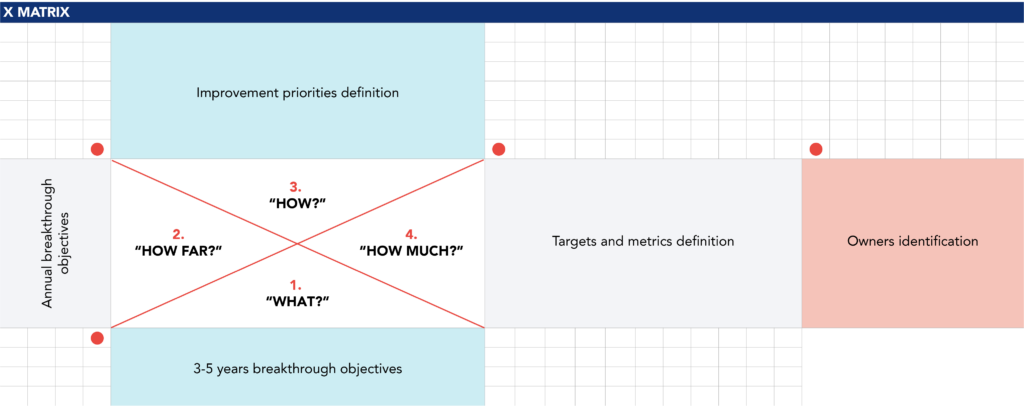
Figure 1 – Top-level X Matrix
The success of strategy deployment depends on the catchball method—a two-way communication process that fosters ongoing dialogue across hierarchical levels. This method ensures alignment, commitment, and shared accountability, making sure that the defined plans are realistic, actionable, and clearly understood by everyone.
The top-level X Matrix is then cascaded into second and third-level matrices, translating strategic objectives into specific goals and initiatives for each functional area. These intermediate matrices ensure both vertical and horizontal alignment, allowing each team to understand its direct contribution to achieving the organization’s overall goals.
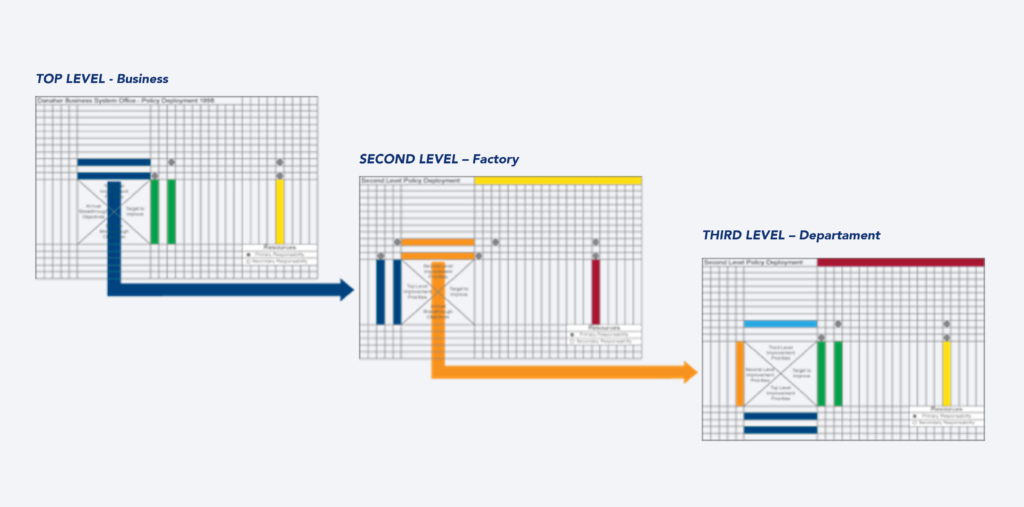
Figure 2 – Strategy deployment using the X Matrix
During this process, the operating model is detailed and adjusted to enable the effective execution of the goals. This includes both capacity planning and resource planning.
This transition from strategy to business execution creates a direct link between the long-term vision and daily operations, enabling the organization to move forward in a coordinated way, focused on achieving sustainable results and operational excellence.
Monitoring and continuous performance improvement
Effective strategy execution requires disciplined monitoring, ongoing review of results, and proactive risk management. Within the Hoshin Kanri methodology, these elements form the foundation of a structured management system that ensures progress tracking, timely correction of deviations, and early identification of potential vulnerabilities.
This systematic follow-up drives operational improvement and reinforces a culture of accountability, transparency, and data-driven organizational learning, enabling the organization to quickly adjust its course and stay aligned with strategic goals.
Hoshin review
The Hoshin Review is the process for continuously reviewing and monitoring both strategic and operational initiatives. Conducted on a regular basis, every month, the Hoshin Review ensures that the organization remains focused on its defined objectives and that management decisions are based on accurate and up-to-date data.
Performance monitoring is supported by a mission control room with dashboards displaying key performance indicators (KPIs), covering both strategic and operational dimensions. Bowling charts are also used to track goals and initiatives in detail. These charts compare planned and actual results, enabling teams to quickly identify deviations and define corrective actions or countermeasures.
This visual and structured approach ensures that each manager and team understands the impact of their actions on overall performance so that they can proactively address any issues.
The Hoshin Review cycle closes the loop between planning, execution, and continuous improvement. It is an organizational learning system that ensures strategies evolve in line with operational reality and the market context.
Risk management
Risk management is a natural extension of Hoshin thinking, ensuring that strategic initiatives are implemented in a safe, controlled, and sustainable way.
The risk register tracks and evaluates key risks related to strategy execution, categorizing them by likelihood and impact, and outlining preventive actions and mitigation strategies. This process promotes a structured and objective approach to decision-making, supported by data and performance indicators.
In parallel, the business continuity plan ensures the organization can maintain critical operations in the face of disruptive events such as technology failures, economic crises, or environmental emergencies. This plan anticipates potential vulnerabilities and develops agile, coordinated responses that protect people, processes, and customers.
Risk management establishes a robust framework for strategic and operational resilience, enabling the organization to move forward confidently, even in highly uncertain environments.
Conclusion: from strategy to execution
Turning strategy into tangible results requires discipline in execution, alignment across all organizational levels, and a culture of continuous improvement.
By combining strategic planning, structured deployment, systematic monitoring, and ongoing review, Hoshin Kanri ensures that every employee understands their role in achieving company-wide objectives.
Hoshin Kanri does not just transform strategy into action—it transforms the very way the organization thinks, acts, and learns, promoting excellence in operational areas, support functions, and services.
This alignment between vision, action, and culture drives sustainable, long-lasting results and strengthens the organization’s ability to evolve and remain competitive over the long term.
Achieve real, lasting results with your strategy
Do you still have questions about operational planning?
What is an X Matrix?
The X Matrix is the central tool of Hoshin Kanri, designed to connect the organization’s strategic vision with the operational actions required to achieve it. Its cross-shaped (“X”) layout provides an integrated view of the relationships between objectives, goals, initiatives, indicators, and owners—ensuring that every element of the strategy is interconnected and aligned.
In practice, the X Matrix answers five key questions:
- What? – What are the long-term strategic objectives (3 to 5 years) the organization aims to achieve? These represent the breakthrough initiatives that will create a sustainable competitive advantage.
- How far? – What are the annual objectives tied to those initiatives, showing the short-term progress needed and defining the organization’s growth pace.
- How? – What are the main improvement priorities—expressed as critical capabilities and processes to develop or optimize to meet the annual goals.
- How much? – What are the key performance indicators (KPIs) and corresponding targets used to measure the effectiveness of initiatives and track results.
- Who? – Who is accountable for each initiative, ensuring clear ownership and cross-functional alignment.
This structure brings clarity, alignment, and accountability throughout the organization. The top-level X Matrix is developed from the overall strategy. It serves as the foundation for cascading to second- and third-level matrices, ensuring that strategic objectives are translated into specific operational plans for each area.
At the same time, the X Matrix functions as a visual communication and integrated management tool. It helps the entire organization share a common vision, understand their role in achieving goals, and actively contribute to collective success.
What are the most common mistakes in strategy planning and deployment?
Mistakes frequently occur during both the planning and execution phases. Among the most critical are:
- Lack of leadership commitment and engagement.
- Limited analytical capability or strategic perspective.
- Overly complex or dogmatic processes.
- Treating the strategic plan as a budgeting or financial forecasting exercise.
- Unclear action plans, without a definition of responsibilities, goals, and realistic deadlines.
- Underestimating required resources and timelines, which undermines execution and frustrates teams.
- Irregular progress reviews, with infrequent check-ins or no feedback mechanisms.
- Jumping to conclusions or making assumptions without data validation or stakeholder involvement.
Avoiding these mistakes requires active leadership, disciplined planning, and transparent communication. Successful strategy deployment relies on a culture of consistent execution, supported by a system that fosters alignment, learning, and continuous improvement throughout the organization.
See more on Kaizen Culture
Find out more about improving your organization