
Article
What is TQM (Total Quality Management)?


In an increasingly dynamic, competitive, and customer-oriented market, quality is no longer a differentiator but an essential requirement for any organization. Today, companies face complex challenges, from rising consumer expectations to the need to work efficiently and sustainably. One response to these challenges inevitably involves structured quality management.
Modern quality goes beyond compliance with standards or product inspection. This translates into an organization’s ability to deliver consistent value, predictably and without fail, through well-defined processes, competent teams, and a culture driven by continuous improvement.
It is in this context that Total Quality Management (TQM) plays a central role, promoting an integrated approach that involves all people, processes, and hierarchical levels in the pursuit of excellence.
In an era where reputation and sustainability depend directly on the consistency and reliability of results, investing in quality is investing in the organization’s future.
What TQM means
The definition of TQM is based on the idea that quality must be built into every step of the process, product, and decision, becoming an integral part of the organizational culture.
More than a set of tools, TQM represents a mindset focused on prevention, collaboration, and innovation, enabling companies to reduce variability, eliminate waste, and strengthen customer trust.
What Is Total Quality Management (TQM)
Total Quality Management, or TQM, is a management philosophy that aims to ensure excellence in quality through the continuous improvement of processes, products, and services, involving all individuals and levels of the organization.
At the core of TQM is the belief that quality is not the sole responsibility of a single department but of the entire organization, embedded in every activity, decision, and customer interaction.
In practice, TQM aims to achieve complete customer satisfaction by eliminating waste, preventing defects, and continually optimizing processes. This approach combines statistical quality control tools, participative management methods, and continuous improvement strategies, fostering a culture where every employee feels responsible for the quality of what they produce or deliver. The principle is simple: do not produce, pass on, or accept defects.
Key tools in TQM include the PDCA (Plan-Do-Check-Act) and SDCA (Standardize-Do-Check-Act) cycles, structured problem-solving methods using cause-and-effect diagrams, poka-yoke (error-proofing devices), flowcharts, histograms, and statistical process control (SPC), among many others.
TQM is therefore a strategic and integrated approach that makes quality a central element of business competitiveness and sustainability.
The origin of TQM
The definition of Total Quality Management has its roots in the post–World War II era, particularly in the Japanese industry, which was seeking to rebuild and become globally competitive. During this period, Japan invited American quality experts, including W. Edwards Deming, Joseph Juran, and Armand Feigenbaum, whose ideas would profoundly shape modern thinking on quality and management.
W. Edwards Deming played a decisive role in Japan’s industrial transformation. Based on the improvement cycle developed by Walter A. Shewhart, the PDCA (Plan-Do-Check-Act) cycle, Deming promoted a systematic approach to continuous improvement, emphasizing the importance of well-defined processes, rigorous measurement, and the involvement of all employees.
Joseph Juran, in turn, emphasized that quality should be managed as a strategic function of the company, introducing the well-known “Quality Trilogy”: planning, control, and improvement. These three pillars formed the foundation of effective management, with a focus on sustainable results.
Armand Feigenbaum was the first to use the term “Total Quality Control,” advocating that quality should not be limited to final product inspection but should span the entire organization, from development through to after-sales service.
Japanese companies such as Toyota and Nippon Denso adopted and refined these concepts, integrating them into their management philosophy. This combination gave rise to a culture of quality and continuous improvement (Kaizen) that would go on to revolutionize the global industry and inspire production and management methodologies worldwide.
In the decades that followed, the TQM philosophy expanded to the United States and Europe, becoming a benchmark for organizational excellence models, such as the EFQM (European Foundation for Quality Management), and for international quality management standards, including the ISO 9000 series.
Today, TQM is considered one of the cornerstones of modern management and serves as the foundation for methodologies such as Lean Management and Six Sigma, which share the same principles: customer focus, variability reduction, continuous improvement, and employee involvement.
Benefits of implementing TQM
Implementing Total Quality Management delivers significant, long-lasting benefits at both the operational and strategic levels. By integrating quality into every process and involving the entire organization, companies can improve overall performance, reduce costs, and enhance competitiveness.
Key benefits of implementing TQM:
- Improved customer satisfaction: With customer focus as a core pillar of TQM, companies deliver more consistent and reliable products and services aligned with market expectations. Fewer defects and increased responsiveness build customer trust and loyalty, driving sustainable growth in customer base and brand reputation.
- Increased operational efficiency: Through continuous improvement principles and standardized processes, organizations reduce waste, eliminate non-value-adding activities, and streamline workflows. This results in improved resource utilization, reduced operating costs, and increased productivity. It also stabilizes processes and prevents unwanted variation, ensuring consistent and predictable results.
- Employee engagement and development: TQM fosters a culture of active participation, where each employee takes responsibility for the quality of their work and collective success. Training investments build technical and behavioral skills, strengthening the sense of ownership and motivation.
- Competitive advantage: Over time, structured TQM implementation helps build solid, data-driven, and process-oriented management systems that support better-informed strategic decisions. The combination of quality, efficiency, and innovation yields a sustainable competitive edge, enhancing profitability and the company’s ability to adapt to market changes.
Discover how to apply TQM to transform your processes
Principles of Total Quality Management
TQM is based on a set of foundational principles that guide organizations in planning, executing, and improving their processes. These principles are interdependent and aim to create an organizational culture where excellence, collaboration, and continuous improvement are embedded in the overall strategy.
Customer focus
In TQM, quality is defined from the customer’s perspective. Customer satisfaction and loyalty are both the starting point and the ultimate goal of all improvement efforts. This requires a deep understanding of customer needs, expectations, and perceptions of value—translating that insight into product, service, and process requirements.
Customer-focused organizations implement systematic practices for gathering feedback, analyzing satisfaction data, and monitoring performance to ensure that each improvement directly impacts the customer experience and strengthens their trust.
Continuous improvement
Continuous improvement (Kaizen) is the driving force behind TQM. Rather than relying on occasional initiatives or large-scale transformation projects, high-performing organizations pursue incremental, sustained process improvements that involve everyone in the effort.
Improvement follows the PDCA (Plan-Do-Check-Act) and SDCA (Standardize-Do-Check-Act) cycles, which structure experimentation, result validation, and the standardization of best practices. Continuous improvement helps eliminate waste, reduce variability, and enhance operational efficiency, ensuring the organization evolves consistently over time.
Employee involvement
Total quality can only be achieved when all employees actively participate in improving processes and results. TQM emphasizes that every person—regardless of role or hierarchy—plays a vital role in creating value.
Involvement means having the autonomy to identify problems, propose solutions, and carry out improvements, supported by a culture of recognition and learning. Organizations that embrace this principle invest heavily in training, internal communication, and empowerment, building motivated teams committed to excellence.
Data-driven decision making
Another core pillar of TQM is fact-based decision making. Decisions must be based on objective information and reliable performance indicators, rather than assumptions or intuition. To support this, organizations implement measurement systems, statistical analysis, and statistical process control to understand variations, identify root causes, and prioritize improvement actions.
This approach enhances transparency, predictability, and consistency in outcomes, ensuring that quality is systematically managed and precisely measured.
Committed leadership
Leadership is the critical factor that supports all other TQM principles. Leaders committed to quality create a shared vision, communicate clear expectations, and inspire behaviors aligned with a culture of continuous improvement.
Beyond supervision, the leader’s role in TQM is to guide, enable, and remove barriers to team progress. Through consistent behavior and leading by example, leaders foster an environment of trust, accountability, and learning, embedding quality as a core value throughout the organization.
Kaizen TQM model
The Kaizen Institute (KI) uses the Kaizen TQM model to help organizations optimize their quality management systems. This model, illustrated in the figure, was developed based on international reference frameworks and KI’s extensive experience in implementing continuous quality improvement practices.
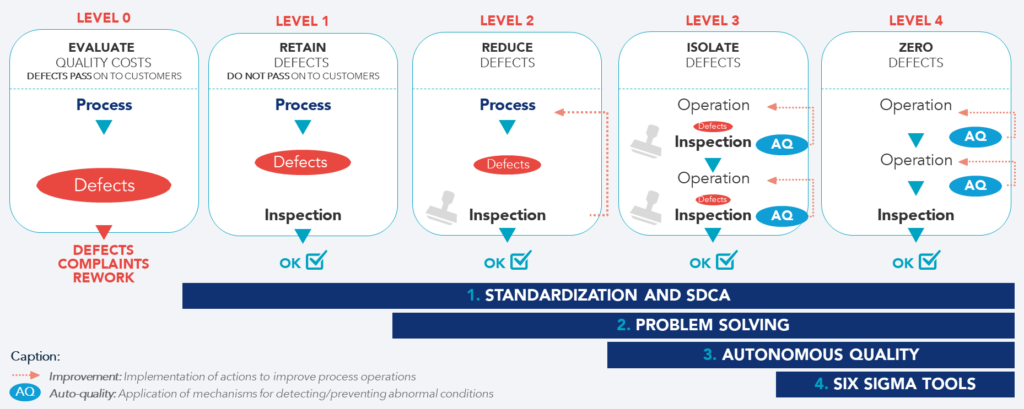
Figure 1 – Kaizen TQM Model
The Kaizen TQM Model outlines the journey of quality maturity within organizations, moving from a reactive stance focused on defect detection to achieving autonomous and preventive quality, fully integrated into business processes and culture.
The model is divided into five maturity levels, each representing a stage in the evolution of quality management—from defect control and reduction to achieving zero defects and full quality autonomy.
Level 0 – Assess quality costs
At this initial level, the organization operates reactively, focusing solely on assessing quality-related costs such as rework, defects, and complaints. Problems are detected after they occur, and corrective actions address only the effects—not the root causes.
The absence of preventive mechanisms leads to a continuous stream of failures and associated costs, hindering sustainable progress.
Level 1 – Contain defects
The focus shifts to preventing defects from reaching the customer. Standardized and systematic inspections are introduced, with quality control applied at the end of the process to retain nonconforming products or services. While this reduces the external impact, the approach remains reactive and relies on manual inspection without addressing the underlying causes of problems.
Level 2 – Reduce defects
At this stage, the organization takes a more proactive approach by implementing improvements to reduce the occurrence of defects at the source. Structured problem-solving methods and root cause analysis tools are applied. The objective is to eliminate problem causes and stabilize processes through standardization, ensuring best practices become routine.
Level 3 – Isolate defects
The organization transitions to an integrated control approach, combining operations with auto-quality mechanisms—systems that enable anomaly detection and prevention directly at the point of execution.
At this stage, quality no longer depends exclusively on specialized teams and becomes the responsibility of operational teams, giving rise to the concept of Autonomous Quality. Various tools are applied to prevent defects from occurring and, if they do occur, to prevent them from advancing to the next stage of the process. Key tools include standards, Poka Yoke, and Jidoka—systems that grant autonomy to stop the process whenever an abnormality is detected, ensuring that no defect is passed along.
Level 4 – Zero defects
The highest level of the model is reached when processes are highly robust and self-sustaining, enabling the elimination of defect causes. The systematic application of Six Sigma tools—from the DMAIC cycle, which forms the methodological foundation, to Statistical Process Control (SPC), which represents an advanced stage of stabilization and defect prevention—ensures robustness, stability, and predictability throughout the value chain.
The quality culture is fully integrated into the organization, and every employee acts as an agent of prevention and continuous improvement, supported by reliable data and well-established standards.
Learn how TQM can boost efficiency and customer satisfaction
Conclusion: TQM as a foundation for excellence
TQM represents a comprehensive quality management model that guides the entire organization toward excellence. By placing the customer at the center, promoting employee involvement, and supporting continuous improvement through data, TQM transforms quality into a strategic asset rather than just a technical requirement.
The Kaizen TQM Model reinforces this vision by demonstrating that the journey to excellence is progressive and sustained, evolving from defect control to auto-quality and to the concept of “zero defects.” Each level of this evolution reflects increasing organizational maturity, in which quality ceases to be an isolated function and becomes part of the culture and daily behavior of every employee.
When properly implemented, TQM delivers measurable and lasting results, increasing customer satisfaction and brand reputation, reducing operational costs and waste, and ensuring greater process stability and predictability.
TQM remains one of the essential models for achieving organizational excellence. By adopting this approach, organizations view excellence as a continuous process of learning and evolution, thereby building a future based on quality, trust, and innovation.
Do you still have questions about TQM?
Differences between TQM, ISO 9001, and other Quality Management Systems (QMS)
While TQM, ISO 9001, and other Quality Management Systems (QMS) share the common goal of ensuring quality and customer satisfaction, they differ in their approaches and purposes.
TQM (Total Quality Management) is a management model designed to foster a culture of continuous improvement throughout the entire organization, with a strong emphasis on quality. It emphasizes employee involvement, defect prevention, and long-term excellence. TQM is applied flexibly and is not a certifiable standard.
ISO 9001, on the other hand, is a certifiable international standard that defines formal requirements for ensuring consistent and compliant processes. It is a structured management system that guarantees traceability, documentation, and regular audits, but, by itself, does not ensure the cultural engagement that TQM promotes.
Other models, such as the EFQM Excellence Model (European Foundation for Quality Management) and Six Sigma, complement these approaches by providing specific tools for measuring, analyzing, and optimizing processes.
What are Deming’s 14 Points?
Deming’s 14 Points are a set of guiding principles for quality management and organizational transformation. These principles reflect W. Edwards Deming’s philosophy on how companies can achieve long-term excellence through leadership, constancy of purpose, and continuous improvement.
- Create constancy of purpose: Focus on the continuous improvement of products and services, avoiding short-term profit priorities.
- Adopt a new philosophy: Accept management’s responsibility for transformation and embrace the principles of total quality.
- End reliance on mass inspection: Build quality into every stage of the production process rather than relying only on final inspections.
- Stop selecting suppliers based solely on price: Develop long-term relationships with a limited number of suppliers, prioritizing quality and value over the lowest cost.
- Continuously improve the system: Constantly seek opportunities to improve production and service systems, enhancing both quality and productivity.
- Establish on-the-job training: Train and empower employees to perform their tasks efficiently, safely, and with quality.
- Institute a program of leadership: Replace traditional supervision with leadership that supports, motivates, and helps employees improve their work.
- Drive out fear: Create a safe and trusting work environment where everyone feels comfortable sharing ideas, identifying problems, and contributing to solutions.
- Break down barriers between departments: Encourage teamwork and collaboration across different areas of the organization, reducing silos and promoting shared goals.
- Eliminate slogans, exhortations, and targets for the workforce: Abandon meaningless motivational phrases and numerical targets that do not lead to real process improvement.
- Eliminate numerical quotas: Replace quotas and purely quantitative goals with leadership that supports quality achievement and continuous improvement.
- Remove barriers that deprive people of pride in a job well done: Eliminate obstacles that prevent employees from feeling valued and proud of their work.
- Implement a program of education and self-improvement: Promote continuous personal and professional development for all employees.
- Involve everyone in the transformation process: Make continuous improvement and organizational transformation a shared commitment across all levels of the company.
These principles continue to serve as a reference for leaders and organizations aiming to implement TQM deeply and sustainably.
See more on Quality
Find out more about improving this business area