
Article
Pareto Chart: Focusing improvement efforts on what matters most


What is a Pareto Chart
The Pareto Chart, also known as the Pareto Diagram, is a key analytical tool in Kaizen, Lean, and quality management that identifies the few causes with the most significant impact on process performance. It displays categories of problems, delays, or defects in descending order of magnitude. It accompanies them with a cumulative line that reveals how quickly a small share of causes accounts for most of the observed effect. This pattern reflects the work of Vilfredo Pareto, whose studies showed that a minority of factors often determine the majority of outcomes, a phenomenon widely known as the 80/20 rule. In operational environments, this principle becomes evident when a small number of defects or deviations produces the majority of quality losses. By highlighting these imbalances, the Pareto Chart supports more accurate decision-making and enables organizations to direct improvement efforts where they will yield the greatest performance gains.
Understanding the Pareto Chart
A Pareto Chart is used to present process data in a structured manner, clarifying the relative importance of different categories. The vertical bars represent the magnitude or frequency of each category. At the same time, the cumulative line shows how each additional category contributes to the total effect as they appear from left to right. Because these categories are ordered from the biggest contributor to the smallest, the chart immediately highlights which issues dominate the overall results. This visual structure helps practitioners to differentiate between the vital few and the many less significant sources of variation.
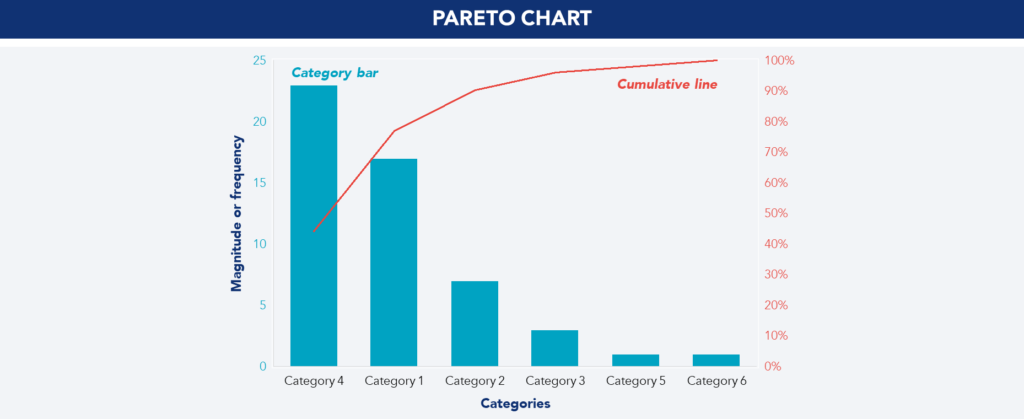
Figure 1 – Pareto chart example: structure and elements
The chart draws on the Pareto Principle, which states that a small proportion of causes typically accounts for a large share of the observed effects. The exact ratio may differ depending on the context, yet the pattern is consistent enough to provide a reliable basis for prioritization. In manufacturing, services, logistics, or healthcare, this principle is frequently observed when a limited number of categories account for most customer complaints, most scrap, or most equipment downtime. By observing how rapidly the cumulative line rises and where it begins to flatten, teams can identify the categories that require immediate attention and those that may be addressed later without compromising performance goals.
The purpose of the Pareto Chart is to simplify complex datasets and guide attention toward the most influential contributors to waste, variation, or quality defects. Its structured format improves clarity in problem analysis, strengthens objectivity in decision-making, and aligns improvement efforts with organizational priorities. By concentrating resources on the categories that matter most, teams can accelerate process improvement and advance continuous improvement initiatives with greater precision and impact.
How to build a Pareto Chart
A Pareto Chart is typically built through the following steps:
- Defining the problem and the scope of the data.
- Collecting and categorizing information consistently.
- Summarizing each category by frequency or impact.
- Ordering the categories from highest to lowest.
- Calculating cumulative percentages.
- Constructing the bars and cumulative line on the chart.
Developing a Pareto Chart begins with a clear definition of the problem or phenomenon under study. Data must be collected consistently and categorized in a way that ensures comparability. These categories may include defect types, delay reasons, customer complaints, failure modes, or other measurable sources of variation. Once data is gathered, each category is summarized by its total frequency or impact.
The categories are then sorted from the highest to the lowest value. This ordering is essential, as it allows the chart to reveal the concentration of problems and identify the vital few contributors. Cumulative percentages are calculated to show how much of the total effect is explained as categories are added sequentially.
The visual is constructed by plotting the bars on a primary vertical axis representing magnitude and the cumulative percentage line on a secondary vertical axis. Together, these elements show both the absolute and relative contribution of each category in a single, unified view.
Accuracy and clarity are critical in this process. Categories must be mutually exclusive, data collection should be objective, and labels should follow a consistent naming convention. When these conditions are met, the resulting chart becomes a reliable tool for identifying improvement priorities and guiding effective resource deployment.
Most organizations construct Pareto Charts using standard analytical tools such as Microsoft Excel, Google Sheets, Power BI, or other business intelligence platforms that include built-in chart functions. Statistical software packages such as Minitab also offer dedicated Pareto Chart capabilities that support advanced quality management and data analysis. Regardless of the tool selected, the essential requirements remain consistent: reliable data collection, accurate categorization, and correct ordering of categories by magnitude to ensure meaningful interpretation.
Start improving your processes today
Pareto Chart relevance in continuous improvement
Pareto Analysis is the methodological process of examining data to determine which causes account for the majority of the observed effect. The Pareto Chart provides the visual basis for this analysis and helps teams understand how problems are distributed across categories. By highlighting the areas with the greatest impact, the chart shifts organizations away from broad corrective actions toward focused, high-leverage interventions.
In Kaizen and Lean Management methodologies, the Pareto Chart plays a foundational role in structured problem-solving. It informs the early stages of analysis by directing teams toward issues warranting deeper investigation through tools such as root cause analysis, the fishbone diagram, process mapping, or standardization reviews. When integrated into Lean Six Sigma practices, including DMAIC cycles, the chart enhances prioritization, supports evidence-based decisions, and accelerates the identification of improvement opportunities. It reinforces the principle of addressing the most relevant sources of waste and variation before investing effort in less impactful areas.
The tool’s relevance becomes clear when observing its application across industries. Manufacturers use Pareto Charts to identify which defect types generate the most scrap or rework, enabling more focused quality management actions and supporting complementary methodologies such as SMED, where understanding the dominant sources of setup loss helps teams target the primary contributors that most influence changeover time. Service organizations apply the chart to uncover patterns in customer complaints, allowing teams to focus on the issues that most influence satisfaction and to inform upstream process definition efforts, often conducted through the SIPOC methodology or Process Mapping. Maintenance departments rely on Pareto Charts to analyze downtime events and determine which failure modes most significantly reduce equipment availability. Healthcare organizations use them to examine incidents, delays, and clinical process inefficiencies, thereby supporting safer, more efficient patient care. In operational contexts, the Pareto Chart helps identify the categories of abnormalities that most often trigger machine stops or require operator intervention, reinforcing Jidoka by enabling faster detection and escalation of the most frequent issues.

Figure 2 – Pareto Chart application examples in different operational environments
These applications demonstrate how the Pareto Chart converts raw data into actionable insight. A production line with recurring defects may discover that only three categories, out of dozens, account for the majority of rework. A service center may find that most customer complaints relate to response time, leading to targeted process adjustments. A hospital may discover that administrative bottlenecks account for most admission delays, prompting a redesign of workflows. In every case, the Pareto Chart ensures that improvement efforts are directed toward the areas with the highest potential for measurable impact and complements the use of other Lean tools by providing clear evidence on where attention should be focused.
Limitations and considerations
While the Pareto Chart is highly effective for prioritization, it has limitations that must be considered. The chart reflects the quality of the data collected; incomplete or inconsistent data may distort the distribution of categories and lead to inaccurate conclusions. Clear definitions, disciplined data gathering, and appropriate categorization are therefore essential.
Operating systems also change over time. A Pareto distribution observed during one period may shift as processes evolve, external conditions change, or improvement actions take effect. Continuous monitoring is necessary to validate that priorities remain accurate and that interventions are producing expected results.
Another important consideration is that the Pareto Chart highlights relative frequency or impact but does not evaluate absolute risk. A low-frequency category may still require immediate action if it poses safety, regulatory, or compliance risks. It is therefore essential to interpret Pareto results in the light of contextual knowledge, operational constraints, and strategic objectives.
Despite these limitations, the Pareto Chart remains a highly valuable tool for fact-based analysis. Its effectiveness depends on thoughtful application and its integration into broader problem-solving frameworks that include root cause analysis, standardization, and continuous monitoring.
Pareto Chart, a clear foundation for prioritization
The Pareto Chart remains one of the most effective tools for directing improvement efforts toward the areas that matter most. By revealing how a limited number of categories account for the majority of observed impact, it provides a clear foundation for prioritization and it supports teams in making informed, evidence-based decisions. Its structured combination of data visualization and cumulative analysis helps organizations focus on the vital few sources of waste, variation, or defects, rather than dispersing resources across less significant issues.
When integrated into Lean, Kaizen, and quality management practices, the Pareto Chart strengthens problem-solving disciplines and enhances the precision of continuous improvement initiatives. Although its usefulness depends on the quality of the underlying data and thoughtful interpretation, it remains an indispensable component of any systematic approach to operational excellence. By applying the insights it generates, organizations can improve efficiency, elevate quality, and sustain progress toward long-term performance goals.
Discover how the Pareto Chart can accelerate your improvement initiatives
Do you still have some questions about the Pareto Chart?
What does the 80/20 rule mean in a Pareto Chart?
The 80/20 rule, also known as the Pareto Principle, states that a small proportion of causes often accounts for a large share of the observed impact. In many processes, approximately 20 percent of the categories account for around 80 percent of defects, delays, or losses. This imbalance is what makes a Pareto Chart valuable: it directs attention to the few categories that contribute most to performance problems and where improvement actions will deliver the most meaningful effect.
Although the principle is commonly expressed as an 80/20 ratio, the exact percentages vary depending on the context. Some processes may show a 70/30, 90/10, or other distribution. The specific numbers are less important than the underlying concept: impact is not distributed evenly across categories. The Pareto Chart reveals this uneven distribution and helps organizations focus improvement efforts on the areas with the highest potential for measurable impact.
What is the difference between a Pareto Chart and a histogram?
A Pareto Chart and a histogram both display data visually, but they serve different analytical purposes. A histogram organizes continuous numerical data into ranges to reveal distribution patterns such as central tendency, variation, or skewness. It is used when the objective is to understand how data points are spread across intervals.
A Pareto Chart, by contrast, arranges discrete categories in descending order of magnitude and includes a cumulative percentage line. Its purpose is not to analyze distribution but to identify which categories contribute most to the problem’s overall impact.
While a histogram supports descriptive analysis, the Pareto Chart supports prioritization by highlighting the few categories that account for most of the effect. The two tools are therefore complementary, with the histogram clarifying how data behaves and the Pareto Chart clarifying where improvement efforts should be focused.
How often should Pareto Charts be updated in continuous improvement initiatives?
The frequency of updating a Pareto Chart depends on the process’s volatility and the objectives of the improvement activity. In stable processes with consistent performance patterns, periodic updates aligned with regular reporting cycles may be sufficient. In contrast, processes undergoing active improvement, experiencing frequent variation, or operating under short feedback loops benefit from more frequent updates to verify whether priority categories are changing.
Within continuous improvement and Lean Daily Management systems, Pareto Charts may be reviewed weekly or even daily when they support problem-solving routines or monitor the effects of newly implemented actions. In DMAIC projects, updates typically occur at key milestones in the Measure, Analyze, and Control phases to confirm that improvement efforts are addressing the dominant contributors. The critical requirement is maintaining a cadence that reflects real process behavior and enables timely, evidence-based decisions.
See more on Quality
Find out more about improving this business area
See more on Lean
Find out more about improving this business area