
Article
SIPOC: High-level view for process optimization


In an increasingly competitive business environment, it is essential to understand and optimize processes to ensure efficiency, quality, and a customer-centric approach. To do so, it’s crucial to have tools that allow for a clear analysis of how processes work and how they interact with suppliers and customers.
SIPOC (Suppliers, Inputs, Process, Outputs, Customers) is one such tool. SIPOC provides a macro view of processes, making it easier to identify critical elements and their interactions. This diagram can serve as a starting point for continuous improvement projects, enabling all stakeholders to share a common understanding of the processes under analysis.
What is SIPOC?
SIPOC is a tool widely used in Kaizen, Lean, and Six Sigma projects. Its simplicity and comprehensiveness allow for a quick and visual understanding of the main elements of processes, from suppliers to customers. It is an effective way to align teams, clarify the scope of a project, and create a common vision before engaging in value stream analysis or mapping a specific process.
What does SIPOC mean?
Meaning of SIPOC:
- Suppliers: Those who provide the inputs necessary for the process.
- Inputs: The resources, materials, information, or requirements that feed into the process.
- Process: The set of activities or steps that transform inputs into outputs.
- Outputs: The final results of the process, whether they are products, services, or information.
- Customers: The end recipients of the output.
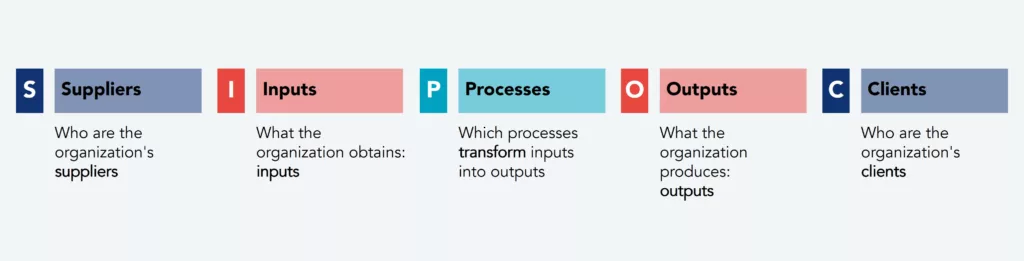
Figure 1 – Meaning of SIPOC
This framework helps to understand what happens inside the organization and its relationship with the broader ecosystem, including suppliers and customers.
SIPOC diagram
The SIPOC diagram is a graphical representation of the process mapping logic. Typically structured in five columns, it allows you to visualize:
- Who provides the inputs.
- Which inputs are critical.
- The main process steps at a macro level.
- Which outputs are produced.
- Who are the impacted customers.
This diagram is particularly useful in the early stages of an improvement project, as it provides a clear, high-level view before moving on to more detailed mapping tools.
SIPOC in Six Sigma and continuous improvement
SIPOC is a key tool in the Lean Six Sigma framework and in continuous improvement initiatives. Its application ensures that all stakeholders share a common understanding of the processes being analyzed, preventing misalignment and ensuring that improvement efforts focus on critical areas.
In the Lean Six Sigma methodology, SIPOC is typically used in the “Define” phase of the DMAIC cycle. At this stage, it helps clarify the project’s scope, design the project charter, and define the problem statement, establishing clear boundaries for where the process begins and ends. It also aids in performing stakeholder analysis (suppliers and customers) and understanding their needs, providing a high-level view that helps validate the relevance and strategic alignment of the project before moving on to more analytical phases.
In Kaizen Lean, SIPOC is equally valuable as a starting point for mapping processes at a macro level before diving into more detailed analysis. It highlights interdependencies between areas and functions, enabling the identification of waste, redundancies, and potential communication failures. Thus, SIPOC is also a strategic alignment tool and decision-making support in operational transformation projects. SIPOC is often covered in training programs such as “Value Stream Mapping Training” and “Process Improvement Training,” as well as in broader programs like Lean Six Sigma.
Optimize processes with our Lean Six Sigma training
Components of the SIPOC model
The SIPOC model is structured around five main components that clearly articulate how a process is defined from its origin to its impact on the customer. Each element offers critical perspectives for analyzing and improving organizational processes.
Suppliers
Suppliers represent the entities (internal or external) that provide the necessary resources for the process to function. They can be teams within the organization or external partners supplying materials, services, or information. Correctly identifying suppliers is essential to ensure the quality and reliability of the process inputs.
Inputs
Inputs refer to all resources that feed the process: products, services, documents, information, or specific requirements. The quality of inputs directly influences the process efficiency and customer satisfaction, making this component critical for management and monitoring.
Process
The process describes the activities that transform inputs into outputs. In the SIPOC context, the level of detail is intentionally macro, focusing on the key steps that characterize the workflow. This framework keeps the analysis focused on the essentials for decision-making.
Outputs
Outputs refer to the results produced by the process, which may take the form of products, services, or documents. They must be defined according to the quality and performance criteria expected by customers.
Customers
Customers are the recipients of outputs, which can be internal (within other areas of the organization) or external (end consumers, business partners, regulatory entities, among others). Clearly identifying customers allows the process to be aligned with their needs and expectations, ensuring relevance and satisfaction.
How to build a SIPOC map
Building a SIPOC map is a collaborative exercise that allows teams to understand, in a structured way, the key elements of an organization.
Steps to create a SIPOC matrix
To effectively create a SIPOC matrix, it is essential to remember that it is a visual tool designed to provide a clear and shared understanding of processes. Its construction should be carried out in workshops with multidisciplinary teams, ensuring diverse perspectives and the involvement of key stakeholders. It is recommended to follow a structured sequence:
- Define the outputs (products, services, or information).
- Identify the customers of the outputs.
- Connect customers and outputs.
- Map the process (key steps that transform inputs into outputs).
- Link processes to the outputs.
- List the inputs (resources, raw materials, documents, or data required).
- Relate inputs to processes.
- Identify the suppliers.
- Establish relationships between suppliers and inputs.
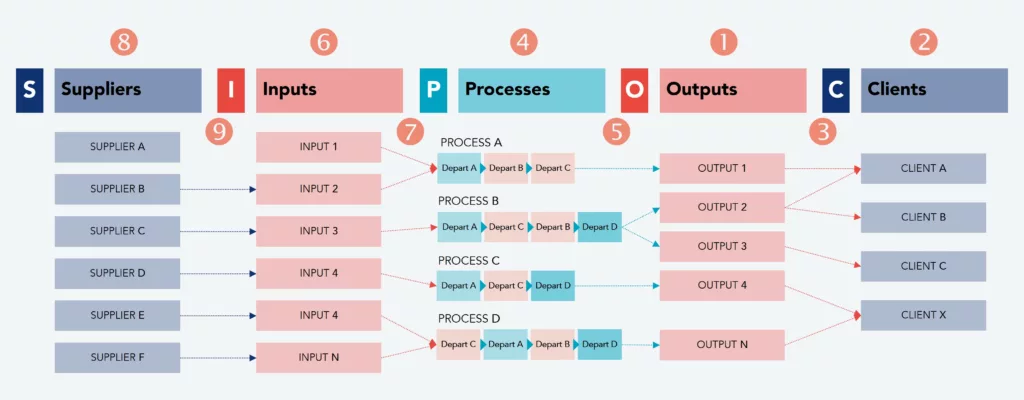
Figure 2 – Sequence of SIPOC stages
Following these steps ensures the SIPOC matrix is built in a structured, collaborative way, allowing teams to clearly understand the process being analyzed.
Benefits and limitations of the SIPOC diagram
The SIPOC diagram is a widely recognized tool for its simplicity and effectiveness in understanding processes. However, like any analytical instrument, it has significant advantages but also limitations that should be considered for proper use.
Advantages in process clarification
The main benefit of SIPOC is its ability to provide a macro and structured view of organizational processes. By mapping suppliers, inputs, processes, outputs, and customers, the tool enables the quick identification of how different elements are related and which are the critical flows.
Another relevant advantage is its usefulness in the early stages of projects. SIPOC helps define process boundaries, validate the problem statement, and ensure that customer needs are properly reflected in the outputs. Additionally, its visual nature makes it an excellent tool for training and integrating new employees, enabling them to immediately understand how processes are interconnected within the organization.
Limitations and considerations in application
Despite its advantages, SIPOC has limitations. It is a high-level representation that does not capture the operational details of each activity. Therefore, it does not replace more detailed tools such as value stream mapping, process mapping, or swimlane diagrams, which help analyze specific times, wastes, responsibilities, or bottlenecks.
Another point of caution is to avoid simplistic interpretations: the clarity of SIPOC might give the impression that the process is fully understood when, in fact, only its more general elements have been captured. There is also a risk of misalignment if participants lack sufficient knowledge of the process.
In summary, SIPOC is extremely useful for clarifying processes and promoting initial alignment, but it must be complemented with other analysis and continuous improvement tools to ensure a more in-depth diagnosis and the implementation of effective solutions.
Want to learn how to apply SIPOC and other continuous improvement tools?
The real impact of SIPOC in organizations
SIPOC is an essential tool for anyone seeking to understand the dynamics of organizational processes in a simple, structured way. Its main virtue lies in offering a macro view that highlights the relationships between suppliers, inputs, processes, outputs, and customers, serving as a starting point for the Kaizen approach to operations.
Although it provides less detail, SIPOC effectively fulfills its purpose: aligning teams, clarifying boundaries, identifying stakeholders, and creating a common language for processes. There are numerous examples of SIPOC applications across various sectors, from industry and financial services to healthcare and public administration, proving its versatility and relevance.
In summary, SIPOC should be understood as a high-level matrix that, despite its simplicity, has a significant impact on how organizations understand their processes, set priorities, and drive customer value creation.
Still have some questions about SIPOC?
What is a swimlane diagram?
A swimlane diagram is a process mapping tool that organizes activities into horizontal or vertical “lanes,” each representing a department, function, team, or system responsible for performing those activities. Its primary purpose is to clarify who does what within a process, highlighting responsibilities, workflows, and interactions between different areas of the organization.
The swimlane diagram is used in improvement projects, process automation, and digital transformation, serving as a bridge between a process’s strategic vision and its day-to-day execution.
What is COPIS?
COPIS refers to the reversal of the SIPOC logic, starting with the customer and their needs, then defining outputs, processes, inputs, and suppliers. This approach is particularly useful in process design or redesign, as it ensures that the system is built with a focus on the value delivered to the customer. While SIPOC is more commonly used in improving existing processes, COPIS is oriented toward creating new, customer-focused solutions.
See more on Operations
Find out more about improving this business area
See more on Lean
Find out more about improving this business area