
Article
Lead time: definition and strategies for reducing it


In operations and supply chain management, lead time is a critical performance indicator. It represents the total time required to complete a process, whether that process involves producing a good, processing an order, developing software, or delivering a service.
In an increasingly competitive market, reducing lead time increases agility, responsiveness, and customer satisfaction. Internally, it contributes to cost reduction, enhances supply chain efficiency, and enables more effective resource management.
In this article, we examine the concept of lead time, its various types, and the primary strategies for reducing it sustainably, thereby transforming it into a genuine competitive advantage.
What is lead time?
The concept of lead time plays a central role in value chain management, as it measures the actual time it takes for a process to deliver something to the customer. Understanding lead time is therefore essential for any organization seeking improvement. Below, we explore its definition, how it’s calculated, and the practical benefits of reducing it.
Understanding lead time
Lead time refers to the total time elapsed between the initiation and completion of a process. It represents the time required to complete a set of activities. In the context of continuous improvement, this concept is critical because it reflects both the customer experience and the efficiency of internal processes. The shorter the lead times across processes, the better an organization’s ability to respond quickly to demand and create value for customers.
Lead time formula:
Lead time = Process completion date – Process start date
This timeframe includes two types of activities:
- Value-added activities: Operations in which the product or service is actually transformed or prepared to meet the customer’s needs (e.g., manufacturing, assembly, data processing).
- Non-value-added activities: Waiting times, transportation, approvals, inspections—periods during which no transformation occurs, yet they still impact the total lead time.
In practice, these non-value-added activities often account for the largest portion of lead time. This is where Kaizen systematically targets waste elimination, helping organizations streamline processes and improve responsiveness.
Discover how Kaizen can help you reduce lead time and increase efficiency
Benefits of reducing lead time
Reducing lead time offers advantages that go far beyond operational efficiency. It directly affects customer satisfaction, market competitiveness, and the organization’s financial health. Key benefits include:
- Higher customer satisfaction: fast, reliable deliveries build trust and enhance the overall customer experience.
- Lower risk of obsolescence: the longer the lead time, the higher the risk that the product may no longer match market demand when it’s ready.
- Reduced operational costs: reviewing internal processes and eliminating inefficiencies shortens lead time while reducing resource waste.
- Improved cash flow: shorter lead times mean faster order-to-cash cycles and lower inventory levels, freeing up working capital.
- Increased sales: in competitive markets, when two companies offer similar products, the one that delivers faster is more likely to gain a larger market share.
- Greater flexibility and agility: reduced lead times allow organizations to adapt quickly to demand spikes or external changes, making them more resilient in the face of uncertainty.
In conclusion, companies with reduced lead times improve their efficiency and stand out for their responsiveness and reliability, building a reputation for trustworthiness that attracts and retains customers.
Types of lead time across the value chain
The concept of lead time can be applied to different stages of the value chain. Each lead time offers a distinct perspective on process performance and reveals specific opportunities for improvement.
Distinguishing between these lead times is critical for diagnosing inefficiencies, eliminating waste, and aligning operations with customer needs. Within Lean and Kaizen frameworks, understanding these lead time types enables more targeted actions that optimize both the customer experience and internal efficiency.
Order lead time
This refers to the total time a customer waits from placing an order to receiving the final delivery. It includes not just production time, but also administrative steps and logistics operations, such as order processing, system entry, credit approval, and potential delays due to limited capacity.
From the customer’s perspective, this is the most important lead time, as it defines their experience and directly influences satisfaction and loyalty.
Production lead time
This corresponds to the time it takes for a part or product to go through the entire production process. It includes processing time (when the product is being worked on) and non-productive time (waiting, handling, queuing, inspections, rework). In some organizations, this indicator is also known as throughput time.
From an improvement perspective, this is one of the main supply chain indicators that should be reduced, as it typically accounts for only a small fraction of added value.
Delivery lead time
This measures the time required to transport the finished product to the final customer. It includes activities such as shipping, load consolidation, physical transportation, and any potential delays at customs, ports, or distribution centers.
Delivery lead time is a critical factor in logistics efficiency, directly influencing how customers perceive the reliability and quality of service.
Supply chain metrics that impact customer satisfaction
In supply chain management, several metrics—beyond lead time—are key to understanding how customers perceive service quality and reliability. These indicators help align operations with customer expectations, identify gaps, and strengthen supply chain trust.
Some of the most relevant metrics include:
- On-Time Delivery (OTD): percentage of orders delivered on the agreed-upon date. It reflects perceived reliability in terms of timing.
- Order Fill Rate: percentage of orders fulfilled in full with available inventory. It shows the company’s ability to meet demand immediately.
- OTIF (On Time In Full): measures the percentage of orders delivered both on time and in the correct quantity. A high OTIF indicates consistency and dependability.
- Customer Complaint Rate: number of complaints per period or per sales volume. A direct indicator of perceived quality.
- Return Rate: percentage of products returned due to defects or delivery errors. Reflects quality issues or failures in the logistics process.
These metrics reflect the customer’s real-world experience with the supply chain. Continuously monitoring and improving them is essential for building trust, retaining customers, and sustaining market competitiveness.
Factors influencing lead time
A process’s lead time isn’t determined solely by its technical complexity. It’s shaped by a combination of internal and external factors that affect the flow of materials and information. Understanding these factors is crucial for identifying the causes of delays and implementing practical improvement actions.
The main factors influencing lead time include:
- Work in progress (WIP) levels: the greater the volume of work in progress, the longer products, services, or orders remain idle and the longer the lead time.
- Process complexity: flows with many steps, handoffs between departments, or dependence on multiple systems introduce variability and prolong lead time.
- Resource capacity and efficiency: overloaded resources, with imbalances between demand and capacity, or with low efficiency, generate waiting times.
- Quality and rework: defects, inspections, and the need for corrections introduce additional non-value-added time.
- Supply chain reliability: supplier delays and logistical failures have a direct impact on the final lead time.
The main challenge involves reducing processing time and eliminating other waste (idle materials and information, unnecessary transportation and handling, as well as errors) that increase lead time.
Kaizen strategies for reducing lead time across the value chain
Reducing lead time requires directly addressing the factors that cause delays—such as waiting times, queues, inefficient transportation, lengthy administrative processes, and external dependencies. Kaizen methodologies provide structured tools to shorten and stabilize the time between order and delivery, increasing agility and improving customer satisfaction.
- Value Stream Analysis (VSA): conducting a Value Stream Analysis is essential for visualizing current lead times by clearly distinguishing between value-added time and waste. Based on this analysis, the process flow can be redesigned to implement targeted improvements that significantly reduce total lead time.
- Lean Line Design: this approach focuses on designing production lines based on one piece flow. This principle eliminates waiting times, reduces WIP limits, speeds up production lead times, and quickly exposes quality issues.
- SMED (Single Minute Exchange of Die): reducing setup times through SMED allows for smaller batch production and greater responsiveness to demand fluctuations.
- Work standardization: inconsistent processes tend to increase lead time and make it harder to identify waste. Standardizing work ensures process predictability, reduces variability, and creates a stable foundation for continuous improvement.
- Pull flow: pull-based production planning—where the flow is driven by actual demand rather than forecasts—significantly reduces inventory levels. This principle can also be extended across the entire supply chain.
- Logistics and transportation optimization: logistics efficiency depends on optimizing routes, transport, and distribution processes. It involves load planning, the use of transport management tools, and the management of warehouse operations. Optimized logistics reduces costs and shortens lead times.
- Supplier management: involves improving sourcing and purchasing by reviewing the supplier base and evaluating their performance, considering delivery times, and compliance with SLAs (Service Level Agreements).
These strategies are just a few examples and should be applied in an integrated manner, in a continuous cycle of analysis, design, implementation, and monitoring. The result is a shorter, predictable lead time that aligns with customer needs.
Want to reduce lead time and transform your supply chain?
Lead time reflects process efficiency
Lead time is far more than just a timing indicator—it reflects process efficiency, supply chain reliability, and the customer experience. Reducing and stabilizing lead time means eliminating waste, increasing predictability, and enhancing competitiveness in a market where speed and agility are critical success factors.
With the support of Lean and Kaizen methodologies, organizations can take structured action on the key factors that prolong lead time, shortening delivery times without compromising quality. The result is a more efficient operation, more satisfied customers, and a solid foundation for sustainable growth.
Still have questions about lead time?
Lead Time vs. Cycle Time: What’s the difference?
Lead time and cycle time are distinct concepts. Understanding these differences is essential for correctly measuring processes and identifying waste:
- Production lead time: this is the total time it takes for a part or product to go through the entire production process. It includes both value-added and wasteful activities.
- Cycle time: this refers to the time required to complete one unit—from start to finish. It reflects the production rate and can be measured at the level of a machine, operator, or production line. The goal is to align cycle time with takt time, which represents the pace of customer demand.
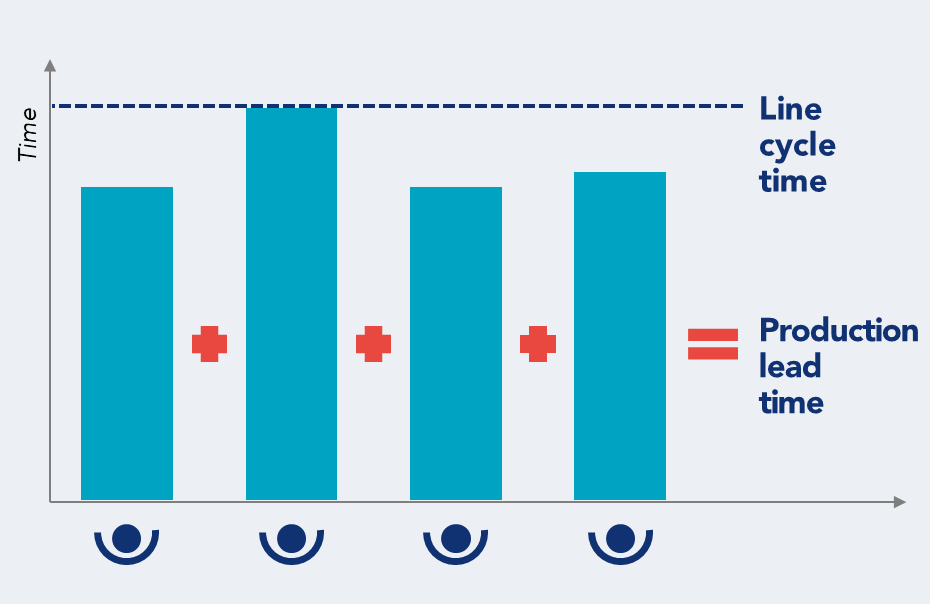
Figure 1 – Lead Time vs. Cycle Time
What is replenishment lead time?
Replenishment lead time is the time elapsed between placing a restocking order and having the products available again at the point of consumption (e.g., a supermarket). It consists of four main stages:
- Information flow lead time: the time needed to generate and transmit the order to the supplier.
- Processing lead time: the time the supplier takes to prepare and fulfill the order.
- Transportation lead time: the time it takes for the stock to be physically delivered.
- Receiving lead time: the time required for receiving, checking, and storing the stock at its destination.
In practice, this indicator is crucial for calculating the reorder point, which corresponds to the demand during the replenishment lead time plus the safety stock.
See more on Discrete Manufacturing
Find out more about transformation in this sector
See more on Process Manufacturing
Find out more about transformation in this sector