
Article
3P in Lean production: Production Preparation Process


The launch of a new product or the implementation of significant changes to a production system are critical milestones for any industrial organization. The decisions made at this stage impact investment, operating costs, quality, productivity, and long-term agility. Therefore, rather than relying on process optimization after the system is already implemented, it is essential to design it properly from the start, incorporating Lean principles even before production starts.
The 3P, or Production Preparation Process, is a structured approach aimed at setting up new production systems. This approach allows for anticipating decisions that, if made only at an advanced stage of the project, could result in waste, costly changes, or limitations that are difficult to eliminate later. By involving cross-functional teams from engineering, production, logistics, quality, procurement, and other relevant areas early on, the 3P aims to create production systems with less waste and lower design risk, thereby laying the foundation for a lean operation right from the design phase.
What is 3P in Lean production?
3P is an approach within Lean Manufacturing and Lean Product Development focused on production preparation. Its purpose is to ensure that the production system is designed consistently with the product’s requirements, Lean principles, and the project’s performance goals.
Rather than acting only on an existing process, 3P seeks to integrate decisions related to suppliers, process, equipment, logistics, quality, and maintenance from the development stages onward. In the KAIZEN™ model, this approach is integrated into the overall product development process.
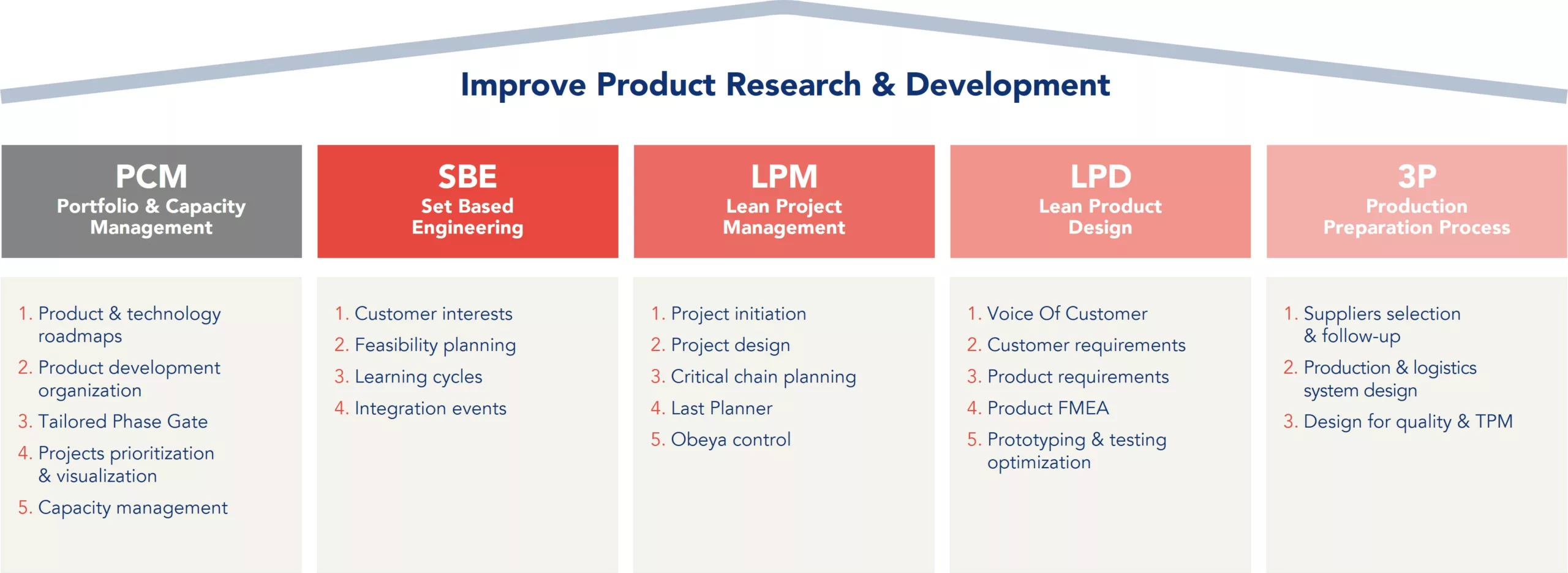
Figure 1 – KAIZEN™ Model for improving product research and development: The 3P approach in the context of other methodologies
What does 3P (Production Preparation Process) mean?
3P stands for the Production Preparation Process.
In the KAIZEN™ model, 3P structures industrial preparation into three main areas:
- Supplier selection, ensuring that external partners meet the requirements for cost, quality, lead time, capacity, and risk.
- Design of production and logistics systems, integrating product engineering and production planning to create processes with less waste.
- Design for quality and TPM (Total Productive Maintenance), incorporating quality, reliability, maintenance, and operational stability requirements from the design stage onward.
Therefore, 3P is not limited to the physical design of a production line or layout. It encompasses a broader set of decisions necessary to prepare the production system prior to industrialization and launch.
What is the goal of 3P?
The main goal of 3P is to design production systems with less waste and lower project risk, creating the conditions from the start for a Lean operation. In practice, this means anticipating decisions that directly influence the system’s future performance, namely:
- Selecting the most suitable suppliers.
- Defining the production process.
- Designing the flow of materials and information.
- Choosing and sizing the equipment.
- Organizing the layout.
- Incorporating quality and maintenance requirements.
- Preparing for a more robust and predictable industrialization.
By addressing these elements before release, 3P seeks to reduce late changes, rework, and industrialization issues, thereby increasing the likelihood that the system will more quickly achieve the desired levels of quality, cost, and productivity.
Do you identify similar goals for your production system?
When should 3P be used?
3P is particularly relevant when there is an opportunity to design or redefine the production system before the main decisions are finalized. The earlier options for processes, equipment, layout, logistics, quality, and maintenance are evaluated, the greater the ability to eliminate waste at the source and prevent subsequent change costs.
Introduction of new products and processes
The introduction of a new product is one of the main situations for applying 3P. A new product may require different components, suppliers, technologies, operations, equipment, or logistics flows, creating the need to prepare the corresponding production system.
In this context, 3P makes it possible to integrate product design and production process design, rather than developing the product first and only later trying to adapt production to decisions that have already been made.
This early integration facilitates the analysis of manufacturability, supplier requirements, capacity needs, production flow, and the conditions needed to ensure quality and reliability from release.
New plants, production lines, or equipment
3P is also recommended when there is a significant capital investment in a plant built from the ground up, a new production line, or new equipment. In these cases, many of the decisions made during the project phase will affect productivity, space utilization, flexibility, and operating costs for several years.
The methodology helps prevent the investment process from beginning with the selection of technology or equipment. The first step is to define the production flow and the necessary production solution and, from there, establish the requirements for the resources that will support it.
Significant redesign of production systems
Although particularly well-suited to new systems, 3P can also be applied when an existing operation requires a breakthrough improvement, not just incremental improvements.
For example, this is the case with major changes in mix or volume, the introduction of new technologies, a thorough reorganization of the layout, equipment replacement, or the redefinition of production and logistics flows.
In these projects, the goal is to take the opportunity to challenge the existing solution and redesign the system according to Lean principles, rather than simply carrying over the current waste and limitations into a new configuration.
Whenever the scope of the change allows for meaningfully reconsidering how the product should be produced, 3P can help develop a simpler, more flexible, more robust solution that is prepared for future needs.
3P methodology: The three pillars of production planning
In the KAIZEN™ model, 3P structures production preparation into three complementary areas: supplier selection, design of production and logistics systems, and design for quality and TPM. These three dimensions make it possible to prepare, in an integrated way, the supply chain, the production system, and the conditions needed to ensure quality, reliability, and operational stability from the outset.
Supplier selection
The goal of supplier selection is to ensure a reliable supply chain with quality and cost levels appropriate to the project’s requirements.
The process begins with defining the needs and requirements that potential suppliers must meet. This is followed by market research, pre-qualification, requests for information and proposals, evaluation of the different options, and, when necessary, site visits and audits.
The final selection considers criteria such as cost, quality, reliability, lead times, and associated risks. After negotiation and contracting, a system for ongoing monitoring of supplier performance is established.
This approach makes it possible to integrate suppliers from early stages of development, reducing supply risks and ensuring greater alignment between product, process, and supply chain requirements.
Design of production and logistics systems
The design of production and logistics systems seeks to create processes with less waste and reduce project risks, integrating product engineering and production planning during the design phase.
At this stage, the processes, flows, equipment, and layouts that will support production are defined. The design should be based on product and demand requirements, prioritizing simple, flexible, and flow-oriented solutions.
In addition to the principles of flow, layout, equipment, and error prevention described below, this stage also focuses on:
- Minimizing unnecessary transport and handling.
- Separating human work from machine work where appropriate.
- Incorporating ergonomics into the design of workstations.
- Using low-cost automation to eliminate non-value-added activities.
The goal is to prevent the production system from being constrained by complex or oversized solutions and to ensure that lean principles are incorporated before physical implementation.
Design for Quality and TPM
The third pillar of 3P is design for quality and TPM, which seeks to ensure that new equipment and processes are designed from the outset to facilitate production, quality, maintenance, and control of operating conditions.
The system must be inherently reliable and safe, easy to operate, monitor, and maintain, and allow for rapid identification of the causes of problems. The design must also facilitate future improvements and create the necessary conditions for teams to develop the appropriate skills to operate and maintain the equipment.
By incorporating these requirements before installation, reliance on later corrections is reduced and released stability is increased. The goal is to bring actual performance closer to the intended performance from the outset, contributing to a vertical release, with fewer problems and a shorter stabilization period.
How do 3P KAIZEN™ Events work?
Each of 3P’s three areas is addressed in a specific KAIZEN™ Event. Each event brings together a multidisciplinary team and focuses on a specific dimension of industrial preparation.
The KAIZEN™ Event for supplier selection is held at an early stage of the project and typically involves project management, engineering, design, procurement, purchasing, and quality. The work includes defining supplier requirements, research and pre-qualification, requests for information and proposals, technical and economic evaluation, risk analysis, negotiation, selection, and defining the performance monitoring model.
The KAIZEN™ Event for the design of production and logistics systems brings together areas such as engineering, production, logistics, quality, purchasing, and procurement to develop the production solution. During the event, the flow, layout, equipment, workstations, material handling, and other elements needed to create a simple, flexible, low-waste system are worked on. Whenever possible, the solutions are tested and refined before implementation, using simulations and mock-ups.
Lastly, the KAIZEN™ Event for design for quality and TPM focuses on ensuring that new equipment and processes are designed to be reliable, safe, and easy to operate, maintain, and monitor. The event involves functions such as engineering, maintenance, production, and quality, and seeks to integrate these requirements before installation, creating the conditions for a faster, more stable ramp-up and for future continuous improvement.
The three events should be understood as parts of the same process, carried out well in advance: preparing suppliers, the production system, and the quality and maintenance conditions needed for a robust industrialization.
Principles for designing a Lean production system with 3P
The design of a Lean production system must start with the voice of the customer, the product’s requirements, demand, and the intended flow, preventing the process from being constrained by excessively complex solutions or by equipment defined too early. In 3P, the goal is to incorporate Lean principles as early as the design phase, when there is greater freedom to test alternatives and eliminate waste before physical implementation:
- Design for manufacturing and assembly: The product and the production process must be developed in an integrated way, considering from the outset the assembly sequence, the number and variety of components, the joining methods, parts access, and the ergonomics of operations. By preventing product characteristics from requiring unnecessary operations, equipment, or controls, design for manufacturing and assembly contributes to simpler, more repeatable, and more efficient processes.
- Flow and layout design: The layout must be designed based on the flow, not the other way around, favoring single-piece flow, proximity between consecutive operations, the elimination of isolated workstations, and making materials available at the point of use. The design should also consider takt time, mix, volume, and product life cycle, so that the system can adapt its capacity to customer needs.
- Simple, appropriately sized equipment: The aim is for equipment sized to actual process needs, compact, easy to move or reconfigure, and with reduced setup times. Automation should be introduced only when there is a clear cost-benefit justification and, before installation, solutions can be tested, for example, with a full-scale cardboard mock-up.
- Quality, maintenance, and error prevention built into the design: Quality and maintenance must be incorporated from the design stage, not added after installation. Principles such as jidoka and poka-yoke help prevent or detect errors at the source, while accessibility to components and ease of inspection reduce release problems and speed up the stabilization of the new production system.
What are the benefits of 3P?
The main benefit of 3P is that it allows many of the problems that typically arise during industrialization to be avoided at the design stage, when there is still flexibility to change the product, the process, the layout, the equipment, or the logistics solution at a lower cost and with less impact on the project timeline.
By integrating decisions about suppliers, the production system, quality, and maintenance from an early stage, 3P contributes to:
- Reduced waste and rework.
- Lower risk of late changes.
- Improved quality from the outset.
- Reduced unnecessary investment.
- Greater flexibility of the production system.
- Improved ergonomics and working conditions.
- Greater equipment reliability and ease of maintenance.
- Faster, more stable releases, bringing the system closer to defined performance levels sooner.
Rather than merely improving a system after it has been installed, 3P seeks to prevent waste and limitations from being built into the design itself. In this way, the organization can prepare a simpler, more robust, and more efficient production system from the very beginning.
Want to boost product development at your organization?
Prepare today the performance of tomorrow’s production
3P makes it possible to shift the focus of improvement to an earlier stage: rather than correcting waste, quality problems, or capacity limitations after release, it seeks to prevent them during the design of the production system itself.
This approach is particularly relevant in projects involving new products, new lines, new equipment, or significant transformations of existing systems. By involving multidisciplinary teams and testing solutions before implementation, 3P reduces the risk of late decisions, rework, and investments poorly aligned to actual needs.
The intended result is a simpler, more flexible, and more robust production system, prepared to reach the expected levels of quality, productivity, and stability more quickly. In this sense, 3P is a way to incorporate lean principles from the outset and create better conditions for sustainable performance throughout the production system’s entire life cycle.
Kaizen Institute helps organizations design Lean production systems from the outset, through our consulting services in lean product development, which include 3P KAIZEN™ Events conducted with multidisciplinary teams. From supplier selection to design for quality and TPM, we support every step of production preparation to ensure faster, more stable releases with less waste.
Still have some questions about 3P?
3P and Value Stream Analysis: When to use each approach?
3P is especially well-suited to situations where there is significant room to design or redesign a production system, such as the launch of new products, new lines, new equipment, or major structural changes.
The Value Stream Analysis (VSA) method, which includes Value Stream Mapping (VSM) and Value Stream Design (VSD), is more suitable when the goal is to analyze an existing flow, identify waste, and define improvement opportunities along the value stream.
In simple terms, 3P acts mainly before or during the design of the system, while VSA acts mainly on processes that are already in operation.
What is the role of PFMEA in 3P?
PFMEA (Process Failure Mode and Effects Analysis) is a tool that makes it possible to identify and prioritize potential process failures, their causes and effects, and define actions to prevent or detect them.
In the context of 3P, PFMEA can be used as a complementary tool during process design, helping anticipate quality risks before equipment installation.
Can 3P be applied to existing processes?
Yes. Although 3P is particularly relevant in preparing new production systems, it can also be applied to existing processes when there is an opportunity for significant redesign.
This can happen, for example, in projects involving a thorough reorganization of the layout, equipment replacement, the introduction of new technologies, or major changes in product volume and mix. In these cases, the goal is not just to improve the current system, but to reconsider how the process should be designed.
Who should partake in a 3P KAIZEN™ Event?
Team composition depends on the topic of the KAIZEN™ Event, but it should always be cross-functional. The different 3P events may involve, among others, representatives from project management, engineering, production, logistics, quality, maintenance, purchasing, procurement, and design. This diversity matters because many of the decisions made during 3P have a simultaneous impact on the product, the process, and future operations.
See more on Discrete Manufacturing
Find out more about transformation in this sector
See more on Manufacturing Operations
Find out more about improving this business area