Article
Design for Manufacturing (DFM): Principles, process, and best practices


Design for Manufacturing (DFM), is a product development approach that aims to ensure, from the earliest stages of design, that a product can be manufactured efficiently, consistently, and cost-effectively.
As a result, DFM makes it possible to anticipate the limitations of production processes, preventing decisions related to design, tooling, or industrialization from resulting in more complex and costly changes.
Applying DFM principles requires analyzing a range of factors, such as material selection, manufacturing processes, tolerances, part count, ease of assembly, and component standardization. Integrating these decisions early on and promoting collaboration among product development, engineering, production, quality, purchasing, and suppliers makes it possible to achieve lower manufacturing costs, improved product quality, and a faster time to market.
In this article, we explore the main principles of Design for Manufacturing, the DFM analysis process, best practices to consider, and some examples of its application to different manufacturing processes.
What is Design for Manufacturing (DFM)?
Design for Manufacturing (DFM), also known as design for manufacturability, is a product development approach that seeks to ensure the design is suitable for the chosen manufacturing process. The goal is to identify, as early as possible, solutions that allow for production with less complexity, less waste, higher quality, and better-controlled costs. In this sense, DFM embodies the logic of built-in quality: quality is built into the design and the production process rather than being inspected at the end.
In practice, DFM assesses how design decisions, such as part geometry, materials, tolerances, component count, or joining method, influence the ease and cost of production.
Rather than developing the product first and only then adapting the production process, the approach promotes a joint analysis between product development and industrialization.
This logic makes it possible to anticipate problems that, if detected at a later stage, could require engineering changes, new testing, tooling modifications, or delays in the start of production.
Therefore, DFM should be integrated early into the development process and supported by cross-functional collaboration.
DFM is also part of a broader set of approaches known as Design for X (DfX), in which the product is developed from the outset with specific goals in mind throughout its life cycle.
These approaches include Design for Cost, focused on optimizing total cost; Design for Quality, focused on product robustness and quality; and Design for Maintenance, which seeks to facilitate maintenance and service activities. DFM focuses specifically on ease and efficiency of manufacturing, although these dimensions are often interconnected.
What are the principles of Design for Manufacturing?
The principles of Design for Manufacturing guide development decisions to make the product simpler, more robust, and more efficient to manufacture. The main ones include:
- Simplify the design and reduce the number of parts: Eliminate unnecessary complexity, reduce components, and look for solutions that facilitate manufacturing and assembly.
- Select the appropriate manufacturing process: Adapt the design to the capabilities and limitations of the chosen process, considering factors such as volume, geometry, precision, and cost.
- Optimize material selection: Choose materials that meet the product’s functional requirements while also supporting the efficiency, availability, and stability of the production process.
- Define tolerances appropriate to the process: Avoid precision levels higher than actually necessary, since overly tight tolerances can significantly increase manufacturing complexity and cost.
- Promote the standardization of components and solutions: Prioritize existing parts, materials, dimensions, and solutions whenever possible, reducing variety, costs, and the need for specific development.
- Involve production and suppliers from the early stages: Integrate manufacturing expertise into product development to identify risks, simplification opportunities, and alternatives before the design is finalized. Close supplier management from the outset makes it possible to assess actual production capabilities, lead times, and component alternatives while it is still possible to modify the design.
Want to apply these principles to your products?
Together, these principles help reduce industrial complexity, anticipate production problems, and make development decisions that are more balanced across performance, quality, cost, and manufacturability. The earlier they are taken into account, the greater the potential for improvement and the smaller the impact of subsequent changes.
How does the Design for Manufacturing process work?
The Design for Manufacturing process should begin in the early stages of development and evolve iteratively as the product and the production process are defined.
More than just a final design review, DFM should function as a structured decision-making process involving product development, engineering, production, quality, procurement, and suppliers.
1. Define functional, industrial, and cost requirements
The starting point is to clarify what the product must achieve and the conditions under which it will be produced.
In addition to functional, quality, and regulatory requirements, cost targets, projected volumes, production rate, level of automation, available capacity, assembly requirements, and supply chain constraints must also be considered.
This step is important to prevent design decisions from being made without considering the actual conditions of industrialization.
2. Define the manufacturing strategy and select materials and processes
With the requirements defined, it is necessary to determine how the product can be manufactured. This analysis includes the selection of materials, manufacturing and assembly technologies, internal or external processes, equipment, and tooling needs.
The choice should consider not only technical feasibility but also production volume, cost, capacity, required quality, supplier availability, and the solution’s scalability.
3. Analyze the design’s manufacturability
At this stage, the design is evaluated in detail against the capabilities and limitations of the selected processes. Analyze aspects such as geometry, accessibility, wall thickness, radii, tolerances, finishes, interfaces, joining methods, and the need for additional operations.
The goal is to identify features that could create manufacturing difficulties, defects, long cycle times, complex tooling, or hard-to-control processes.
4. Optimize the design to simplify manufacturing
Based on the risks identified, the product is redesigned to reduce complexity and improve industrial efficiency. This may involve reducing the number of components, simplifying geometries, eliminating operations, widening tolerances where technically possible, using standardized components, or making parts easier to position and assemble.
The different alternatives should be compared while simultaneously considering performance, quality, cost, and ease of manufacturing.
5. Conduct a DFM review and validate the solution
Before finalizing the design, a manufacturability review (DFM review) should be conducted with a multidisciplinary team to confirm that the main industrialization risks have been considered and that the solution is technically and economically sound.
Whenever necessary, validation may include prototypes, simulations, supplier samples, process trials, or pilot production. The results allow you to confirm critical parameters and make final adjustments before approving the final design.
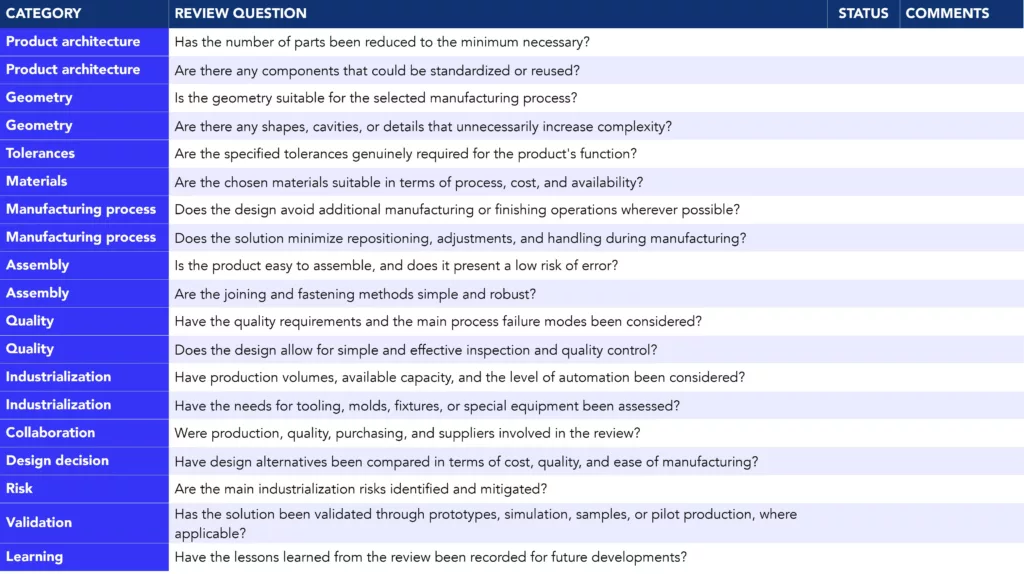
Figure 1 – Example of a DFM review checklist
6. Monitor industrialization and apply lessons learned
DFM does not end with design approval. During the first production batches and the ramp-up, indicators such as defects, cycle times, rework, assembly difficulties, process stability, and actual costs should be monitored.
The problems identified should feed into product or process improvements and, above all, become knowledge for future development through the updating of standards, design rules, and best practices.
When applied in this way, DFM ceases to be a verification performed at the end of development and becomes an integral part of the product design process itself, allowing for the anticipation of problems, the reduction of late-stage changes, and the creation of simpler, more robust, and more efficient solutions for industrialization, thereby helping to sustain production efficiency throughout the entire product lifecycle.
What are the best practices for Design for Manufacturing?
Beyond design principles, the effectiveness of Design for Manufacturing depends on how manufacturing knowledge is integrated into development and applied consistently across projects and teams. The most relevant best practices include:
- Define design rules by manufacturing technology: Translate the real capabilities and limitations of each process into concrete criteria for geometry, wall thickness, radii, tolerances, angles, and finishes, making more robust design decisions possible from the start.
- Integrate DFM reviews into key decision milestones: Use checklists and structured review criteria throughout development, involving the relevant functions before the design is too far along.
- Make decisions on real data: Compare alternatives using information on process capability, defects, cycle times, costs, and assembly complexity, rather than relying solely on theoretical assumptions.
- Validate critical solutions early: Use prototypes, simulations, supplier samples, or process trials while design changes are still simple and inexpensive.
- Turn experience into reusable knowledge: Update standards, design rules, checklists, and libraries of standardized components with the lessons learned from each project, avoiding the repetition of problems already identified.
Together, these practices help turn DFM from a one-off review into a systematic way of incorporating industrial knowledge into product development, reducing complexity, risk, and late-stage changes.
What are the benefits of Design for Manufacturing?
Integrating Design for Manufacturing principles from the early stages of development makes it possible to simultaneously enhance industrial performance, product robustness, and cost efficiency. The main benefits are:
- Lower manufacturing costs: Simplifying the design, reducing the number of parts, purchasing standardized components, and eliminating unnecessary operations all help reduce costs for materials, labor, equipment, and tooling.
- Improved product quality: Simpler designs suited to the capabilities of the production processes tend to reduce variability, defects, rework, and risks associated with production and assembly.
- Reduced time to market: Early identification of manufacturability issues reduces redesign cycles, late changes, and delays during industrialization, helping speed up the launch of new products.
- Fewer changes needed after industrialization: Considering the constraints and capabilities of production processes early on reduces the likelihood of costly modifications once tooling, equipment, or production lines are already in place.
- Greater collaboration among teams: DFM promotes the early involvement of suppliers, product development, engineering, production, quality, and purchasing, enabling better-informed decisions and reducing problems caused by an overly sequential approach.
Together, these benefits contribute to a more efficient and predictable development process, in which product decisions are made with their impact on industrialization in mind from the start. The result is products that are simpler to manufacture, with lower risk, higher quality, and a more competitive total cost.
How to integrate DFM into the product development process?
To drive impact, Design for Manufacturing must be integrated into the product development process from the earliest stages, rather than serving only as a validation step before industrialization. Decisions made during concept definition, design of the product, materials, and processes shape much of the future cost, quality, and production complexity.
In practice, integrating DFM means creating formal review milestones throughout development, involving early on the functions that will produce, purchase, control, and support the product. Multidisciplinary DFM workshops can be used at these milestones to analyze the design together, challenge solutions, compare alternatives, and anticipate industrialization risks before decisions are finalized.
This approach can be reinforced through DFM standards and checklists, design rules based on manufacturing technology, lessons learned from previous projects, quality and production data, and clear criteria for approving the different phases of development. In this way, industrial knowledge no longer depends solely on individual experience but is systematically incorporated into the process.
Integrating DFM is particularly effective when it is part of a broader Lean Product Development approach, in which multidisciplinary teams explore alternatives, anticipate critical decisions, and seek to eliminate waste as early as the development phase. The goal is not just to ensure the product can be manufactured, but to create, from the outset, a solution that balances customer value, performance, quality, cost, and manufacturing efficiency.
This integrated vision of product and process is what Kaizen Institute works to instill in organizations through its consulting work in lean product development. In these projects, DFM is one of the tools that supports multidisciplinary teams in making joint decisions, from concept through to full-scale production.
Leanprinciples can make your product development more efficient
Still have some questions about Design for Manufacturing?
Design for Manufacturing vs. Design for Assembly: What’s the difference?
Design for Manufacturing (DFM) focuses on making the product simpler, more efficient, and more economical to manufacture. Design for Assembly (DFA), on the other hand, focuses on ease and efficiency of assembly.
In practice, the two approaches are complementary and are often applied together under the name Design for Manufacturing and Assembly (DFMA). While DFM seeks to optimize aspects such as materials, geometries, tolerances, and manufacturing processes, DFA seeks to reduce the number of components, simplify interfaces, make parts easier to position, and reduce assembly time and complexity.
How to apply DFM to different manufacturing processes?
DFM principles should be adapted to the characteristics and limitations of each production technology. For example:
- DFM in injection molding: Prioritize uniform wall thickness, adequate radii, draft angles, and geometries that facilitate mold filling and part ejection.
- Design for CNC machining: Avoid unnecessarily complex geometries, deep cavities, excessively tight tolerances, and multiple repositioning steps.
- Design for additive manufacturing: Consider part orientation, the need for supports, accessibility for post-processing, and opportunities for function integration.
The goal is to ensure the design leverages the chosen process’s capabilities without adding complexity that doesn’t add value to the product.
What is the relationship between DFM and PPAP?
PPAP (Production Part Approval Process) is the formal procedure through which a customer approves a supplier’s parts before mass production begins. It is particularly common in the automotive sector, but the same logic applies to any industry with demanding quality and traceability requirements.
DFM and PPAP operate at different, but complementary stages. DFM seeks to ensure, during development, that the design is suited to the production process and that the main industrialization risks are anticipated. PPAP verifies, at the final stage, that the defined process is capable of consistently producing conforming parts, through initial samples, capability studies, control plans, and other evidence.
A robust application of DFM can also make PPAP easier, reducing late engineering changes, repeated sample submissions, and the risk of delays in approval and production startup.
What is the relationship between DFM, DFMEA, and PFMEA?
PFMEA (Process Failure Mode and Effects Analysis) is a structured methodology for identifying, evaluating, and prioritizing potential failures in production processes, along with their causes and consequences, before they turn into defects, downtime, or customer complaints.
DFMEA (Design Failure Mode and Effects Analysis) applies the same logic to the product, assessing how design decisions, such as geometries, materials, interfaces, or tolerances, could lead to functional failures during use. In short, DFMEA analyzes the risks associated with the product, and PFMEA analyzes the risks associated with the process that produces it.
The relationship to DFM is direct, and the three approaches are complementary: DFM seeks to make the product simpler and more robust to manufacture, DFMEA evaluates the potential failure modes associated with the design, and PFMEA analyzes the risks of the production process. A design developed using DFM principles can eliminate sources of complexity and reduce industrialization risks, contributing to more focused and robust risk analyses.
In practice, the three approaches should reinforce one another. Risks identified in PFMEA may justify design changes while there is still time to act, and decisions made during the DFM review should be reflected in the process risk assessment before production begins.
See more on Lean Product Development
Find out more about improving this business area
See more on Discrete Manufacturing
Find out more about transformation in this sector