
Article
PPAP: The Production Part Approval Process explained


The customer portal receives a message without warning: “PPAP required.” For a supplier with no prior experience in the preparation of submissions, those two words can trigger weeks of frantic activity. For one that treats the Production Part Approval Process (PPAP) as the natural result of careful planning to ensure quality, it is a checkpoint, not a crisis.
PPAP is a standardized framework. It is used to assess whether a supplier’s manufacturing process can consistently produce parts that meet all customer engineering design specifications and quality requirements. The Automotive Industry Action Group (AIAG) governs PPAP, which is now being applied well beyond the automotive sector. Documentary and physical evidence is provided by PPAP in manufacturing, which ensures that customer requirements have been understood, that the product meets those requirements, and that the process can sustain that performance at full production rate.
A comprehensive understanding of the practical implications of PPAP and its requirements for a quality system is pivotal in shifting its perception from a compliance obligation to a catalyst for enhancing supplier quality management and achieving industrial cost reductions.
Struggling with PPAP submissions or supplier qualification challenges?
What is PPAP and why does it matter in manufacturing?
PPAP is the formal mechanism by which a manufacturer gains confidence that a supplier is ready to deliver conforming parts at volume. Before any new part ships in production quantities, the supplier must demonstrate three things: that the engineering design record and all specifications have been fully understood; that the manufacturing process, run at the quoted production rate, not on a bench in ideal conditions, produces conforming output; and that the quality management system in place will sustain that performance and prevent non-conforming parts from reaching the customer.
PPAP is one of the six Core Quality Tools defined by AIAG alongside Advanced Product Quality Planning (APQP), Control Plan, Failure Mode and Effects Analysis (FMEA), Measurement System Analysis (MSA), and Statistical Process Control (SPC). It is a mandatory requirement under IATF 16949, the automotive quality management system standard, and has been adopted in aerospace and defense via AS9145, where it is integrated into the APQP framework alongside First Article Inspection (FAI) requirements.
A PPAP submission is required whenever a new part enters production, a design is changed via an engineering change notice, tooling is replaced or added, a supplier or material source changes, or production moves to a new location. Critically, the customer may request a PPAP at any point in the product life cycle, which means a supplier’s quality system must always keep all documentation current and available.
The 18 PPAP elements
A complete PPAP package contains 18 elements, organized into three functional groups in the table below. Not every element is submitted in every case; what is submitted versus retained depends on the submission level, but the supplier is responsible for developing and maintaining all of them.
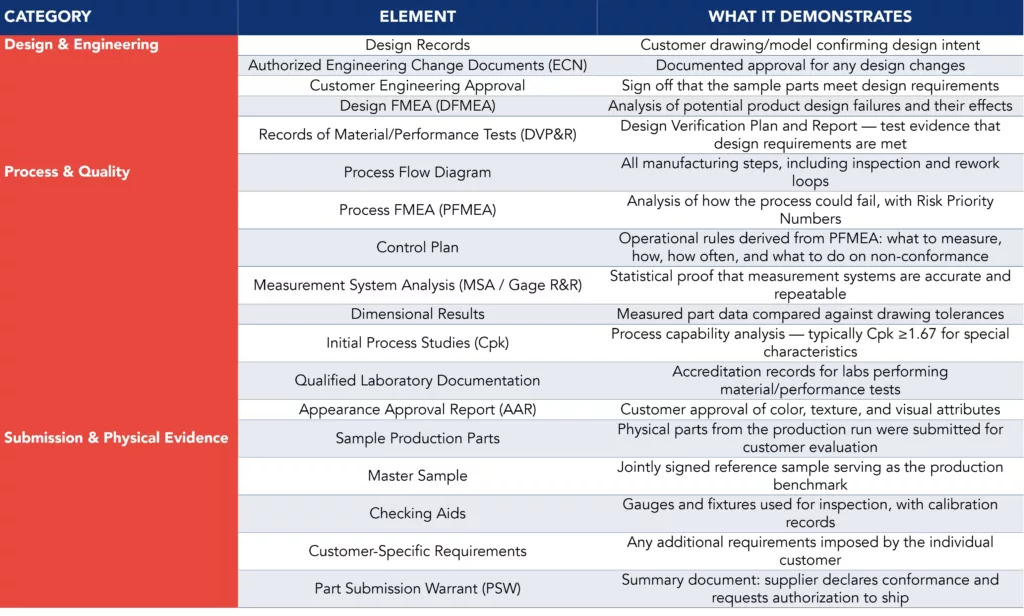
Table 1 – the 18 PPAP elements by category
Several elements carry disproportionate weight. The PFMEA is where risk is analyzed: each potential failure mode in the manufacturing process is rated by severity, occurrence, and detectability, producing a Risk Priority Number that drives the Control Plan. The Control Plan then translates that risk analysis into daily operational rules on the shop floor, what to measure, how, at what frequency, and what the reaction plan is when a measurement goes out of specification. This is where Standard work and daily management principles become quality assurance.
The Measurement System Analysis (MSA), conducted through a Gage R&R study, verifies that the measurement equipment itself introduces acceptably low variation. An MSA with a Gage R&R above 30% is unacceptable. Data collected from an unreliable gauge invalidates every dimensional result in the package. The Initial Process Studies establish process capability through Cpk analysis, with a Cpk of 1.67 or higher typically required for special characteristics. And the PSW is the formal summary document in which the supplier declares conformance and requests authorization to begin shipping.
The process flow diagram and the PFMEA must be consistent with each other and with the Control Plan. Customer quality engineers review all three side by side; disconnects between them are among the most common reasons for PPAP rejection.
PPAP submission levels: choosing the right one
PPAP defines five submission levels that determine how much documentation a supplier must provide to the customer and how much to retain on file. The customer specifies the required level; suppliers do not self-select. The table below summarizes each level and its typical application.
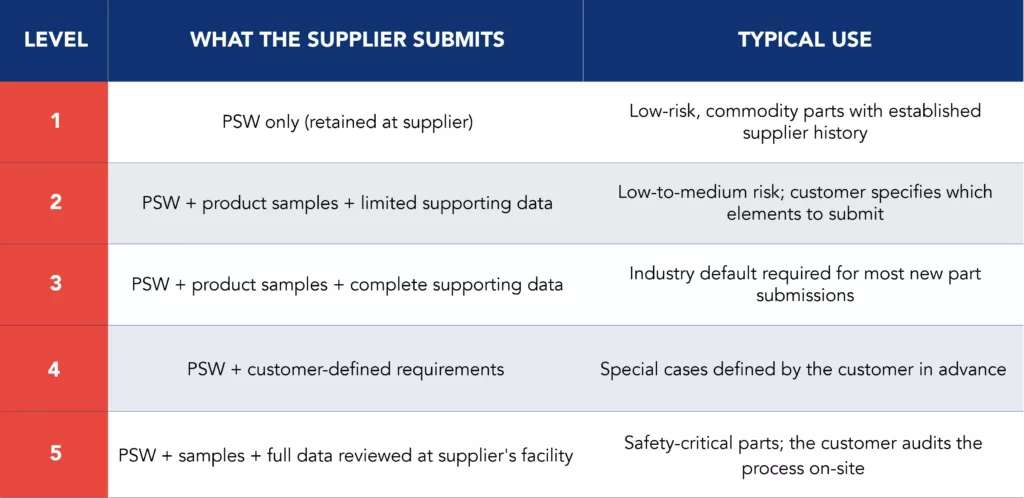
Table 2 – PPAP submission levels and typical applications
Level 3 is the default across most automotive and manufacturing contexts. A Level 3 PPAP submission includes the PSW, physical sample parts, and the full supporting data package: DFMEA, process flow diagram, PFMEA, Control Plan, MSA, dimensional results, material/performance test records, and Initial Process Studies. For a new part with established tooling and a known manufacturing process, preparing a Level 3 PPAP typically takes two to four weeks longer if new tooling or new process development is involved.
Level 5 is reserved for safety-critical or high-complexity parts, where the customer reviews the complete data package at the supplier’s facility rather than accepting a remote submission. It is the most demanding level and, in practice, functions as a supplier audit combined with PPAP validation.
PPAP and APQP: why the planning connection matters
The single most important insight into supplier quality management is this: PPAP is not a process. It is the output of a process. That process is APQP, a structured, phase-gated methodology that runs from product conception through production validation, ensuring that design intent, manufacturing capability, and quality controls are aligned before a single production part ships.
PPAP provides evidence that APQP was executed successfully. A rejected PPAP submission is almost always a symptom of upstream APQP weaknesses made visible, not a documentation problem. Organizations that treat PPAP as a standalone compliance event, assembling documents at the end of a development program rather than building them through the planning process, systematically expose themselves to late-stage failures that are expensive to correct.
The pattern repeats with predictable consistency in quality and productivity in discrete manufacturing operations: a PFMEA that was completed as a form rather than used as a decision-making tool; a Control Plan that lists controls not actually in use on the line; an MSA run on laboratory gauges rather than the production instruments operators use every day; a capability study conducted under controlled trial conditions rather than at the quoted production rate. Each of these is a case where documentation maturity exceeded process maturity. The binder looked complete, while the process was not.
Built-in quality, the principle of designing conformance into the process rather than inspecting it into the product, is what APQP enforces and PPAP validates. Value Stream Mapping applied to new product introduction makes the flow of risk decisions visible: from customer requirements through design validation, process design, PFMEA, Control Plan, and capability confirmation. When that chain is intact, the PPAP package assembles itself from living documents rather than being created under deadline pressure.
Manufacturing Process Improvement initiatives that engage with PPAP at this level, treating it as a quality architecture exercise rather than a submission exercise, consistently achieve shorter approval lead times and fewer resubmissions.
Build quality systems where PPAP approval is a natural outcome, not a last-minute effort
PPAP beyond automotive: aerospace, defence, and discrete manufacturing
Although PPAP originated in automotive manufacturing consulting contexts developed by Automotive Industry Action Group (AIAG) with Ford, General Motors, and Chrysler, the methodology has migrated to other industries because the underlying problem it solves is universal: how does a customer gain confidence that a supplier can deliver conforming parts consistently, across a production run, under real operating conditions?
In aerospace and defense, AS9145, published by the International Aerospace Quality Group (IAQG) in 2016, formalizes the application of APQP and PPAP to aviation, space, and defense supply chains. AS9145 integrates with AS9102, the FAI standard, but the two are distinct: FAI is one component of a PPAP submission in aerospace, not a substitute for it. Discrete and Process Manufacturing operations in aerospace face a genuine adaptation challenge: statistical tools such as SPC, Gage R&R, and process capability studies were designed for high-volume continuous production. Applying them meaningfully to a batch of three complex machined components requires judgment about what the data can and cannot tell you. AS9145 acknowledges this; suppliers and Original Equipment Manufacturers (OEMs) working with it need to ensure the tools are applied in ways that reflect actual production reality.
Across industries, the organizations that use PPAP most effectively are those that have embedded it in their supplier development programs, not as a gate that must be passed, but as a structured conversation between customer and supplier about whether the conditions for consistent quality are genuinely in place.
PPAP as a continuous improvement lever
PPAP documentation that reflects the actual manufacturing process rather than an idealized version establishes a quality baseline. The Control Plan defines the standard. The Gage R&R establishes measurement confidence. The Cpk results show where process capability is strong and where it is marginal. This is the foundation from which continuous improvement manufacturing programs can operate.
In practice, the organizations that extract the most value from PPAP treat the Control Plan the way high-performing operations treat standard work: as a living document updated when the process changes, reviewed when defects occur, and used as a reference when training new operators. The PFMEA becomes a risk register that evolves as production experience accumulates. The Baseline Performance established at PPAP approval becomes the KPI Tree starting point for subsequent improvement cycles.
When production flow, line design, and layout design decisions are made with PPAP requirements in mind, ensuring that measurement points, inspection stations, and control mechanisms are physically accessible and practical for operators to use at production rate, the result is a quality system that is both compliant and functional. Designing the production line first and retrofitting PPAP documentation around it is the root cause of many MSA and capability failures that lead to resubmissions.
Realizing this requires capability on two fronts: the shop floor and the supply chain. Kaizen Institute supports organizations through its Automotive Consulting Services, helping manufacturers build robust production systems where process discipline, quality management, and PPAP requirements are structurally aligned. Complementing this, our Quality Management Services strengthen quality systems across the organization, while our Sourcing and Procurement Consulting develops supplier qualification and performance as a managed capability rather than a reactive process.
Do you want to know more about PPAP?
What does PPAP stand for?
PPAP stands for Production Part Approval Process. It is a standardized framework, governed by the Automotive Industry Action Group (AIAG), for demonstrating that a supplier’s manufacturing process can consistently produce parts that meet all customer engineering design specifications and quality requirements.
What is the difference between PPAP and APQP?
Advanced Product Quality Planning (APQP) is the upstream planning process, a structured, phase-gated methodology that runs from product concept through production validation. PPAP is the output of APQP: the package of documents, data, and physical parts that proves the planning was executed successfully. A failed PPAP submission is almost always a sign of an incomplete APQP process.
What is a PSW?
The PSW is the final document in a PPAP package. Signed by the supplier, it declares that all 18 elements have been completed, that the parts conform to all engineering design requirements, and formally requests customer authorization to begin shipping production quantities. It is the official gate for production approval.
See more on Automotive
Find out more about transformation in this sector
See more on Quality
Find out more about improving this business area