
Article
What is DFMEA? How to prevent failures from the product design phase


As products become more complex, simply identifying potential failures during testing or later, at the start of production, is no longer sufficient. Organizations that aim to develop more reliable, safe, and robust products must anticipate risks from the initial stages of development. The Design Failure Mode and Effects Analysis (DFMEA) is specifically designed to support this approach.
DFMEA is a structured methodology that makes it possible to identify the potential failure modes of a given product during the design phase, evaluate their effects, understand their causes, and define corrective actions to eliminate or reduce these risks before they reach production or are passed on to the customer. By adopting a preventive approach, organizations reduce development costs, minimize late-stage changes, improve product quality, increase customer satisfaction, and contribute to industrial operations that are more efficient and robust.
Although it was initially developed for industries with high requirements for product safety, such as automotive and aerospace, DFMEA is now widely used across various industrial sectors to support new product development, design changes, and innovation processes.
More than a risk analysis tool, DFMEA promotes a structured approach to decision-making during product development, helping multidisciplinary teams identify vulnerabilities, set priorities, and build in quality from the design phase onward.
In this article, you will learn what DFMEA is, how it works, what its main steps are, how it differs from PFMEA, how it has evolved over time, and how it can be integrated into an operational excellence strategy to reduce risks and develop more robust products.
What is DFMEA?
DFMEA is a preventive risk analysis and management methodology used to identify, analyze, and reduce potential failures during the design and development phase of a product. Its main objective is to ensure that risks associated with the design are identified and addressed before the product enters production, that is, before it is made available to the customer.
Unlike reactive approaches, which seek to solve problems after they occur, DFMEA makes it possible to anticipate failure scenarios during development. For each product function, the team identifies possible failure modes, analyzes their effects, determines the probable causes, and assesses the level of risk, defining actions to eliminate or reduce that risk at the source.
This methodology is based on a multidisciplinary approach, typically involving professionals in product engineering, quality, production, purchasing, suppliers, and, whenever possible, specialists with knowledge of the product’s final application. Combining different perspectives makes it possible to identify risks that would be difficult to detect from a single area of the organization.
DFMEA is typically applied in situations such as:
- New product development.
- Development of new systems, subsystems, or components.
- Significant changes to the design of existing products.
- Introduction of new materials or technologies.
- Cost reduction projects that may affect product performance or reliability.
DFMEA helps improve product quality, lower warranty and rework costs, reduce development time, and increase confidence in engineering decisions. It is also an essential tool for meeting quality requirements in sectors of the discrete and process manufacturing industry, including the automotive industry, aerospace, electronics, medical devices, chemical, food, and other industries where product reliability is critical.
When applied consistently, DFMEA becomes a decision-support tool, promoting the development of products that are more robust, safer, and better aligned with customer expectations.
Want to reduce design risks before they become costs?
DFMEA vs. PFMEA vs. FMEA: What are the differences?
The terms FMEA, DFMEA, and PFMEA are often used as if they were synonyms, but they represent different and complementary concepts.
FMEA (Failure Mode and Effects Analysis) is the general preventive failure analysis methodology. Its objective is to identify potential failure modes, evaluate their effects, and implement actions that reduce or eliminate risks before they affect the customer.
Within this methodology, there are different types of FMEA, the most widely used being DFMEA (Design Failure Mode and Effects Analysis) and PFMEA (Process Failure Mode and Effects Analysis). The main difference between the two lies in the stage of the product life cycle at which they are applied and the type of risk they analyze.
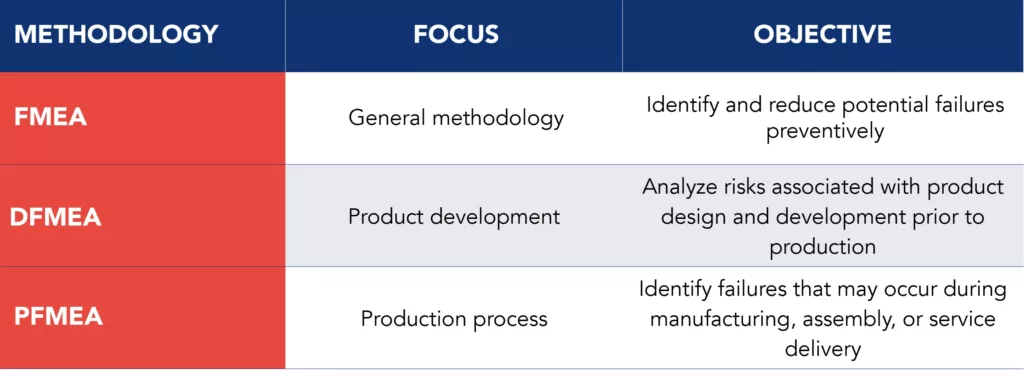
Table 1 – Differences between FMEA, DFMEA, and PFMEA
In practice, DFMEA seeks to eliminate or reduce risks through improvements in product design, while PFMEA ensures that the production process, including the production line design, manufacturing methods, and assembly, can manufacture that product consistently, in compliance with the defined requirements. Together, they constitute two of the main tools of preventive quality engineering, contributing to the development of more robust products and more reliable processes.
Why is DFMEA important in product development?
Decisions made during a product’s development phase have a significant impact on its quality, cost, reliability, and performance throughout its life cycle. The later a design failure is identified, the greater the effort required to correct it and the higher the associated costs, ranging from engineering changes and launch delays to customer complaints and recall campaigns or warranty costs.
DFMEA helps reduce these risks by enabling teams to identify potential failures before production, when it is still possible to introduce design improvements more quickly and economically, contributing to the reduction of industrial costs. Rather than reacting to existing problems, it promotes a preventive approach, building in quality from the design phase.
Beyond reducing technical risk, DFMEA improves decision-making throughout product development. The structured analysis of failure modes makes it possible to compare design alternatives, identify critical characteristics, and define actions that increase product robustness and reliability before industrialization.
Another important advantage is the involvement of multidisciplinary teams. By bringing together knowledge from engineering, quality, production, procurement, suppliers, and after-sales service, DFMEA facilitates the identification of risks that might otherwise go unnoticed in an analysis carried out by a single function, promoting a more complete view of the product and its expected performance.
When systematically integrated into the development process, DFMEA contributes to:
- Developing more robust and reliable products.
- Reducing engineering changes in later project stages.
- Lowering warranty, rework, and non-quality costs.
- Accelerating the development and industrialization of new products.
- Improving customer satisfaction and regulatory compliance.
- DFMEA is a prevention mechanism that helps organizations develop products right first time, reducing the likelihood of failures before they even occur and contributing to quality and productivity in the manufacturing industry.
Steps of DFMEA
DFMEA is developed in a structured way and tracks the product’s evolution from the earliest stages of design. As the design is developed, the analysis is continuously reviewed to identify new risks, validate engineering decisions, and ensure that the product meets functional, performance, reliability, and safety requirements. The process can be divided into five main phases.
1. Define the scope, functions, requirements, and failure modes
The first step consists of defining the scope of the analysis, identifying the system, subsystem, or component to be analyzed, as well as its boundaries, interfaces, and the context in which the product will operate. This definition helps ensure that the team has a shared understanding of the object of the analysis and avoids omissions of critical functions or requirements.
Next, the functions that the item must perform throughout its useful life are identified. For each function, the corresponding technical, functional, and regulatory requirements are established. The team then identifies potential failure modes, that is, the ways in which the design might fail to meet these requirements, as well as the effects these failures could have on the customer, the product, or the system in which it is integrated.
At this stage, a severity rating is also assigned, representing the potential impact of each failure.
2. Identify potential failure causes and assess occurrence
After identifying the failure modes, the team seeks to understand their potential causes.
These causes may result, for example, from inadequate material selection, incorrect dimensions, excessive tolerances, insufficient strength, calculation errors, incompatibility between components, or limitations of the design concept itself.
Design prevention controls are also identified, that is, the engineering strategies used during development to reduce the occurrence of failure causes. Whenever possible, these controls should reduce the probability of occurrence of the potential failure cause or eliminate it through the design itself. Common prevention controls include validated engineering standards, proven technologies, computer-aided engineering (CAE), engineering calculations, and design reviews.
Based on this analysis, an occurrence rating is assigned, reflecting the probability that the potential failure cause will occur.
3. Evaluate detection controls
At this stage, the effectiveness of the design detection controls is evaluated for identifying causes or failure modes before the product launch. These controls include verification and validation activities carried out throughout development to confirm that the design meets the defined requirements.
Unlike PFMEA, the focus is not on inspecting the production process, but rather on design detection controls, such as design reviews, laboratory testing, functional testing, prototype verification and validation, reliability testing, and other design verification activities. Computer-aided engineering (CAE) analyses, such as Finite Element Analysis (FEA) or Computational Fluid Dynamics (CFD), can play a prevention role when used to optimize the design before its completion, or a detection role when used to verify or validate design decisions already made. Their classification should therefore be defined on a case-by-case basis, depending on the purpose for which they are used.
The detection rating reflects the ability of these controls to identify a cause or a failure mode before the product launch. The greater this ability, the lower the detection rating assigned in the DFMEA.
4. Prioritize risks and define actions
After the severity, occurrence, and detection ratings are assigned, the team determines which risks should be addressed as a priority.
The AIAG & VDA methodology currently recommends the use of Action Priority (AP) to support this decision, although many organizations continue to use the Risk Priority Number (RPN). Unlike RPN, which multiplies the ratings for severity, occurrence, and detection into a single numerical value, the AP follows a hierarchical logic: severity takes absolute precedence and can alone determine a high priority regardless of the values for occurrence and detection. Only once severity is set do the remaining criteria influence the final classification, which ensures that failures with a high impact on the customer or on functional safety always receive appropriate attention.
Thus, for each priority risk, actions are defined to improve the robustness of the design, such as geometric changes, selection of new materials, review of technical requirements, reinforcement of safety margins, or additional validations.
Each action must have a clearly defined owner and implementation deadline.
5. Implement actions and update the DFMEA
After the improvements are implemented, the DFMEA is updated to verify whether the risk has actually been reduced.
This reassessment confirms the effectiveness of the changes introduced and ensures that the product meets the defined requirements before moving into production.
DFMEA is a living document and should track the entire evolution of the design. Whenever there are changes to the product, new requirements, test results, customer complaints, or lessons learned from production, the analysis should be reviewed to ensure that it continues to reflect the product’s actual level of risk.
What information should a DFMEA template include?
A model or template for DFMEA is the structure used to document the analysis of risks associated with a product’s design. More than a form, it is a collaborative working tool that guides the team throughout the entire development process, from identifying product functions to implementing and validating improvement actions.
Although the format may vary among organizations, the main fields follow a logical sequence that mirrors the progression of the analysis.
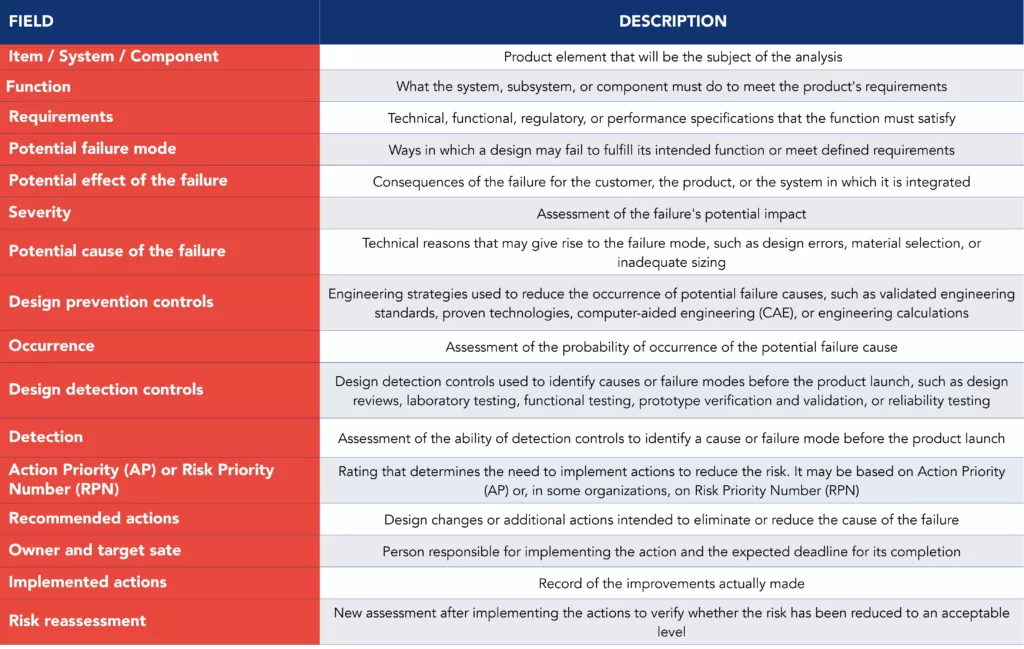
Table 2 – Structure of a DFMEA template
Regardless of the format used, a good template for DFMEA should be updated throughout the entire product development process. Design changes, test results, new requirements, or knowledge gained from previous projects should be incorporated into the analysis, turning the DFMEA into a repository of technical knowledge and a tool that supports continuous improvement in product development.
Most common mistakes in applying DFMEA
The effectiveness of DFMEA depends on the quality of the analysis carried out by the team. When used merely as a documentation requirement, its potential to prevent failures is significantly reduced.
The most frequent mistakes include:
- Starting the DFMEA too late, when the design is already practically finalized and changes become more costly.
- Treating the DFMEA as a compliance document rather than a decision-support tool during development.
- Not involving a multidisciplinary team, limiting the identification of risks and improvement opportunities.
- Not updating the DFMEA after project changes, test results, or lessons learned during industrialization and product use.
When applied from the early stages of development and continuously updated, DFMEA becomes an essential tool for developing more robust products, reducing risks, and building in quality from the design stage.
How to integrate DFMEA into an operational excellence strategy
DFMEA generates greater value when it stops being a one-off activity and becomes an integral part of the product development process. Rather than being used only to meet quality or customer requirements, it should support engineering decisions from the early design stages through to final product validation.
Integrated into an operational excellence strategy, DFMEA creates a link between product development, industrialization, and continuous improvement. Information from testing, production, customer complaints, and actual performance should be used to continuously update the analysis, allowing each new project to benefit from the experience accumulated in previous developments.
This integration promotes a built-in quality approach, in which quality no longer depends on defect detection and instead becomes built into the product’s own design. At the same time, it strengthens collaboration between engineering, quality, production, and suppliers, ensuring that development decisions take the product’s entire life cycle into account.
When used in this way, DFMEA is no longer just a risk analysis tool but becomes a central element of product development. The result is more robust products, more efficient development cycles, less need for late-stage changes, and an organization capable of continuously learning from each new project.
Kaizen Institute supports this integration through a combined approach across the areas involved in the product life cycle. Our quality consulting services reinforce the built-in quality approach, ensuring that robustness and failure-prevention requirements are incorporated from the outset. The connection between engineering, quality, and production allows the knowledge generated during industrialization and production ramp-up to feed continuous improvement, ensuring that the DFMEA is applied in a structured way from the design stage onward. In this way, collaboration between functions is maintained throughout the entire product life cycle, allowing each new project to learn from previous ones.
Turn DFMEA into a competitive advantage
Still have some questions about DFMEA?
What does DFMEA mean?
DFMEA stands for Design Failure Mode and Effects Analysis. It is a methodology used to identify, assess, and reduce potential product failures during the design phase.
What is the difference between DFMEA and PFMEA?
DFMEA analyzes the risks associated with product design, while PFMEA (Process Failure Mode and Effects Analysis) identifies potential failures in the manufacturing or assembly process.
What is the difference between DFMEA and FMEA?
FMEA is the general failure mode and effects analysis methodology. DFMEA is one of its applications, focused specifically on analyzing risks during product development.
What is the difference between RPN and Action Priority?
RPN (Risk Priority Number) calculates risk priority by multiplying the severity, occurrence, and detection ratings. Although it was the most widely used method for many years, it can assign the same priority to risks with very different impacts.
The Action Priority (AP), introduced by the AIAG & VDA FMEA methodology (2019), is presented as a more robust alternative to RPN. Instead of multiplying the three values, it uses hierarchical decision tables that determine whether a risk requires high, medium, or low priority for intervention. However, RPN continues to be used in many organizations and regulatory contexts, so the adoption of AP should be evaluated based on the specific requirements of each customer and sector.
Who should participate in a DFMEA?
DFMEA should be developed by a multidisciplinary team, typically involving professionals in product engineering, quality, production, testing, and purchasing, and, whenever possible, suppliers and specialists in the product’s application.
See more on Discrete Manufacturing
Find out more about transformation in this sector
See more on Quality
Find out more about improving this business area