Article
What is process manufacturing? Definition, types, and performance


Process manufacturing is the transformation of raw materials into finished goods through a variety of chemical reactions, biological processes, or irreversible physical changes. These processes include mixing, heating, fermenting, distilling, and polymerizing. The output of this model cannot be disassembled back into its inputs, which is a key distinction from discrete assembly. This characteristic influences numerous downstream processes, including performance measurement, quality assurance, plant scheduling, and identification of improvement opportunities. This guide defines process manufacturing, contrasts it with discrete manufacturing, details batch and continuous production, covers the software stack and compliance landscape, and concludes with a discussion of how leading process manufacturers improve performance.
What is process manufacturing?
Process manufacturing is the production of goods through formulation, combining ingredients in defined proportions and subjecting them to physical or chemical transformation until the inputs are no longer recoverable. A liter of detergent, a ton of polyethylene, a tablet of paracetamol, a wheel of cheese, a barrel of refined diesel: each is the output of a recipe and a process, not an assembly. This is the operational reality across pharmaceutical manufacturing, chemical manufacturing, food and beverage, cosmetics, pulp and paper, cement, metals, and energy.
The non-reversibility matters. It means a defective batch is not reworked; it is destroyed, downgraded, or recycled at high cost. It means the bill of materials is a recipe rather than a parts list. And it means yield is often the most important number on the plant floor, not throughput. These are the features of the manufacturing industry that determine how a process operation is run.
Discrete vs. process manufacturing
The cleanest way to understand process manufacturing is by contrast. Discrete manufacturing assembles distinct components, wheels onto a car, chips onto a board, screws into a chassis, into a final product that can be taken apart again, while process manufacturing transforms ingredients into something fundamentally new. Also, discrete operations bring many components together into a finished unit; process operations start with a small set of inputs and diverge into many finished SKUs through formulation and packaging, as shown in the table below.
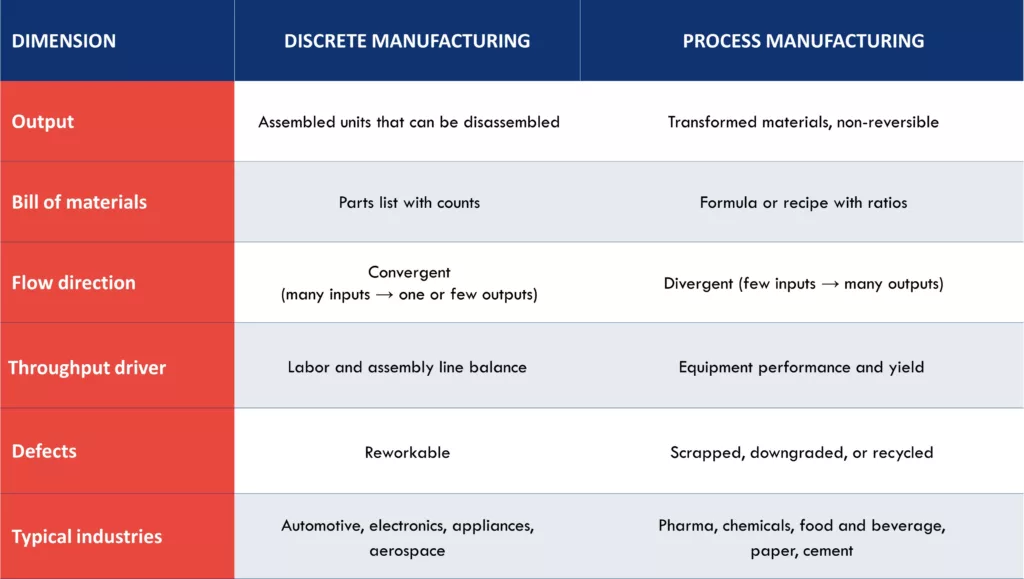
Table 1 – Comparison table: process manufacturing vs. discrete operations
The implication for management is direct. In discrete plants, throughput is largely a function of line balance and labor allocation, meaning adding people to a station reduces its cycle time. In process plants, throughput is locked into the equipment: a reactor, a fermenter, an oven, an extruder; there, adding operators does not increase output. The performance question becomes how to extract more from the asset, which is why Kaizen in process industry looks quite different from lean rolled out on an assembly line.
Types of process manufacturing: batch vs. continuous
Two production regimes dominate, with a third hybrid worth naming.
Batch manufacturing processes a defined quantity of material through a sequence of unit operations before the next batch begins. A pharmaceutical tablet line, a specialty paint kettle, a brewery, and a cosmetics filler each run production in fixed-size batches. Batch operations enable product variety: different SKUs share the same equipment by changing the recipe between runs. The cost is changeover time, cleaning cycles, and validation overhead, which often consume more line hours than actual production.
Continuous process manufacturing runs without interruption through fixed equipment trains for weeks or months between scheduled turnarounds. Petroleum refining, basic chemicals, glass, paper, bulk dairy, and steel are the classic examples. Every shutdown is expensive, and the engineering focus is reliability, energy efficiency, and yield. Product variety is limited, but unit costs are low.
Semi-continuous is the hybrid: operations run continuously within a campaign of one product, then stop for changeover before the next. Specialty food, biopharma, and fine chemicals frequently operate this way. Treating it as either a pure batch or a pure continuous process leads to poor scheduling decisions.
Reducing changeover with SMED has a high impact on batch production but has lower relevance in continuous production. Energy intensity per ton dominates cost in continuous operations and is secondary in batch operations.
Better equipment won’t lift throughput. Operational discipline will.
Process manufacturing software: MES, ERP, and the digital stack
A modern process plant runs on three software layers. Understanding the stack matters because vendor categories overlap, making decisions muddled.
Process control, the bottom layer runs the plant in real time. Distributed Control Systems (DCS), Programmable Logic Controllers (PLCs), and Supervisory Control and Data Acquisition (SCADA) platforms execute control loops, manage interlocks, and acquire sensor data at the millisecond level.
A Manufacturing Execution System (MES) sits above process control. It manages electronic batch records, recipe execution, scheduling, downtime tracking, calculation of Overall Equipment Effectiveness (OEE), and the operator interface. In regulated industries, MES enforces Good Manufacturing Practice (GMP) compliance through electronic signatures and audit trails.
Process manufacturing Enterprise Resource Planning (ERP) is the top layer. Where discrete ERP handles parts lists and assemblies, a process manufacturing software platform handles formula management, batch-level costing, lot/batch genealogy, regulatory reporting, and characteristic-based inventory (allergens, potency, purity).
Above the stack, manufacturing analytics platforms convert sensor and event data into dashboards and predictive models. Smart manufacturing IIoT (Industrial Internet of Things), edge computing, digital twins, and AI/ML deliver the most value today in four applications: predictive maintenance, yield optimization, energy management, and quality prediction. Among the global manufacturing trends shaping investment decisions, these four consistently pay back; the broader hype outpaces what most operations need.
Quality and compliance: GMP, SPC, and validation
Process manufacturing operates inside regulatory frameworks with no real equivalent in discrete industries.
GMP, codified in the FDA (Food and Drug Administration) 21 CFR (Code of Federal Regulations) Parts 210/211 in the US, the EU GMP guidelines in Europe, and equivalent frameworks elsewhere, defines the minimum conditions under which pharmaceuticals, biologics, and many food and cosmetic products may be produced. GMP compliance covers facility design, personnel training, documentation, equipment qualification, and change control. In food, ISO 22000 and HACCP play parallel roles. Non-compliance shuts plants down.
Process validation is the documented proof that a process consistently produces outputs that meet specifications. The current FDA framework requires three stages: process design, process qualification, and continued process verification supported by statistical evidence across batches. Cleaning validation is the quieter sibling: proof that residues from one product are removed below acceptance limits before the next run on the same equipment. Both define the actual usable capacity.
Statistical process control (SPC) catches drift before it produces out-of-spec product. Control charts, capability indices (Cp, Cpk, Pp, Ppk), and Western Electric rules detect variation patterns within the process’s natural noise. Modern SPC integrates with Process Analytical Technology, moving quality control from end-of-batch laboratory testing toward real-time release.
Lot traceability, reconstructing the genealogy of every batch from raw materials through delivery, is required in pharma, food, and increasingly specialty chemicals. Without it, recall becomes catastrophic.
Measuring performance in process manufacturing
The dominant performance metric is OEE, calculated as Availability × Performance × Quality. OEE captures the three ways a line loses output: time not running, time running slowly, and time producing defects. World-class batch OEE sits around 85%; many plants run between 50% and 65% and do not know it because shifts, planned downtime, and CIP (Clean-in-Place) are netted out before the calculation starts.
Capacity utilization of the bottleneck (reactor, fermenter, oven, or filler) sets the upper bound on what the plant can produce. Mapping the bottleneck through Value Stream Mapping is the first step in any serious improvement program: half the time, a perceived capacity shortage turns out to be a hidden changeover problem or a yield loss masquerading as a throughput limit.
Production planning uses hybrid logic. High-rotation SKUs (A class) run on a Make-to-Stock (MTS) basis, with replenishment driven by supermarket pull. Low-rotation specialties (C class) run on Make-to-Order (MTO) and are triggered only by confirmed demand. Mid-rotation SKUs depend on the service level the business commits to. Sequencing considers product families to minimize allergen, color, or grade changeovers, as well as tank availability and shelf life.
Beyond OEE, the metrics that matter are first-pass yield, right-first-time batches, specific energy consumption per unit produced, and mean time between failures. A well-built KPI Tree connects these operational indicators to the financial outcomes leadership cares about, so improvement efforts are allocated where they move the business.
Unlock capacity within your regulatory boundaries
How leading process manufacturers improve performance
This is the question the standard reference articles skip. Once a team understands what process manufacturing is, the question is what to do about a plant running at 55% OEE when 80% is possible. Improvement follows a specific sequence.
First, make performance visible. The highest-return early intervention is honest OEE measurement at the bottleneck, with losses categorized by cause rather than aggregated into a single percentage that hides the levers. Standard work on changeovers, cleaning, and start-ups removes the silent variation operators absorb as a matter of course.
Second, attack the largest loss category. In batch plants, this is almost always addressed through SMED on vessel turnovers and CIP optimization. In continuous plants, unplanned downtime is typically addressed through reliability-centered and predictive maintenance. These are the highest-yield levers for Manufacturing cost optimization in process operations: cost reduction here comes from recovered capacity, not from cutting heads or squeezing inputs.
Third, stabilize the process. SPC and structured problem-solving recover output previously written off as inherent variation. First-pass yield improvements of 5 to 15 points within twelve months are common when the right parameters are identified, standardized, and monitored.
Fourth, redesign the flow. Lean manufacturing principles – eliminating muda, mura, and muri – apply with adaptations: pull-flow planning replaces forecast-driven scheduling, supermarkets between stages absorb variability, and changeover sequencing reduces lost time. Kaizen continuous improvement, layered on top of disruptive workshops, converts one-time gains into sustained capability.
The gap between average and top-quartile process plants is wider than most leaders assume. Closing it does not require a digital transformation or a capex round. It starts with an honest Operational excellence assessment of where the losses sit, then disciplined attention to the right losses, in the right sequence, with the people who run the equipment.
Optimizing performance across process and discrete operations
At Kaizen Institute, we help manufacturers address the unique demands of both process and discrete settings by assisting them in transitioning from a management style focused on instability to one characterized by mastery. Our process manufacturing consulting services are designed to build a culture of performance and consistency. Our approach involves identifying and addressing unreliable equipment, unstable processes, and inadequate management routines. This ensures consistent and reliable results across shifts and sites, preventing the accumulation of silent losses. Our discrete manufacturing consulting turns fragmented operations into synchronized, high-performing systems. We implement daily management routines and digital tools that make decisions visible and data-driven, empowering teams to act.
Still have some questions about process manufacturing?
What is the difference between process and discrete manufacturing?
Discrete manufacturing assembles distinct components into a finished product that can be disassembled into cars, electronics, and appliances. Process manufacturing transforms ingredients through chemical, biological, or irreversible physical processes into goods that cannot be taken apart again – pharmaceuticals, chemicals, food, paper, and cement. Discrete uses parts lists; process uses formulas and recipes.
What is GMP compliance, and who needs it?
Good Manufacturing Practice (GMP) is the regulatory framework that defines the minimum conditions under which products affecting human health may be produced, including pharmaceuticals, biologics, medical devices, and many food and cosmetic categories. GMP covers facility design, equipment qualification, personnel training, documentation, and change control. In food, ISO 22000 and HACCP play equivalent roles. Compliance is not optional in regulated markets.
What software do process manufacturers use?
Three layers: process control (DCS, PLC, SCADA) for real-time operation; a manufacturing execution system (MES) for electronic batch records, scheduling, and Overall Equipment Effectiveness (OEE); and a process manufacturing Enterprise Resource Planning (ERP) for formulas, batch costing, lot traceability, and regulatory reporting. Manufacturing analytics platforms sit above the stack, converting sensor and event data into operational insights.
See more on Process Manufacturing
Find out more about transformation in this sector
See more on Manufacturing Operations
Find out more about improving this business area