
Article
Performance improvement in healthcare: Model, steps, and indicators


Healthcare organizations face an increasingly complex challenge: providing safe, high-quality healthcare and enhanced patient experience while simultaneously addressing pressures on capacity, costs, and resources. In this context, improving healthcare performance has become an essential management skill.
The goal is to deliver greater value to patients through smoother processes, better-trained teams, and the sustainable use of resources. For this to become possible, the organization needs an integrated system for continuous improvement that aligns initiatives with strategy, optimizes end-to-end workflows, engages teams in daily problem-solving, and tracks results using relevant indicators.
What is performance improvement in healthcare?
Performance improvement in healthcare is a structured and continuous approach to identifying opportunities, redesigning processes, testing solutions, and tracking the impact of changes on clinical, operational, and financial outcomes. The focus is on the performance of the system as a whole, not just the efficiency of a single function or resource.
In practice, performance improvement connects three questions: which results we want to improve, which processes determine those results, and which management system can sustain the new way of working. This perspective is particularly relevant to performance improvement in healthcare, where the patient’s journey spans different teams, specialties, and services.
In performance improvement in hospitals, key benefits include reduced wait times, increased available capacity, less waste and variability, improved quality, and greater financial sustainability.
Quality and performance improvement in healthcare: What’s the difference?
Quality improvement and performance improvement concepts are closely related. Quality improvement tends to focus mainly on safety, compliance, and care outcomes, while performance improvement takes a broader perspective, also integrating flow, capacity, productivity, patient experience, and costs.
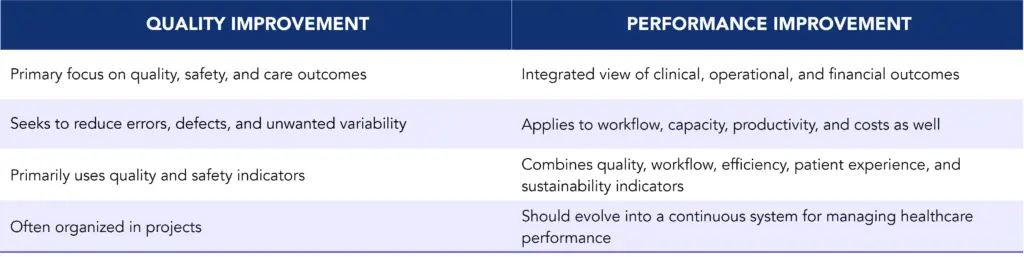
Table 1 – Difference between quality and performance improvement
The distinction is not a strictly defined boundary: improving quality is an indispensable component of improving performance.
Three priorities: Patient experience, operational efficiency, and financial sustainability
In healthcare, three goals are particularly interconnected: improving patient experience, increasing operational efficiency, and strengthening financial sustainability.
Patient experience: Reducing waiting time and fragmentation
Patient experience is shaped not only by the clinical act itself, but also by the entire journey: scheduling, admission, waiting, diagnosis, treatment, information, discharge, and follow-up. When these stages are managed in silos, queues, handoffs, repeated information, and anxiety arise.
The KAIZEN™ approach begins by mapping the end-to-end flow and defining value from the patient’s perspective, as the basis for patient-centered healthcare. The principle is simple: first improve the efficiency of patient flow, and only then optimize the utilization of each resource.
Operational efficiency in healthcare: Increasing capacity without increasing waste
Operational efficiency in healthcare does not mean keeping all resources busy 100% of the time. High local utilization can create queues and increase total response time. Efficiency must be analyzed together with flow, variability, compliance, and available capacity. It is this integrated view that distinguishes healthcare operations optimization from a simple maximum of utilization.
The biggest gains usually come from reducing non-value-added time (room preparation, changeovers between patients, searching for materials and information, unnecessary travel, among others) and from a better balance between workload and capacity. In settings such as the emergency department, outpatient care, inpatient units, or the operating room, these gains help increase patient throughput and predictability without compromising quality.
Financial sustainability in healthcare: Eliminating costs without sacrificing value
Financial sustainability in healthcare depends on the ability to make better use of available resources and avoid costs that do not add value to the patient. Waiting, rework, errors, excess stock, unnecessary travel, inadequate use of capacity, or complex administrative processes consume resources without improving clinical outcomes.
Therefore, operational opportunities should be prioritized by their economic impact and translated into financial results. The goal is not to cut resources indiscriminately, but rather to reduce the causes that require spending more to achieve the same result.
Shorter waiting time, increased capacity, and greater team engagement
Performance improvement model for healthcare
Performance improvement in healthcare requires more than one-off projects or isolated tool applications. The best results come when principles, methods, and management routines are combined into an integrated system of continuous healthcare performance improvement, capable of acting simultaneously on strategic priorities, end-to-end processes, and teams.
Aligning operational improvement with strategy
The starting point is to link improvement directly to the organization’s strategic priorities. This involves selecting the highest-impact initiatives, setting goals across different levels, and systematically tracking execution and results.
In healthcare, this alignment makes it possible to link process improvement to goals such as patient experience, operational efficiency in healthcare, clinical quality, and financial sustainability in healthcare.
Optimizing workflows and improving end-to-end processes
Many performance issues span multiple departments and cannot be solved through local improvements alone. Lean management in healthcare seeks to maximize the value delivered to patients by eliminating waste, reducing variability, and creating flow.
The first step is to select the value stream to analyze. Next, Value Stream Mapping in healthcare makes it possible to map the current journey, identifying waits, handoffs, rework, and bottlenecks. This is followed by the Value Stream Design, which outlines a simpler, more effective future flow and defines the implementation plan.
This plan is carried out through KAIZEN™ Events with multidisciplinary teams, and implementation is tracked in a space usin visual management, where actions, indicators, and deviations are monitored. This approach is particularly relevant for patient flow optimization and for freeing up capacity without relying solely on increasing resources.
In these events, KAIZEN™ Lean tools, such as standardizing procedures and times, workload-capacity analysis, consumption-based replenishment, or waste and cost-structure analysis, are used. Depending on the nature of the problem, these can also be combined with Six Sigma tools in healthcare, especially when variability and the consistency of results carry greater importance.
Daily team improvement and problem solving
On a daily basis, improvement happens with the teams that carry out clinical and administrative processes. Making performance visible, identifying deviations, and developing problem-solving skills make it possible to act more quickly on root causes and avoid repeating the same problems.
Problem-solving should occur as close to the process as possible, based on observation of actual work, data analysis, and on-site validation of causes. Tools for root cause analysis in healthcare, visual management, standardization, and daily monitoring help transform recurring problems into opportunities for learning and improvement.
Building a culture of continuous improvement
When this logic is no longer limited to specific projects and becomes part of daily management, a true culture of continuous improvement is established. Problems become visible, teams participate in solving them, and processes are systematically reviewed based on facts.
More than a methodology, continuous improvement becomes a way of running the organization: aligning people, processes, and results, learning continuously, and adapting more quickly. It is this culture that makes it possible to sustain better results over time.
Teams and governance in improvement
Performance improvement in healthcare requires clear responsibilities at every level of the organization. Top management sets strategic goals, cascades them across the organization, ensures priority, and removes obstacles that cannot be resolved locally.
Those responsible for the main value streams — for example, the emergency department, inpatient care, outpatient care, or the operating room — must improve the end-to-end performance of those flows, mobilizing multidisciplinary teams whenever the problem spans multiple functions or departments.
At the team level, each leader is responsible for improving day-to-day processes and developing their people’s capabilities, making problems visible, tracking indicators, and promoting the structured resolution of deviations.
A continuous improvement team can support these different levels, providing methods, training, facilitation, and consistency to improvement routines. However, its role is to support and build internal capability, not to take on the responsibility that should remain with management and operational teams.
This way, improvement governance is no longer centered in a specialized function and becomes part of the organization’s own management system.
How to implement performance improvement in healthcare
Implementation should start with a real, relevant problem, but should not end with a single isolated project. The goal is to create a way of working that combines process improvement, team development, and systematic tracking of results.
- Clarify goals and accountability: Define the goals, the expected impact, and who is accountable for the improvement. Leadership should set direction, remove obstacles, and track results.
- Choose a priority flow or problem: Start with a process where there is a clear need and committed leadership, avoiding the temptation to transform the entire organization at once.
- Understand the current process and define the future state: Observe the process on the spot, measure current performance, and identify waste, variability, bottlenecks, and root causes. Based on this analysis, design the future state and the plan to achieve it.
- Implement through multidisciplinary teams: Involve the people who know and carry out the process, combining improved results with the development of internal improvement capability.
- Standardize and consolidate gains: Turn the new way of working into standardized work, avoiding regressions and creating a stable base for further improvements.
- Create daily management routines: Track indicators, make deviations visible, and solve problems in a structured way close to the process.
- Scale and align with strategy: After proving results in one flow, progressively expand the approach, linking daily improvement, transformation of priority processes, and strategic goals.
The logic is simple: start focused, demonstrate results, consolidate, establish a routine, and scale, until continuous improvement ceases to be a set of initiatives and becomes the normal way of running the organization.
Indicators, balanced scores and ROI
KPIs and hospital indicators must cover the five dimensions of performance (growth, quality, cost, delivery, and motivation) and be complemented by balancing measures, which make it possible to detect potential unwanted effects. Measuring only productivity or only quality produces an incomplete picture. Whenever possible, translate operational improvements into economic impact.
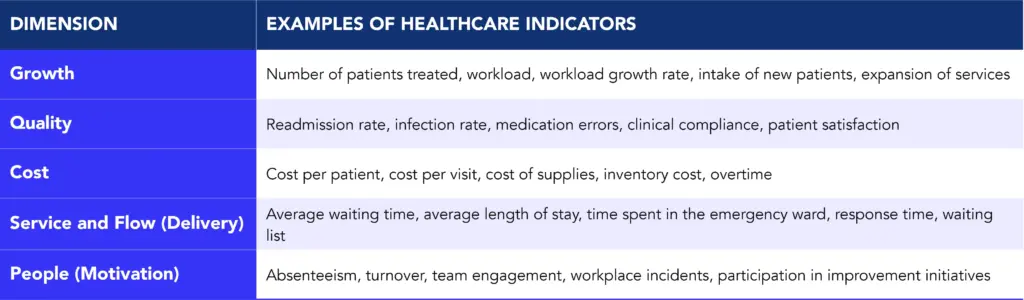
Table 2 – Examples of health indicators by performance dimension
Balancing measures are essential to ensure that improving one indicator does not degrade another. For example, reducing average wait time should be accompanied by monitoring hospital readmission rates, safety events, and patient experience. Similarly, increasing productivity should not come at the cost of permanently overloading teams.
ROI should be calculated with caution. Freed-up capacity does not automatically translate into accounting savings: the benefit may take the form of more activity with the same resources, fewer overtime hours, less need for additional investment, reduced stock, or an actual reduction in costs.
Examples of outcomes from KAIZEN™ projects in healthcare
Kaizen Institute’s experience shows that working on processes can generate simultaneous gains in flow, capacity, and experience, from emergency department wait times to average length of stay. The examples of quality improvement projects and performance improvement shown below reflect actual results achieved in sector projects and should be interpreted in their own context, not as guaranteed figures for other organizations.
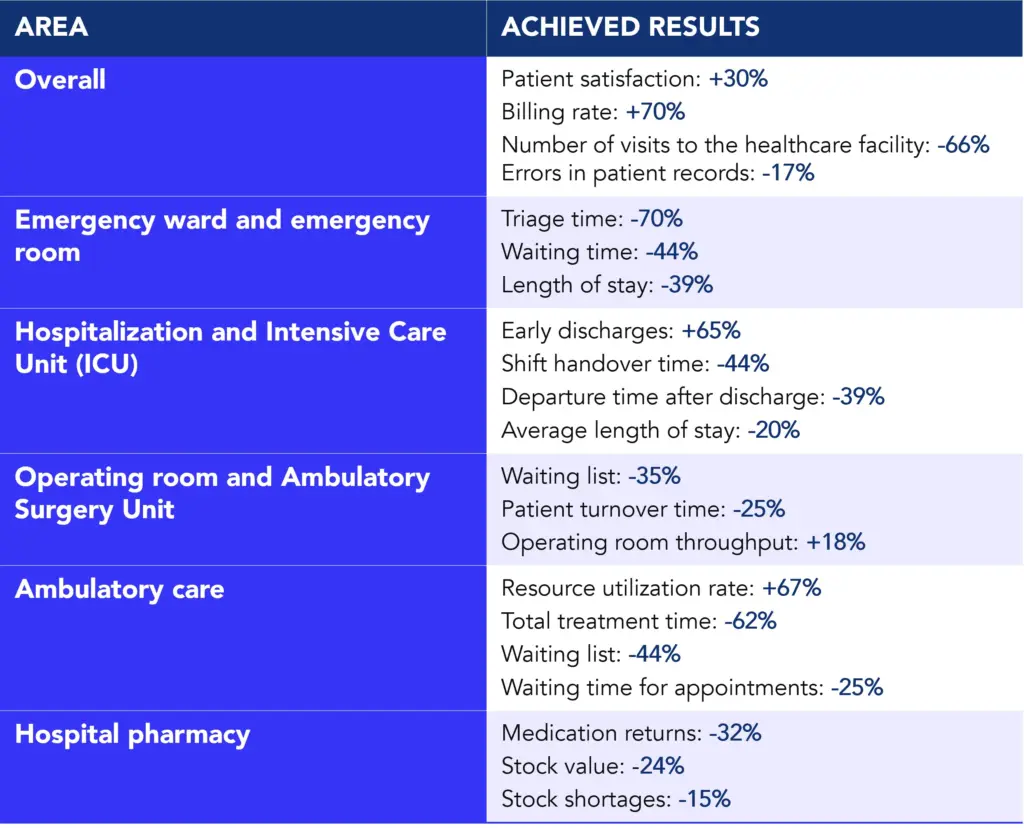
Table 3 – Examples of outcomes from KAIZEN™ projects in the healthcare sector
The role of technology in improving healthcare performance
Digitalization in healthcare, artificial intelligence, automation, and analytics offer growing potential, but technology must solve real problems. Digitizing an inefficient process can simply accelerate waste and make it harder to fix.
The recommended sequence is to understand the flow, simplify and stabilize the process, and only then select the right technology. Automating repetitive administrative tasks can free up staff time; integrating systems can reduce waits for information; implementing analytics can improve planning and forecasting; and artificial intelligence can support certain decisions. In all cases, technology, process, and people must be designed together.
Improving healthcare performance: From project to operational excellence
The greatest potential arises when an organization develops an integrated system: clear priorities, processes designed around patient value, engaged teams, relevant indicators, and management routines that sustain gains.
It is with this perspective that Kaizen Institute supports healthcare organizations in transforming their operations through our healthcare sector consulting services, combining flow improvement, resource efficiency, standardization, planning, analytics, technology, and daily management. The goal is to turn improvement opportunities into measurable results and build internal capability to keep improving after each project.
Are you ready to lead the change toward improving healthcare?
Still have some questions about improving healthcare performance?
What is QAPI CMS, and how is it related to performance improvement?
QAPI — Quality Assurance and Performance Improvement — is the approach defined by the Centers for Medicare & Medicaid Services (CMS) to integrate quality assurance and continuous performance improvement. It combines the tracking of standards and outcomes with a systematic, data-driven approach to identifying problems, addressing their causes, and improving processes and outcomes. In practice, it is aligned with a continuous improvement vision in which quality, safety, operational performance, and team engagement are managed in an integrated way.
What is the IHI Improvement Model, and how does it use the PDSA cycle?
The IHI Model for Improvement (Institute for Healthcare Improvement) structures improvement around three questions: what we want to achieve, how we will know that a change represents an improvement, and what changes can lead to better results. The first should translate into a goal statement that is clear and measurable.
The PDSA cycle in healthcare — Plan, Do, Study, Act — is used to test these changes on a small scale, measure results, learn from the experience, and adjust before wider implementation.
How should the return on an improvement project be measured?
The return should relate the benefit generated to the investment required, distinguishing between actual savings, freed-up capacity, increased activity, reduced stock, and avoided costs. Whenever possible, the calculation should be validated with the finance and operations areas.
See more on Healthcare
Find out more about transformation in this sector