
Article
Complete guide to VSM (Value Stream Mapping) in Lean Manufacturing


Value Stream Mapping (VSM) is a strategic tool used to map and analyze the flow of materials and information throughout the entire value stream, aiming to improve it. In this context, where competitiveness in the industrial sector requires well-structured, waste-free processes, VSM plays a crucial role in ensuring profitable operations and maintaining strong customer service levels. This tool allows you to identify waste and design a vision for process improvement, which is no simple task.
In this article, we analyze Value Stream Mapping, its key benefits, and the correct approach to its implementation, offering a comprehensive framework to ensure a successful application.
What is Value Stream Mapping?
Value Stream Mapping (VSM), also known as Value Stream Analysis (VSA), is one of the most powerful tools in Lean Manufacturing. Used to visualize and analyze the flow of materials and information throughout the value chain, it helps organizations identify waste and implement improvements, driving operational excellence.
Although the terms VSM and VSA are often used interchangeably, some make a distinction by using ‘VSM’ to describe the current-state map and ‘VSD’ (Value Stream Design) to represent the future-state vision. In this article, we’ll use VSM in its broadest sense.
Definition of VSM and its importance in Lean Manufacturing
Value Stream Mapping (VSM) is a visual method for representing every step of a process, from customer order to product delivery. Unlike a traditional flowchart, VSM focuses not only on value-added activities but also on inventory, transportation, and other waste sources that create inefficiencies.
Popularized by the book Learning to See: Value-Stream Mapping to Create Value and Eliminate Muda (Lean Enterprise Institute, 1999), VSM is an essential tool for optimizing operations and ensuring that every activity contributes to customer value.
VSM allows organizations to map both the current state and the future state of their processes, enabling the implementation of improvements aligned with the principles of Kaizen and Lean. Its main elements include:
- Value stream mapping: Analysis of the current state of the process.
- Value stream design: Creation of the future-state map.
- Implementation roadmap: Definition of improvement initiatives to transform the value chain.
What is the purpose of VSM in companies?
Value Stream Mapping is widely used to redesign process flows based on Lean and Kaizen principles. Its primary purpose is to enable organizations to identify waste and inefficiencies, facilitating the implementation of improvements that impact key business indicators, such as reducing lead time, increasing efficiency, and optimizing costs.
One of VSM’s greatest strengths lies in its collaborative approach. It brings together key stakeholders from across departments to jointly analyze the value chain and define a shared vision for future improvement.
While originally developed for discrete manufacturing, VSM is now applied across various industries, including healthcare, retail, logistics, and engineering, helping to streamline both material and information flows and improve operational efficiency.
Key benefits of Value Stream Mapping
Implementing Value Stream Mapping helps reduce waste across the entire value chain, generating significant benefits and directly impacting core performance indicators.
The main benefits of applying VSM include:
- Increased productivity: Eliminating waste such as unnecessary movement, waiting times, and rework allows employees to focus on value-added tasks, boosting overall productivity.
- Increased overall efficiency: By analyzing equipment losses and implementing improvement actions, organizations can increase equipment availability and utilization, ensuring more stable and efficient production.
- Reduced inventory levels: Continuous flow, shorter setup times, more stable processes, and efficient planning significantly lower inventory levels, freeing up capital and reducing storage costs.
- Reduced lead times and increased flexibility: Eliminating unnecessary activities, reducing changeover times, and improving process synchronization shorten response times and enhance the ability to adapt to demand fluctuations.
- Improved quality: By analyzing defect rates, rework, and root causes, companies can implement practical improvements, enhancing quality while reducing the cost of failures and corrections.
- Improved customer satisfaction: Reduced delivery times, improved quality, and more predictable processes lead to a better customer experience, increasing trust and loyalty.
- Cost reduction: Eliminating waste and optimizing processes leads to a significant decrease in operational costs, improving profitability and competitiveness.
- Team engagement and cultural shift: Involving employees in process analysis and improvement fosters a culture of accountability and continuous improvement, strengthening commitment to organizational goals.
With all these benefits, Value Stream Mapping becomes an indispensable tool for companies seeking to reduce waste, enhance efficiency, and boost customer satisfaction.
Facing efficiency challenges? Unlock results with VSM and expert support
How to create a VSM step by step
Value Stream Mapping (VSM) is a crucial Lean tool for visualizing and optimizing the value stream, enabling organizations to identify waste and opportunities for improvement. The process follows four key stages: mapping the current state, analyzing improvement opportunities, designing the future-state vision, and creating an implementation roadmap. By following this approach, companies can reduce costs, boost efficiency, and improve productivity.
Step 1 – Mapping the current value stream
Value Stream Mapping (VSM) begins with representing the current state of the value stream. To ensure the effectiveness of the process, it is essential to involve the company’s key decision-makers in the project team.
The team receives introductory training on the VSM methodology, including how to complete data collection sheets and the standardized symbols used in mapping. Then, they go to the Gemba to record all the operations that make up the process, as well as waiting materials, quality controls, overall checks, and material movements. This information is documented on a process analysis sheet.
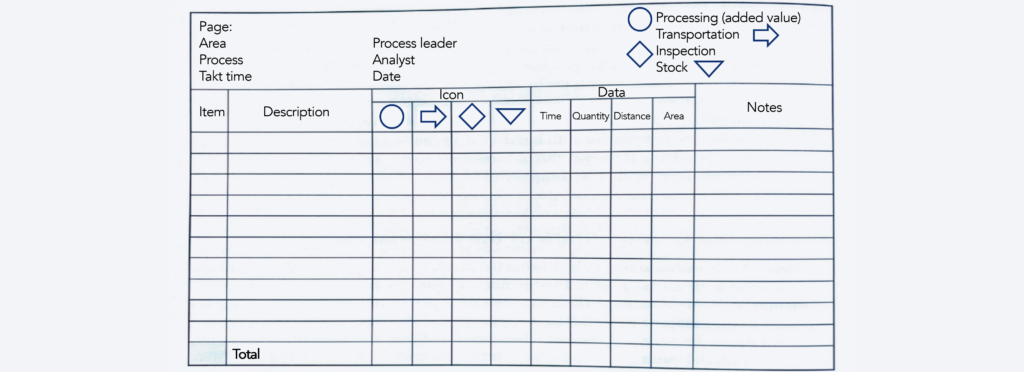
Figure 1 – VSM form
The exercise begins by following the flow of the process, starting at the end and moving upstream. Once data collection is complete, the team meets to draw the current-state map on a large sheet of paper placed on the wall, using standardized symbols on sticky notes.
After mapping the material flow, key performance indicators are added in data boxes beneath each operation, ensuring that essential information is recorded. Data to be included includes customer demand, the quantity of materials on hand, the level of customer service, machine and labor efficiency, machine changeover times, and setup times.
The mapping continues with the representation of the information flow, which should clearly demonstrate the capacity planning process and the order execution process. This part of the mapping can be more challenging, as the information flow is not physically visible in the Gemba.
In addition, complementary analyses such as Muda hunting exercises, Yamazumi diagrams, and spaghetti diagrams are conducted to increase the team’s awareness of organizational waste.
The data registered on the map is used to calculate both the total waiting time and the value-added time. This mapping is crucial to providing a clear and objective view of the value stream, serving as the basis for the next step of the VSM.
Step 2 – Waste analysis and solutions
With the current-state map completed, the team gains a clear understanding of the value stream and can identify major issues within the process. This analysis identifies areas where waste, bottlenecks, and inefficiencies occur, all of which impact productivity and operational efficiency.
The next step is identifying improvement opportunities, which should be noted directly on the map. However, for the team to spot meaningful opportunities and actively contribute to designing the future-state vision, they must have a strong grasp of Lean and Kaizen methodologies.
For this reason, the VSM team undergoes targeted training on Lean and Kaizen methodologies, ensuring that all participants are equipped to assess waste in a structured and informed manner. After this training, participants are able to determine how far (or close) the current state is from a pull system.
With this consolidated foundation, brainstorming begins to explore new opportunities for improvement, promoting a collaborative environment that gathers ideas to redesign the value stream in a more efficient manner and align it with the company’s strategic goals.
Step 3 – Designing the future-state map
Once the current-state value stream is fully understood, the next step is designing the future-state map. The goal is to create a continuous flow by eliminating waste and optimizing operations. The emphasis should be on reducing waiting times, increasing productivity, and improving quality and customer service.
To achieve this goal, the team explores several options, including reorganizing the layout, structuring the line and the Border of Line (BOL), balancing operations, and reducing changeover times. It’s also essential to evaluate improvements in production planning and implement continuous flow and pull systems, making the process more agile and efficient.
The results of these analyses are documented in the future-state map, accompanied by a revised layout and supporting sketches. To validate the proposed solutions, they are tested directly in the Gemba using prototypes, mockups, SMED evaluations, pull-flow simulations, and other methodologies.
During this phase, the team quantifies the expected operational gains from implementing the future state. New performance benchmarks are established, and operational structures and layouts are adjusted to ensure the transformation is both practical and sustainable.
At the end of this phase, the team consolidates all ideas and concepts, achieving a shared understanding of how the future-state vision will be implemented. This alignment ensures a well-structured execution plan that supports the company’s strategic objectives.
Step 4 – Creating a roadmap for implementing the vision
To bring the future-state vision to life, a clearly defined implementation roadmap is essential. The first step involves planning a series of Kaizen Events or workshops where the proposed solutions will be carried out. These events must have well-defined start and end dates to maintain momentum and ensure timely implementation. Each workshop is led by a designated leader who collaborates with a cross-functional team to ensure alignment across all impacted areas of the organization.
In addition to scheduling the workshops, it’s critical to build a solid business case for the project by performing a cost-benefit analysis. This analysis outlines both the required investments—such as equipment, layout changes, and other operational needs—and the expected gains, which may include improved productivity, reduced inventory, higher quality, and increased customer satisfaction.
The ultimate goal is to make the initiative self-financing within a year, maximizing return on investment while ensuring a positive and sustainable impact on operational performance.
Optimize processes with VSM and reduce waste
Tools and software for Value Stream Mapping
Ideally, a Value Stream Map (VSM) should be created manually on a wall using sticky notes, encouraging more dynamic and interactive collaboration among team members. However, the use of specialized software facilitates the transition to digital format, making the process more agile and accessible for future analysis and review.
Top platforms for creating a VSM
There are several digital platforms that allow you to efficiently create and analyze a VSM, offering symbol libraries, integration with other tools, and data analysis capabilities. Some of the most widely used include:
- Microsoft Visio – Commonly used for process diagrams and flowcharts, Visio includes templates specifically designed for VSM.
- Lucidchart –A cloud-based, user-friendly platform that offers customizable VSM templates and real-time collaboration.
- Minitab Workspace –Combines statistical tools and data analysis capabilities for in-depth process mapping and optimization.
- EdrawMax –A versatile software for VSM design, with an easy-to-use interface and integration with other business applications.
- iGrafx –Focused on process modeling and analysis, enabling simulations and value stream optimization.
Each of these tools has specific advantages, and the choice should consider the organization’s needs, the complexity of the processes, and the ease of integration with other systems.
How AI and data analytics are transforming value stream management
Artificial intelligence (AI) and data analytics are revolutionizing the management of value streams by providing greater visibility, automation, and predictive capabilities across every stage of the value chain. Key ways these technologies are reshaping this area include:
- Real-time monitoring and visibility of the value chain: AI and IoT enable real-time data collection, interactive dashboards, and the use of Digital Twins for simulations.
- Production flow optimization with machine learning: Algorithms detect patterns, identify bottlenecks, and dynamically adjust inventory levels and cycle times.
- Automated decision-making: Processes automatically adjust based on demand.
- Demand forecasting and inventory management: Predictive AI anticipates demand fluctuations and optimizes stock levels in collaboration with suppliers.
- Quality and predictive maintenance: Sensors and computer vision detect anomalies early and prevent breakdowns before they occur.
By combining traditional VSM with AI and advanced analytics, companies can achieve much greater precision and efficiency, making their processes more agile, resilient, and better equipped to meet the demands of today’s competitive markets.
Example of VSM in a real company
Applying Value Stream Mapping in real-world scenarios enables companies to visualize and optimize their processes by identifying waste and uncovering improvement opportunities in a structured way. Below is an example of a real VSM applied to industrial production. Effective implementation of VSM requires a solid understanding of Lean and Kaizen principles or expert support to ensure a well-defined vision and a roadmap for successful implementation.
Case study in industrial production
This case focuses on a company that had been using Lean and Kaizen tools for several years but had never made the shift from a push system to a true pull system, believing their existing model was already efficient enough. However, only 50% of their production schedule was being met, directly affecting both operational efficiency and customer service levels. This led them to launch a pull flow project, focusing on process mapping, waste elimination, and system redesign.
The project included:
- Current-state analysis using Value Stream Mapping.
- Future-state vision design.
- Development of an implementation roadmap.
The team selected one of the company’s main product families and mapped its entire value stream, analyzing how work was performed and identifying waste (Muda) and improvement opportunities.
The main issues identified included excess inventory, planning based on unreliable forecasts, and low adherence to the assembly schedule. Additional inefficiencies were identified on the production line, including isolated operators, inadequate supply, and a lack of standardization. In addition, poor synchronization led to frequent stoppages and daily adjustments, overburdening managers and leaving little time for Kaizen initiatives.
The team received training in Lean Manufacturing principles and methodologies and redesigned the system to enable a true pull flow. The results were eye-opening, revealing just how significantly the situation could be improved.
The team reviewed the future-state map and defined the events necessary for its implementation. These events focused on three core areas:
- Production flow: Redesigning the system into U-shaped, one-piece flow lines, reducing product variety, and improving cycle-time balance. Kanban and Junjo were introduced to streamline material supply and standardize work, while changeover times were shortened using SMED.
- Internal logistics: Setting up supermarkets and Mizusumashi (logistics trains), synchronizing deliveries with Kanban and Junjo, and shifting to pull-based production planning.
- External logistics: Creating logistics cells near production lines, implementing Milk Runs for daily deliveries, optimizing inbound and outbound logistics, and extending pull planning to suppliers.
These changes significantly improved efficiency, reduced waste, and enabled a more agile and synchronized flow.
The Value Stream Mapping lasted 9 days, followed by a 10-month implementation phase.
The project delivered significant results:
- Inventory reduction: from 50 days to 30.
- Internal defect rate: from 12,000 to 5,750 ppm.
- Increased customer service level: from 93% to 98.5%.
- Improved assembly planning accuracy: from 50% to 92%.
- Increased productivity: from 70 to 94.5 parts per operator.
- Increased assembly line efficiency: from 75% to101%.
This initiative gave the company a renewed perspective, proving that there are always opportunities for improvement, regardless of the maturity level of the Lean system.
How to correctly interpret a Value Stream Map
The interpretation of the Value Stream Map (VSM) should be based not only on the analysis of material and information flow, but also on process indicators and the pursuit of Muda, ensuring a comprehensive view of the operation. The focus is to identify where waste exists, determine its causes, and determine the most effective ways to eliminate or reduce it.
To ensure the analysis is truly effective, it is essential that the team, or at least some of its members, possesses deep knowledge of Kaizen and Lean Manufacturing tools and principles. If this expertise is not available internally, engaging specialized consultants can be a strategic move to guide the team through the VSM process and ensure successful implementation of improvements.
Do you still have some questions about Value Stream Mapping?
How to read a VSM?
Value Stream Mapping (VSM) is a visual tool used to map the flow of materials and information throughout a value stream, with the goal of identifying opportunities for improvement. To correctly interpret a VSM, it’s essential to understand the standardized symbols used in process mapping and to be familiar with the performance indicators associated with each stage.
This type of analysis enables organizations to pinpoint waste, bottlenecks, and inefficiencies, thereby visualizing their current state and defining targeted improvements. However, designing a future-state map and building an effective transformation roadmap requires a deep understanding of Kaizen and Lean methodologies.
What is the disadvantage of applying VSM?
Value Stream Mapping (VSM) is most effective when applied to value streams that involve a physical flow of materials. In environments where information flow dominates, such as administrative services or project management, other Kaizen tools may be more suitable. For example, Process Mapping can offer better visibility into the interactions between functions and process steps in these contexts.
While not a disadvantage in itself, a critical success factor in applying VSM—especially when developing the future-state vision and implementation roadmap—is the presence of Lean and Kaizen expertise on the team. This knowledge is essential to ensure that proposed improvements are feasible, sustainable, and aligned with the principles of continuous improvement.
Who created the VSM?
The concept of Value Stream Mapping (VSM) originated within the Toyota Production System (TPS). While Toyota had been using value stream-based flow mapping for decades, VSM gained widespread recognition in the West with the publication of the book Learning to See (1999) by Mike Rother and John Shook, released by the Lean Enterprise Institute.
See more on Discrete Manufacturing
Find out more about transformation in this sector
See more on Operations
Find out more about improving this business area