
Article
Customer Acquisition Cost: formula, benchmarks, and how to reduce CAC profitably


In today’s business environment, where competition for customer attention is fiercer than ever, understanding the true cost of acquiring each new customer is not just a financial exercise — it is a strategic imperative. Customer Acquisition Cost (CAC) is one of the most revealing metrics that an organization can track. Yet many companies still measure it incorrectly, inconsistently, or not at all.
This article explains what CAC is, how to accurately calculate it, what drives it across industries and how organizations can reduce it systematically without compromising growth. Crucially, it establishes CAC as a core component of robust sales and marketing strategies, enabling companies to base their commercial strategy on data rather than intuition.
What is Customer Acquisition Cost?
The CAC meaning is the total amount a business spends, on average, on acquiring a single new paying customer. It encompasses all costs associated with converting a prospect into a customer, including marketing campaigns, sales team activities, technology, and overhead.
CAC is a foundational metric because it reflects the efficiency and scalability of a company’s commercial engine. When CAC is high relative to the value a customer generates, growth can become economically unsustainable over time. As a result, strong top-line growth may hide underlying inefficiencies in customer profitability.
How to calculate Customer Acquisition Cost?
The customer acquisition cost formula is straightforward in principle:
CAC = Total Sales & Marketing Costs ÷ Number of New Customers Aquired
For example, if a company spends $500,000 on sales and marketing in a quarter and acquires 250 new customers in the same period, the CAC is $2,000.
One important limitation of this calculation is timing. CAC typically compares costs incurred in a given period with customers acquired in that same period. In businesses with long or complex sales cycles, particularly in B2B, this can distort results, as acquisition costs may precede customer conversion by several months.
More advanced approaches align costs and acquisitions using cohort analysis or by adjusting for average sales cycle length. These approaches rely heavily on structured marketing data analysis, ensuring that CAC reflects actual performance rather than simplified assumptions.
Improve your CAC and turn it into a growth lever
What to include in sales and marketing costs and types of CAC
A common source of measurement error is an incomplete or inconsistent definition of what constitutes sales and marketing costs. Without a standardized approach, CAC becomes unreliable and difficult to compare over time or across channels.
A robust CAC calculation should include:
- Salaries and commissions for the entire sales and marketing team.
- Advertising and paid media spend (ad spend across all channels).
- Content production, design, and creative costs.
- Marketing technology.
- Event and trade show costs.
- Agency and contractor fees.
- Overhead allocated to sales and marketing functions.
Organizations that exclude internal salary costs or technology overhead will consistently underestimate their true cost per customer acquisition and make investment decisions based on distorted data.
In practice, CAC can be calculated at different levels of granularity depending on the decision context. The most common variations include:
- Fully Loaded CAC: Includes all sales and marketing costs (salaries, overhead, and technology) and provides the most accurate view of true acquisition cost. This is the appropriate metric for financial planning and unit economics.
- Blended CAC: Represents the average cost of acquiring customers across all channels, combining both paid and organic sources. While it provides a useful high-level view of overall acquisition efficiency, it may exclude certain indirect or fully allocated costs and therefore should be interpreted as a directional performance metric rather than a fully comprehensive measure.
- Paid CAC: Isolates the cost of paid acquisition channels only (e.g., media spend and performance marketing). This is primarily used for channel-level optimization and campaign decision-making.
Understanding these distinctions is critical. Blended CAC provides a high-level performance view, paid CAC supports tactical optimization, and fully loaded CAC ensures that strategic and financial decisions are grounded in economic reality.
CAC vs. CPA: Understanding the difference
A common source of confusion is the distinction between CAC and CPA (Cost Per Acquisition). While the terms are sometimes used interchangeably in digital marketing, they refer to different metrics.
CAC measures the total cost of acquiring a new paying customer, incorporating all sales and marketing investments across the organization. CPA, by contrast, measures the cost of driving a specific conversion event within a campaign, which may or may not correspond to an actual customer.
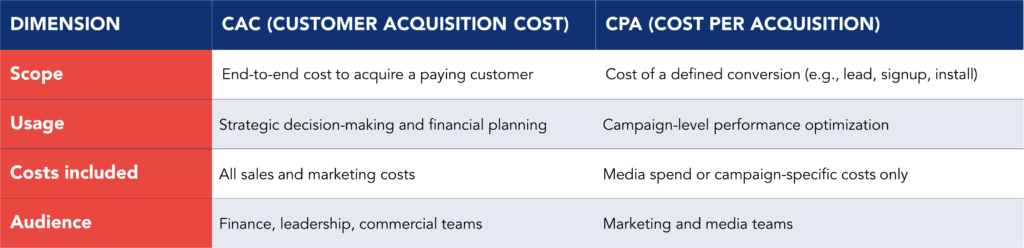
Table 1 – CAC reflects overall acquisition efficiency, while CPA focuses on campaign-level conversion costs.
In practice, CPA is used to optimize individual campaigns and channels, helping teams understand which activities are generating conversions efficiently. CAC, on the other hand, provides a holistic view of acquisition efficiency and is the metric that ultimately determines whether growth is economically viable. While CPA informs tactical decisions, CAC underpins strategic ones, including budgeting, forecasting, and long-term investment allocation.
The LTV/CAC ratio: An important commercial health indicator
No analysis of customer acquisition cost is complete without reference to Customer Lifetime Value (LTV). The LTV/CAC ratio is one of the most important indicators of whether a company’s commercial model is economically sustainable. LTV represents the total contribution margin (or gross profit, depending on definition) a customer is expected to generate over the course of their relationship with the company. By comparing LTV to CAC, businesses can assess whether they are investing efficiently in acquiring customers who will ultimately create value.
LTV/CAC Ratio = Customer Lifetime Value ÷ Customer Acquisition Cost
A 3:1 LTV to CAC ratio is often cited as a general benchmark for sustainable growth, particularly in SaaS. In practical terms, this implies that for every dollar invested in acquiring a customer, the business generates three dollars in lifetime value. In this context, the commonly cited 3:1 ratio should be interpreted as a minimum threshold for sustainable unit economics, while higher ratios may indicate either strong efficiency or an opportunity to invest more aggressively in growth.
However, this benchmark should not be treated as universally optimal. The appropriate ratio varies significantly depending on factors such as industry dynamics, business model, capital strategy, and stage of growth.
A ratio below 1:1 indicates that the business is not recovering its acquisition costs, meaning each new customer generates negative unit economics. Conversely, a ratio significantly above 5:1 may indicate that the company is underinvesting in growth, potentially sacrificing market share and long-term revenue expansion in favor of short-term efficiency.
CAC payback period: How long until you break even?
Alongside the LTV/CAC ratio, the CAC payback period is a critical operational metric. It answers a fundamental question: how long does it take for a customer to generate enough gross profit to recover the cost of acquiring them?
CAC Payback Period = CAC ÷ (Average Monthly Revenue per Customer × Gross Margin%)
In practical terms, the payback period measures how quickly acquisition investments are converted into cash. This makes it particularly important for managing liquidity, especially in high-growth environments where upfront acquisition costs are significant.
For high-growth SaaS companies, a payback period of 12 to 18 months is generally considered acceptable. In more capital-intensive or relationship-driven industries, longer payback periods may be expected. However, a core principle holds across business models: the payback period should be shorter than the expected customer lifetime.
Importantly, while the LTV/CAC ratio captures total value creation, the payback period reflects the timing of that value realization. A business may have a strong LTV/CAC ratio but still face cash flow constraints if payback is too slow.
From an operational perspective, reducing the CAC payback period is one of the most powerful levers available to commercial leadership. Shorter payback improves cash flow, lowers financial risk, and accelerates the reinvestment cycle, enabling faster, more sustainable growth.
Average Customer Acquisition Cost by industry
Understanding what constitutes a healthy CAC requires industry context. Average customer acquisition cost varies widely, reflecting differences in sales cycle complexity, deal size, competition, and channel mix. To improve accuracy, it is essential to distinguish between customer segments, particularly in B2B environments, where CAC can vary significantly between SMB (Small and Medium Business), mid-market, and enterprise customers.
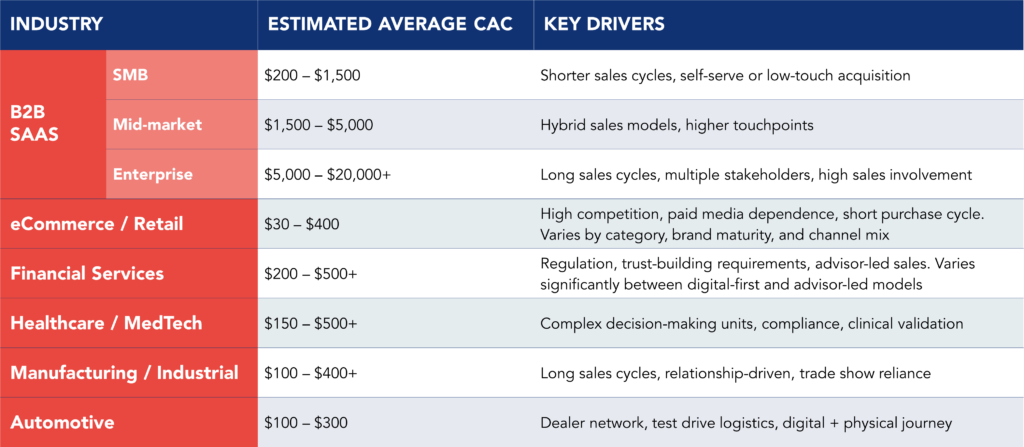
Table 2 – Estimates based on aggregated industry benchmarks and market observations. Figures should be interpreted as directional ranges due to variations in business models, customer segments, and cost attribution methods.
These figures should be treated as directional benchmarks rather than absolute standards. The most meaningful benchmark for any organization is its own historical trend and channel-level data, tracked consistently over time.
Why CAC rises: Operational drivers of acquisition inefficiency
Understanding how to calculate customer acquisition cost is only the starting point. The more operationally important question is: why does CAC increase and what can be done about it?
Rising CAC is rarely caused by a single factor. It typically reflects a combination of market dynamics and internal operational failures:
External pressures
- Increased competition for digital media inventory drives up paid media costs.
- Market saturation reduces the effectiveness of existing channels.
- Economic conditions affect conversion rates across the customer acquisition funnel.
Internal operational inefficiencies
- Poor alignment between marketing and sales teams leads to wasted handoffs and lost leads.
- Inconsistent measurement — different teams using different definitions of CAC — masks the true picture.
- Over-reliance on a single acquisition channel creates fragility and increases dependence on platforms with strong pricing power.
- Weak qualification processes allow low-probability leads to consume disproportionate sales time.
- Insufficient use of data to identify which segments, channels, and messages generate the most cost-efficient and highest-value customers.
The Kaizen approach to CAC improvement begins with making these inefficiencies visible and measurable before moving to solutions.
Improve your customer acquisition performance and lower your CAC
How to reduce Customer Acquisition Cost: A structured operational approach
Reducing CAC profitably requires a systematic methodology — not a series of isolated tactical adjustments. At its core, this is fundamentally a commercial excellence challenge: aligning processes, data, and decision-making across the entire commercial organization. The following operational improvement levers have proven effective across industries and business models.
1. Standardize how CAC is measured across the organization
The first step is to ensure that CAC is calculated consistently. This means agreeing on a precise definition of sales and marketing costs, establishing the time window for measurement (monthly, quarterly, or annually), and attributing new customer acquisitions accurately. Without standardized inputs, any subsequent analysis is compromised.
2. Decompose CAC by channel, segment, and campaign
Aggregate CAC hides the most actionable insights. Channel-level CAC analysis reveals which acquisition channels are efficient and which are consuming budget without delivering proportionate results. Cost per customer acquisition will vary dramatically between, for example, organic search, paid social, field events, and outbound prospecting. Organizations that understand these differences can reallocate investment rationally rather than relying on intuition. This is a fundamental capability within any effective marketing strategy, where budget allocation is continuously optimized based on performance data.
3. Improve lead qualification and funnel efficiency
A significant proportion of CAC in many organizations is driven not by the cost of generating leads, but by the cost of working leads that will never convert. Improving the quality of the customer acquisition funnel — through tighter Ideal Customer Profile (ICP) definition, better qualification frameworks, and clearer handoff criteria between marketing and sales — directly reduces the cost per closed customer. This is closely linked to sales team optimization, ensuring that sales resources are focused on the highest-probability opportunities.
4. Build compounding organic channels
Paid acquisition channels can be highly effective in the short term, but their efficiency often declines over time as competition increases and costs rise. In contrast, organizations that invest in organic channels — such as content marketing, SEO, referral programs, and community building — create acquisition capacity that tends to compound when consistently maintained.
While organic channels also require ongoing investment, they typically generate increasing returns over time as brand visibility, content assets, and network effects accumulate. Over a multi-year horizon, a well-executed organic strategy can significantly reduce blended CAC.
5. Invest in retention and expansion to improve LTV/CAC
While not strictly a CAC reduction lever, improving customer retention and expansion revenue has the same economic effect as reducing CAC — it improves the unit economics of the commercial model. Organizations that invest in post-sale customer success often find that their most effective CAC improvement comes not from spending less to acquire customers, but from extracting more value from those already acquired.
6. Improve operational efficiency in commercial processes
The principles of lean and kaizen, applied to commercial operations, offer significant opportunities to reduce CAC. This includes eliminating non-value-added activities in the sales process, reducing time-to-first-contact with new leads, improving sales call effectiveness and efficiency, and building standardized workflows that reduce variability in conversion rates. B2B sales organizations, in particular, often find that improving the discipline and structure of their sales processes reduces CAC significantly.
Connecting CAC to commercial strategy
CAC should not exist as a standalone operational metric. Its greatest value is realized when it is integrated into the broader commercial strategy, informing decisions about channel investment, pricing, segmentation, and growth targets.
Organizations with mature commercial operations build CAC into their planning cycles, setting targets by channel and segment, tracking performance on a regular cadence, and using CAC data to inform annual budget allocation. This transforms CAC from a retrospective measurement into a forward-looking management tool.
Sales and marketing alignment is a critical enabler of this maturity. When commercial teams operate in silos — with marketing optimizing for lead volume and sales optimizing for near-term conversion — CAC is systematically underoptimized. Integrated planning, shared accountability for cost per customer acquisition, and joint review of funnel metrics are the organizational conditions that allow CAC to be managed proactively.
Conclusion: Making CAC a strategic advantage
Customer Acquisition Cost is more than a financial metric — it is a window into the operational health and strategic coherence of a company’s commercial model. Organizations that measure it rigorously, analyze it at the right level of granularity, and act on its insights systematically gain a genuine competitive advantage.
The most successful companies do not simply aim to lower CAC in isolation. They build commercial systems in which acquisition costs are continuously visible, channel efficiency is continuously improving, and the relationship between CAC, LTV, and payback is managed as an integrated whole.
For leaders building scalable commercial engines, kaizen provides the foundation for sustained improvement. The challenge is not reducing CAC in isolation but reducing it while increasing customer lifetime value — and doing so consistently through disciplined measurement and cross-functional alignment.
Organizations that embed these principles consistently are better positioned to achieve sales excellence over time.
Do you still have some questions about CAC?
What is the difference between CAC and CPA?
CAC measures the total cost of acquiring a paying customer across all sales and marketing activities, while CPA focuses on the cost of a specific conversion event within a campaign, such as a lead or signup. In practice, CPA is used for channel optimization, whereas CAC determines whether growth is economically sustainable.
CAC vs. LTV: why does the relationship matter?
The relationship between CAC and LTV determines whether a company’s growth model is viable. If customer lifetime value significantly exceeds acquisition cost, the business generates positive unit economics. If not, growth becomes unsustainable regardless of revenue performance.
See more on Marketing & Sales
Find out more about improving this business area