
Article
The Consumer-Packaged Goods (CPG) supply chain: Stages, challenges, and how to optimize it


A CPG supply chain moves products from raw ingredients to retail shelves across dozens of handoffs, and every handoff is a place where dollars, days, or trust with a retail partner can disappear. So, in practical terms, what is a CPG supply chain? It is the network of sourcing, contract manufacturing, warehousing, transportation, and order fulfillment that gets CPG from supplier to shopper, coordinated tightly enough that the product sits on the shelf when the shopper wants it, not in a warehouse when they don’t. Most guides on this topic describe this network in terms of software: which platform to buy, which dashboard to build. However, that misses the point. Supply chain management performance is decided less by which system a company installs and more by whether its planning, flow, and problem-solving routines are held under pressure. This guide covers the stages, challenges, and operational levers that determine the performance of a CPG supply chain.
What is a CPG supply chain?
A CPG supply chain is the coordinated set of activities- sourcing raw materials, contract manufacturing, warehousing and storage, transportation and logistics, and order fulfillment- that converts CPG from ingredients into shelf-ready products delivered to retailers and consumers. Within the Consumer-Packaged industry, the chain spans multiple companies rather than one firm’s four walls. A single company can run an efficient plant and still miss shelf dates because coordination across those company boundaries determines whether the product reaches the shelf on time.
The stages of CPG supply chain management
Every Consumer-Packaged Goods supply chain runs through five stages, and each one carries a distinct set of failure modes that a generic supply chain framework does not fully capture.
Sourcing raw materials
Sets the ceiling on everything downstream. Ingredient and packaging specifications, supplier lead times, and single-source dependencies determine how much flexibility the rest of the chain must absorb a demand spike or a shipment delay. A CPG supply chain sourcing raw materials from a concentrated supplier base looks efficient on a cost report and fragile the first time that supplier has a problem. Procurement teams that chase unit cost without weighing that fragility often trade small savings for a large exposure.
Contract manufacturing
Converts input into product, often through co-packers rather than owned plants. This is where Overall Equipment Effectiveness (OEE), the discipline of measuring availability, performance, and quality losses on a production line, becomes the clearest signal of whether a plant can hit its commitments. The same production discipline behind continuous improvement in meat production applies equally to bottling lines, filling stations, and packaging cells, whether the operation is a large food processing company or a regional co-packer: line-level loss visibility is what separates a plant that hits OTIF (On Time, In Full) targets from one that doesn’t.
Warehousing and storage
This is where inventory turns from a planning number into a physical, costly reality. A facility built for pallet-in, pallet-out flow performs poorly the moment a brand adds e-commerce split-case picking. Second, consulting practice behind lean warehousing treats storage as a flow problem first and a real estate problem second, redesigning layout and replenishment routes around actual movement patterns rather than historical habit. Warehouse management built for one flow pattern rarely serves two well without a deliberate redesign.
Transportation and logistics
Connect plants, warehouses, and retail distribution centers, and it is usually where freight volatility, fuel cost swings, and carrier capacity constraints show up first. Route design, load consolidation, and fleet utilization determine cost per unit delivered far more than headline freight rates do, and the final leg of last-mile delivery to a store or a doorstep is usually the most expensive and least visible part of the entire route.
Order fulfillment
Is the stage the consumer experiences whether the right SKU, in the right quantity, arrives at the right store or doorstep on time. It is also the stage most exposed to channel complexity, since a Direct-to-Consumer order, a big-box replenishment order, and a marketplace order each carry different service expectations and different penalty structures for getting it wrong.
Ready to turn your CPG supply chain into a competitive advantage?
The biggest CPG supply chain challenges
Four challenges dominate CPG supply chain management in practice, and they compound rather than operate in isolation.
- Demand forecasting breaks down first when a brand sells across retail, Direct-to-Consumer, and marketplace channels simultaneously, because each channel has a different lead time, a different promotional cadence, and a different tolerance for being wrong. A single SKU-level forecast rarely serves all three well.
- Supply chain visibility gaps are structural, not just technical. A brand’s ERP records the purchase order and the invoice, but it rarely shows what a co-packer shipped yesterday or what sits in a distributor’s distribution center today. That blind spot is where deductions, chargebacks, and stockouts hide until month-end close forces them into view.
- Sustainable packaging has moved from a compliance checkbox to a commercial variable, since major retailers now tie vendor scorecards to environmental performance alongside OTIF metrics. A brand tracking global food trends 2026 will notice that consumer expectations on packaging and provenance are converging with retailer scorecard requirements, which means sustainable supply chain practices now affect shelf placement, not just brand reputation.
- Supply chain resilience is the hardest to build because it requires spare capacity, and spare capacity looks like waste on a cost report until the day it isn’t. Concentrated sourcing, lean inventory models tuned for cost rather than variability, and single-lane freight routes all reduce cost in a stable year and amplify disruption in an unstable one. The organizations that manage this well design that trade-off deliberately, before a disruption forces the issue. Waiting until a disruption exposes the gap turns a planning decision into a crisis response.
How to optimize a CPG supply chain
The CPG supply chain solutions that move the needle on cost and service start with planning discipline, not with a new platform. Sales and operations planning, known inside the organization as S&OP (Sales & Operations Planning), is the process of aligning commercial forecasts, production capacity, inventory targets, and financial projections into a single monthly consensus, and it is where most CPG organizations lose the most value, because it is run as a reporting exercise rather than a decision forum. When S&OP works, it resolves conflicts between sales ambition and production reality before they turn into a stockout or a markdown.
Inventory management benefits from the same logic applied at the flow level. Pull flow thinking, replacing forecast-push scheduling with signals that authorize production only when real downstream consumption creates demand, reduces the buffer stock a chain needs to carry without increasing service risk. Leveling production volumes and mix across a planning horizon, a practice known in lean manufacturing as heijunka, absorbs demand variation through small, planned buffers instead of large, reactive ones.
AI in supply chain management is a genuine enabler for demand sensing and exception management, but only after the underlying process is disciplined. Machine learning applied to a chaotic S&OP process accelerates the chaos; applied to a disciplined one, it shortens the time between a demand signal and a corrected plan. Supply chain analytics that ingest point-of-sale data, promotional calendars, and lead-time history are only as good as the process that acts on what they surface. The gap between companies that talk about AI and companies that use it well is almost always a data and process gap, not a model gap.
Reverse logistics, the handling of returns, recalls, and retailer deductions, deserves the same structured attention as forward flow. In regulated categories, particularly food and beverage, tracing products backward through the chain is now a compliance requirement, not an optional capability. A CPG business managing a food and beverage supply chain must be able to trace lot numbers to their origin as fast as it can ship a new order.
The table below summarizes these four levers, the specific problem each one fixes, and its typical impact on cost or service.
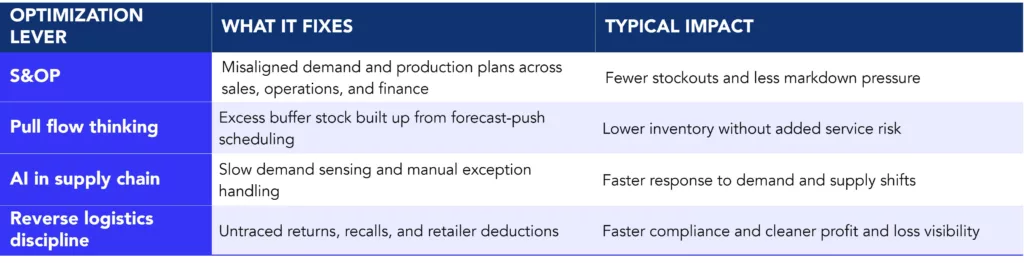
Table 1 – Summary table of CPG supply chain optimization levers
When problems recur (chronic stockouts on a specific SKU, chronic delays from a specific lane, chronic quality escapes from a specific supplier), the discipline that resolves them permanently is structured root cause analysis. Structured problem solving with RCPS (Root Cause Problem Solving) closes the loop that a one-time fix leaves open by providing a systematic way to identify the underlying cause, implement a countermeasure, and verify its effectiveness. For example, this approach was followed in addressing recurring operational issues at Kenvue, where RCPS provided a structured way to identify the underlying cause, implement a countermeasure, and verify its effectiveness, reinforcing the focus on continuous improvement at Kenvue’s plant operations. While RCPS helps resolve individual recurring problems, Value Stream Analysis provides the broader end-to-end perspective needed to determine where intervention will have the greatest impact. By mapping the current-state flow of materials and information end to end, it reveals which recurring problems sit at the highest-leverage points in the chain and therefore deserve attention first. This is the same structured lens behind supply chain transformation work across regulated industries and broader transformation in consumer goods: map the flow, quantify the loss, fix the highest-leverage point first.
CPG supply chain organization design
Optimization efforts stall when no one owns the decision rights between commercial, manufacturing, and logistics teams. A Governance Model, defining who decides what and on what cadence, is what turns a good S&OP process into a sustained one rather than a quarterly reset. KPI Trees, decomposing headline metrics like OTIF or total delivered cost into the operational drivers each function controls, give every team a metric they can act on rather than one they can only observe.
Consumer products manufacturing organizations that get this right also invest in Standardization, the discipline of documenting, auditing, and continuously updating work standards so that a process improvement survives staff turnover instead of eroding within a quarter. The same principle behind standardizing excellence across a retail network applies inside a manufacturing and logistics organization: a standard that is not audited will not hold.
Design a consistent operating system for your CPG network
A CPG supply chain earns its resilience and its cost position the same way: through disciplined flow, disciplined planning, and a structured way of finding and permanently fixing the problems that arise. This emphasis on building operational discipline, rather than simply introducing new tools, is central to the approach promoted by Kaizen Institute and is increasingly relevant to CPG supply chains navigating greater complexity. Software accelerates a disciplined chain. It cannot substitute for one. The organizations winning in 2026 are the ones treating operational discipline as the actual point of leverage. Buying a platform is easy; building that discipline is the harder work, and it is exactly that gap where CPG supply chain consulting earns its place.
Still have some questions about CPG supply chain?
What is the difference between a CPG supply chain and a general supply chain?
A CPG supply chain manages high-volume, low-margin products with short shelf lives, dense SKU counts, and heavy promotional activity, which creates forecasting and inventory pressure that slower-moving industrial supply chains do not face to the same degree.
What are the main stages of a CPG supply chain?
The core stages are sourcing raw materials, contract manufacturing, warehousing and storage, transportation and logistics, and order fulfillment, coordinated across multiple companies rather than inside a single firm.
How does AI improve CPG supply chain management?
AI strengthens demand sensing and exception management once the underlying planning process, particularly S&OP, is already disciplined. Applied to a chaotic process, it accelerates errors rather than correcting them.
See more on Consumer Products
Find out more about transformation in this sector
See more on Warehousing & Distribution
Find out more about improving this business area