
Article
Developing problem-solving capability with Lean Six Sigma


Many recurring operational problems in organizations are not due to a lack of technical competence, but rather to the absence of a common method to identify, analyze, and resolve them consistently. Process variability, rework, and short-term solutions often stem from fragmented, poorly structured problem-solving approaches.
In this context, problem solving should be viewed not as an isolated responsibility of specialists or dedicated teams but as an organizational capability. When a shared approach does not exist, problems are addressed reactively, with limited impact on sustained performance improvement.
Lean Six Sigma training equips teams to identify problems where they occur, understand their causes, and implement sustainable solutions. In this way, problem solving becomes part of daily work, supporting continuous improvement in operational performance, quality, and efficiency.
Problem solving as a critical organizational capability
The ability to solve problems effectively is one of the main factors that distinguishes organizations with consistent performance from those trapped in a continuous cycle of “firefighting.” To avoid this cycle, organizations need a structured approach. When problem solving is not treated as an organizational capability, the same deviations tend to reappear, limiting performance improvement over time.
Why operational problems persist in organizations
Operational problems often persist because they are addressed reactively and in isolation. The pressure to “resolve quickly” often leads to corrective actions focused on symptoms rather than adequate root cause analysis. The absence of reliable data, clear prioritization criteria, and common analysis methods contributes to decisions based on individual perceptions, with limited and unsustainable impact.
Additionally, when a structured approach is lacking, each area or team tends to solve problems differently, making organizational learning and standardizing best practices more difficult. As a result, similar problems are repeatedly analyzed, consuming time and resources without yielding consistent improvements in overall performance.
Solving problems individually vs. organizationally
Solving problems individually relies heavily on the experience and capability of specific employees. Although this approach may be effective in the short term, it is not scalable and does not ensure consistency, particularly in contexts of growth, employee turnover, or increasing operational complexity.
In contrast, when problem solving is viewed as an organizational capability, the organization has a common language, shared methods, and clear criteria for analysis and decision-making. This enables different teams to address similar problems consistently, accelerating collective learning and reducing dependence on individual tacit knowledge. In this model, problem-solving capability is no longer concentrated in key individuals but becomes embedded in the organization’s routines and way of working.
Lean Six Sigma is the difference between reacting and improving sustainably
Lean Six Sigma as an approach to structured problem solving
Lean and Six Sigma provide a common framework for systematically addressing problems, from defining them to controlling the improvements achieved. By integrating Lean principles with Six Sigma methods, this approach enables organizations to address operational problems of varying levels of complexity, ensuring rigorous analysis, a focus on root causes, and disciplined solution implementation.
A common language to identify, analyze, and solve problems
In Lean Six Sigma, structured problem solving is supported by the DMAIC cycle (Define, Measure, Analyze, Improve, Control), which establishes a logical and common sequence for addressing operational problems. This framework ensures that problems are properly defined, analyzed using data, and resolved with sustainable solutions, avoiding intuitive or unstructured approaches.
The Define phase clarifies the problem, its impact, and the objective to be achieved, ensuring alignment among the stakeholders involved. In the Measure phase, relevant metrics that characterize the process’s current performance are identified and collected, creating a factual basis for analysis. The Analyze phase focuses on identifying root causes, using analytical methods that enable understanding of the factors influencing variability and performance. In the Improve phase, solutions targeting the identified causes are developed and tested to ensure improvements deliver measurable results. Finally, the Control phase ensures the sustainability of the implemented solutions through monitoring and standardization mechanisms.
By using DMAIC as a common language, teams consistently address problems, regardless of area or function. This approach reduces ambiguity, facilitates communication among teams, and promotes fact- and data-based decision-making. In addition, it enables comparison of similar problems, reuse of lessons learned, and strengthening of the organization’s capability to solve problems systematically and continuously.
Structured methods for reducing waste and variability
In Lean Six Sigma, the methods and tools used in each DMAIC phase are not applied rigidly. On the contrary, methodologies are selected based on the nature of the problem, the level of process complexity, and the type of variability or waste to be eliminated. This methodological flexibility is one factor that enables Lean Six Sigma to be applied across different organizational contexts and problem types.
During the initial phases, priority is given to tools that enable understanding the process, clarifying the problem’s scope, and characterizing current performance. Depending on the context, more qualitative or quantitative approaches may be used, ranging from process mapping and flow analysis to defining indicators and structured data collection. The objective is to create a solid foundation to guide analysis objectively.
In the Analyze phase, the choice of methodologies depends on the type of causes under investigation. Problems related to waste, inefficient flows, or non-value-added activities benefit from Lean tools, whereas problems associated with high variability or process instability require more in-depth analytical and statistical methods.
The Improve and Control phases follow the same principle of alignment with the problem. Solutions are designed based on the identified causes and may involve process changes, standardized practices, layout improvements, the introduction of control mechanisms, or simple operational adjustments. In the Control phase, the methods adopted aim to ensure process stability and prevent problem recurrence through indicators, follow-up routines, and operational standards.
By enabling continuous improvement tools to be adapted to the specific problem, Lean Six Sigma ensures rigor in analysis without losing pragmatism in execution. As a result, Lean Six Sigma drives the reduction of waste and variability through targeted, sustainable interventions aligned with the organization’s operational reality.
Engaging the entire organization in problem solving
The effectiveness of structured problem solving depends on its integration into the organization’s daily operations. When methods such as Lean Six Sigma are applied only to isolated projects or specialized teams, the impact tends to be localized and difficult to sustain. Engaging the entire organization means making problem solving part of daily work, with clear responsibilities, shared methods, and alignment between operational and Lean leadership levels.
From isolated problem solving to daily continuous improvement
Isolated problem solving is characterized by reactive interventions, typically triggered by critical deviations or unsatisfactory results. Although necessary in certain contexts, these interventions do not ensure learning or prevent the recurrence of problems. For improvement to be continuous, problem solving must be integrated into the organization’s regular operations and conducted systematically, where problems occur.
Within this framework, most operational problems should be addressed within natural teams, that is, by the teams responsible for the process on a day-to-day basis. These teams are best positioned to identify deviations early, analyze causes, and implement incremental improvements that stabilize processes and progressively enhance performance.
For more complex problems, with cross-functional impact or involving multiple areas, forming multidisciplinary teams structured as projects becomes necessary. These teams combine different perspectives, technical competencies, and decision-making levels, ensuring more in-depth analysis and solutions aligned with the organization’s overall performance. Coordination between daily problem solving within natural teams and structured projects for broader issues is essential to sustain effective continuous improvement.
Continuous improvement training and Lean Six Sigma certification
Adopting Lean Six Sigma as an organizational approach to problem solving requires more than the occasional application of tools. It requires structured capability development that enables the organization to address problems of varying levels of complexity, ensuring methodological consistency and depth of analysis. Lean Six Sigma certification provides a clear framework for this development by defining progressive levels of capability aligned with the types of problems to be solved.
Belts in Lean Six Sigma
The Lean Six Sigma certification model structures capability development into different levels, referred to as belts, corresponding to increasing degrees of autonomy, analytical rigor, and organizational impact. Below is a brief description of the belts in Lean Six Sigma:
- White Belts: acquire a fundamental understanding of Lean Six Sigma principles and the logic of structured problem solving. This level ensures conceptual alignment, clarifies each employee’s role in continuous improvement, and creates a common foundation for informed participation in improvement initiatives.
- Yellow Belts: develop problem-solving skills, enabling them to identify deviations, participate in root cause analysis, and implement simple improvements within natural teams. This level promotes broad engagement of operational teams and reinforces consistent application of methods in daily work.
- Green Belts: take an active role in leading improvement projects, applying DMAIC to more complex problems, often with cross-functional impact. In addition to data analysis, they develop project management skills and the ability to coordinate multidisciplinary teams.
- Black Belts: focus on solving complex and systemic problems with high impact on organizational performance. This level requires advanced mastery of analytical methods, the ability to guide project teams, and to ensure alignment between improvement initiatives and strategic objectives.
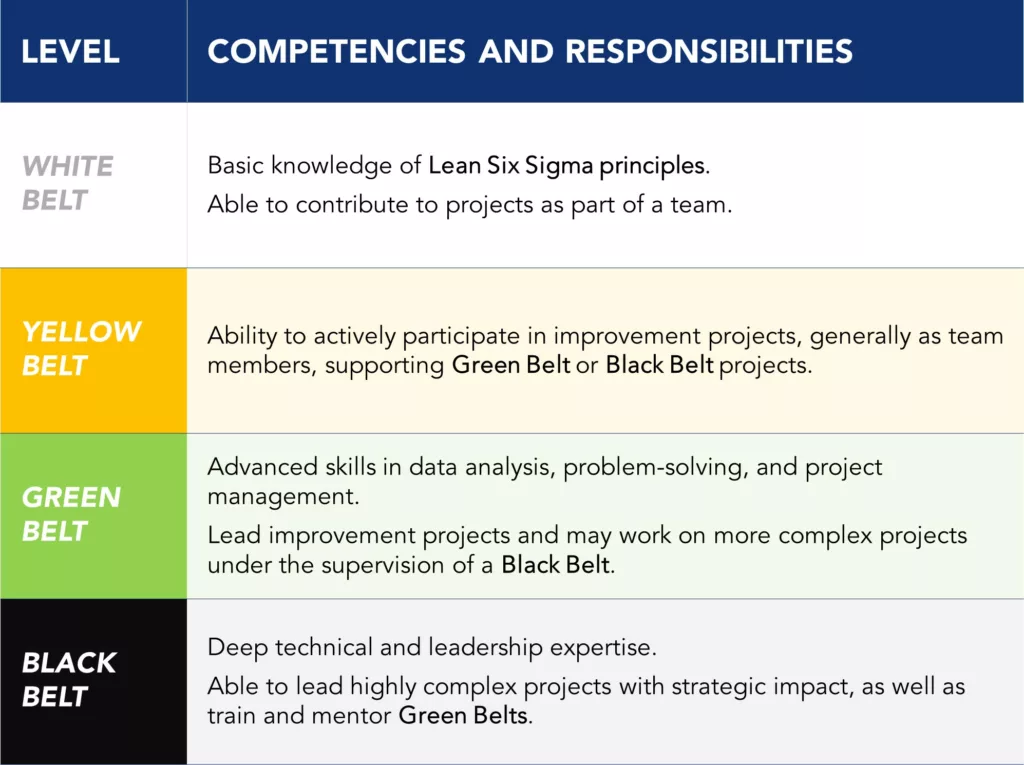
Table 1 – Summary of Lean Six Sigma Certification Levels
Impact of structured problem solving on the organization
When structured problem solving is applied consistently and across the organization, it gains an internal capability to analyze deviations, implement sustainable solutions, and stabilize operational performance.
Improving productivity and quality
The systematic application of structured problem-solving methods enables organizations to improve productivity and quality. By addressing the root causes of rework, inefficiencies, and process variability, it is possible to free up operational capacity, reduce errors, and increase result predictability. In this context, applying Lean and Six Sigma for cost reduction is central to eliminating waste and optimizing the use of available resources.
This approach enables more to be achieved with existing resources, ensuring that team efforts are directed toward value-added activities. Performance improvement thus results from more stable and effective processes.
Reducing dependence on specialists and external consultants
By developing internal structured problem-solving capabilities, the organization reduces its dependence on external specialists to address recurring challenges. Although external support may be relevant in specific contexts, the absence of internal capabilities limits the sustainability of improvement and increases costs in the medium and long term.
Establishing an internal capability base enables problems to be addressed autonomously, more quickly, and with a better understanding of the operational context. In addition, the knowledge generated during improvement projects remains within the organization, strengthening its ability to respond to future challenges.
Empowered, more engaged, and more stable teams
Engaging teams in structured problem solving directly contributes to increased commitment and organizational stability. When employees have clear methods to analyze and improve their own work, they develop a stronger sense of responsibility and contribution to the organization’s results.
Investing in the development of technical and analytical capabilities strengthens team engagement and creates conditions for talent retention. Empowered teams tend to handle complexity more effectively, collaborate more efficiently, and maintain higher performance levels over time, sustaining the organization’s continuous improvement.
It is not enough to solve problems; their recurrence must be eliminated
Lean Six Sigma as the foundation for a sustained improvement culture
When integrated into a continuous improvement culture, Lean Six Sigma is no longer seen as a set of isolated projects or initiatives; instead, it becomes part of how teams think, analyze, and act on problems. Structured problem solving is embedded in operational routines, management processes, and performance monitoring mechanisms, becoming a fundamental pillar of operational excellence. Consolidating this culture depends on the consistent application of practices, ongoing capability development, and leadership that aligns with improvement as an integral part of the work.
Do you still have any questions about Lean Six Sigma certification?
What are the key differences between the Lean Six Sigma belt levels?
The main differences between the Lean Six Sigma belts – White Belt, Yellow Belt, Green Belt, Black Belt, and Master Black Belt – lie in the level of knowledge, depth of skills, accountabilities, and roles they play within an organization’s continuous improvement.
What is the duration required to complete each Lean Six Sigma belt certification?
The duration required to complete each Lean Six Sigma belt certification varies according to the belt level, the certifying entity, the course format (in-person, online, intensive, etc.), and the participant’s involvement. Here is a general estimate:
- White Belt: About 8 hours.
- Yellow Belt: About 3 days spread over 1 to 3 weeks.
- Green Belt: About 5 days spread over 1 to 5 weeks.
- Black Belt: About 5 days spread over 1 to 5 weeks.
- Master Black Belt: About 3 days spread over 1 to 3 weeks.
It is important to note that, in addition to training hours, Green, Black, and Master Black Belt courses usually require completing a practical improvement project. This can significantly increase the total duration necessary to obtain the certification, depending on the project complexity and the candidate’s availability to dedicate time to it.
See more on Lean
Find out more about improving this business area