Article
What is CPG?


CPG stands for Consumer Packaged Goods. This term is used in both retail and manufacturing to describe products that consumers buy repeatedly, use up quickly, and need to restock on a short cycle. Toothpaste, breakfast cereal, laundry detergent, and shampoo are all examples of this category. It is important to understand the unique characteristics of the CPG category, as it operates differently from other sectors of the economy. Demand remains relatively stable during recessions, margins per unit are thin, and success is less dependent on a single, large sale. Instead, it is more sustainable to win the same purchase decision on a weekly basis. This article fully defines the meaning of CPG, differentiating it from Fast-Moving Consumer Goods (FMCG) and durable goods. It also explains how the industry’s core operational demands drive continuous improvement and operational excellence as key performance indicators.
What does CPG mean?
CPG are products that consumers buy frequently, consume or use up quickly, and repurchase on a predictable cycle. The category covers food, beverages, personal care items, household cleaning products, and over-the-counter health goods sold through retail and online channels. CPG meaning centers on purchase frequency and short shelf-life, not on price or brand prestige.
What does CPG stand for in practice? It stands for a specific commercial logic: purchase frequency, defined as how often a household buys and rebuys a given item, dominates every decision a CPG manufacturer makes, from packaging size to production scheduling to promotional calendar. Consumer-packaged goods meaning also carries an operational implication that generic definitions skip. Because purchase frequency is high and unit prices are low, the manufacturer’s margin depends on running enormous volume through a stable, low-variability process. A single percentage point of waste in a CPG plant multiplies across millions of units a year in a way it never would in a business that sells one expensive item a decade. What consumer packaged goods ultimately come down to is this: high-frequency, low-consideration purchases where operational consistency is as much the product as the item on the shelf.
Design a consistent operating system for your CPG network
CPG vs. FMCG: What is the difference?
CPG and FMCG are often used interchangeably, and in day-to-day conversation that substitution rarely causes confusion. A more precise reading treats FMCG as a subset of CPG. It points to the fastest-turning, lowest-cost items in the category, such as fresh dairy, bread, and basic toiletries, for which daily or near-daily replenishment is normal. CPG is the broader term, including FMCG plus cosmetics, over-the-counter medications, and household goods that turn over more slowly but still qualify as non-durable goods.
Fast-moving consumer goods sit at the fastest end of the CPG spectrum, while a premium skincare line sits at the slower end without leaving the category. The distinction matters for planning. FMCG requires daily forecasting and rapid replenishment cycles, whereas broader CPG planning must accommodate a wider range of turnover rates within the same production network and distribution footprint. In CPG vs FMCG comparisons, the two terms describe the same underlying commercial behavior at different points along a shared spectrum.
CPG vs. durable goods
Durable goods sit at the opposite end of the consumption spectrum from consumer-packaged goods. A washing machine, a car, or a laptop is designed to last years and gets replaced infrequently, while a bottle of shampoo is designed to be used up within weeks. This distinction between durable goods and nondurable goods drives fundamentally different business models. Nondurable goods, the formal term for CPG products, generate revenue through repeat purchase volume and shelf-life management rather than through occasional high-value transactions.
Shelf-life, the period during which a product remains safe and effective for consumer use, becomes a central planning constraint for CPG manufacturers in a way it never is for durable goods manufacturers. A delay in the supply chain can turn inventory into waste, not just a carrying cost. The table below summarizes the core distinctions.
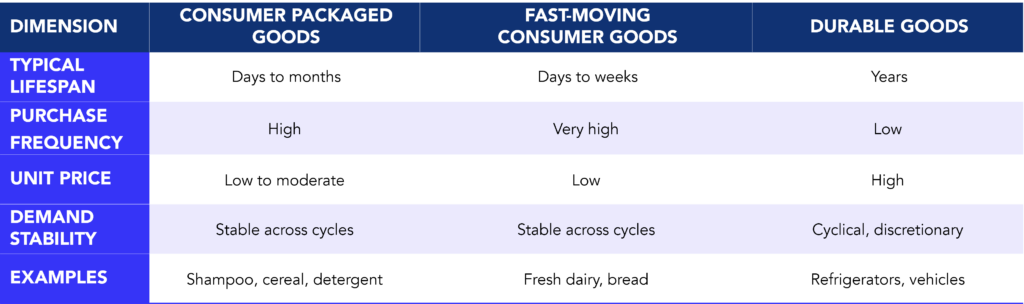
Table 1 – Comparison between CPG, FMCG, and Durable Goods
Types and examples of Consumer Packaged Goods
Types of consumer-packaged goods break down into a small number of categories that cover nearly everything on a supermarket shelf. Food and the food and beverage industry make up the largest share by volume: packaged snacks, frozen meals, canned goods, and beverages from bottled water to soft drinks. Personal care products form a second major category, including toothpaste, shampoo, skincare, and cosmetics, where brand loyalty, a consumer’s tendency to keep buying the same brand rather than switching on price alone, plays an outsized role because product performance is hard to evaluate before purchase. Household products, covering laundry detergent, dish soap, and surface cleaners, make up a third category defined by frequent, low consideration repurchase. A fourth category, over-the-counter health and hygiene items, sits closer to durable-goods purchase behavior in decision time but remains non-durable in consumption.
Examples of consumer-packaged goods illustrate how varied the category is in practice. A manufacturer running lines for both a fast-turning snack brand and a slower-turning premium skincare range faces two different demand patterns inside the same facility. That complexity shows up in consumer goods manufacturing and in food and beverage plants alike, and increasingly in agrifood company operations managing both fresh and shelf-stable product lines side by side.
What is a CPG company, and what makes the industry different?
A CPG company manufactures, markets, and distributes non-durable consumer goods at scale, competing on shelf presence, brand recognition, and the ability to keep the same product consistently available, priced, and stocked at the right volume across thousands of retail locations. CPG industry meaning extends beyond the products themselves to the distribution architecture built around them: multichannel retail, high SKU counts, and promotional cycles that shift demand unpredictably from one week to the next. Retailers reward consistency, and building retail network excellence across dozens or hundreds of stores requires a production line that runs the same specification correctly every time, whether the retailer is a national chain or a regional network.
Operational Excellence in the CPG industry
This is where most definitions of the category stop short. CPG demand is stable across economic cycles, but that stability creates a specific kind of pressure on operations that generic explanations leave unaddressed. High SKU counts force frequent changeovers on the same production lines. Thin per-unit margins mean waste that would be absorbed elsewhere in a business that shows up directly in the bottom line. Retailer service-level requirements mean a single stockout can cost a listing, with downstream effects that outlast the missed sale itself.
KAIZEN™ practice, the ongoing discipline of continuous improvement applied to daily operations, addresses these pressures directly rather than treating them as background noise. Equipment productivity in CPG plants is measured through Overall Equipment Effectiveness (OEE), which separates total loss into availability, performance, and quality components so improvement teams can target the specific loss category draining output, rather than chasing generic efficiency. Pull Planning replaces forecast-driven scheduling with demand signals that authorize production only when downstream consumption creates real need, which matters for a category where overproduction turns into expired shelf-life inventory rather than a storable asset. Heijunka levels the production schedule across a mixed-SKU portfolio, smoothing the changeover spikes that high-SKU-count CPG lines generate when they run to forecast rather than to a leveled sequence.
Supply chain resilience, the capacity to absorb demand shocks and supplier disruption without breaking service levels, has become a defining CPG supply chain challenge as networks have grown more global and more exposed to disruption. Days of supply, the inventory metric that tracks how many days of demand current stock can cover, is the metric that most directly translates operational discipline into shelf availability; getting it wrong in either direction results in stockouts or expired inventory. Logistics Loops design standardized, time-based internal delivery routes that keep production lines fed with the right materials in the right quantities, reducing the manual firefighting that erodes days-of-supply accuracy at the point of consumption. Digital transformation CPG initiatives, when built on top of these operational disciplines rather than substituting for them, extend visibility across the network; deployed without that operational grounding, the same technology surfaces the same waste faster without eliminating it.
In our work with consumer goods manufacturers, this pattern shows up consistently: the plants delivering the most reliable service levels are rarely the ones with the newest equipment. They are the ones that treat supply chain transformation as a continuous discipline rather than a one-time project. That same discipline, applied consistently, has produced measurable gains in operational excellence at Kenvue and drives similar transformation in consumer goods facing comparable SKU and changeover pressures.
Turn continuous discipline into measurable results at every plant
CPG meaning, at its core, describes products that consumers buy often, use quickly, and replace on a short, predictable cycle: food, beverages, personal care, and household items sold through mass retail. The category’s demand stability across economic cycles is real, but it obscures operational demands that are anything but simple: high SKU counts, thin per-unit margins, and shelf-life windows that turn delay into waste. Brands that treat these pressures as background noise compete on marketing alone and quietly lose ground, one changeover and one stockout at a time. Brands that build operational discipline, informed by manufacturing operations consulting and sustained through continuous improvement, convert the category’s structural stability into compounding advantage instead.
This is the discipline Kaizen Institute applies in consumer goods manufacturers, through our consumer products consulting focused on the sector’s specific volume, margin, and shelf-life pressures, and through our manufacturing operations consulting addressing the OEE, pull planning, and heijunka disciplines described above. KAIZEN™ Cycles is what keeps that work from becoming a one-time project: a structured rhythm of continuous improvement built into daily operations, so gains in equipment productivity and supply chain resilience compound rather than erode over time.
Do you want to know more about CPG?
What does CPG stand for?
CPG stands for consumer-packaged goods: products that consumers buy frequently, consume or use up quickly, and repurchase on a predictable cycle, such as food, beverages, personal care items, and household products.
What is the difference between CPG and FMCG?
FMCG, or fast-moving consumer goods, is generally treated as a subset of CPG that covers the fastest-turning, lowest-cost items, such as fresh dairy and bread. CPG is the broader term, also covering cosmetics, over-the-counter health products, and household goods that turn over more slowly.
What is an example of a CPG company?
A CPG company manufactures and distributes non-durable goods on a scale across retail channels. Well-known examples span food and beverage, personal care, and household product manufacturers that often run food and beverage and personal care lines within the same production network.
See more on Consumer Products
Find out more about transformation in this sector
See more on Manufacturing Operations
Find out more about improving this business area