
Article
Make it last — Governance, capability building and the 90-day rollout plan


This article is Part 6/6 of the series: The 90-Day Operational Excellence Blueprint. “Part 5/6: Build-In Quality — A3 Problem Solving and Quality Routines” introduced the structured methodology for eliminating the root causes of recurring defects. This final article pulls together all five preceding parts into a sequenced 90-day rollout plan and addresses the governance structures and capability-building disciplines that determine whether the improvement lasts.
The previous five articles in this series have covered the full technical methodology of operational excellence, including identifying the constraint, building the KPI tree, mapping the value stream, stabilizing operations through daily management, and eliminating root causes through A3 problem-solving. Each method is well-established and produces measurable results when applied correctly. However, what determines whether those results last is not the quality of the methods themselves, but rather the quality of the governance and capability infrastructure that surrounds them. Improvements delivered by external teams, temporary project structures, or concentrated bursts of effort tend not to survive the return to normal operations. The management system that produced the original problem reasserts itself, and performance drifts back towards its previous baseline.
In order to make improvements last, three things are required: a sequenced implementation plan that builds on each phase before introducing the next; a governance cadence that keeps the improvements visible and accountable over time; and a training program that transfers capability from the improvement team to the organization’s own employees. This article addresses all three.
From five methods to one integrated system
The five methods introduced in Parts 1 through 5 are not independent tools, but interdependent components of a single operational excellence roadmap. Each one depends on the others to function at full capacity, and removing any one weakens the system.
- The current state assessment from Part 1 provides the starting point: the constraint, the maturity profile, and the strengths-and-gaps map.
- The KPI tree from Part 2 translates that finding into a measurement architecture.
- The value stream map from Part 3 shows where performance is being lost within the flow.
- The daily management system from Part 4 ensures that deviations from target are detected, escalated, and resolved in real time.
- The A3 process from Part 5 eliminates the root causes of recurring deviations permanently.
Together, these five methods constitute an integrated process improvement system that operates across three time horizons: the diagnostic phase, the stabilization phase, and the embedding phase. The 90-day rollout plan sequences the work across these three horizons, ensuring that each phase creates the conditions for the next.
The 90-day rollout plan
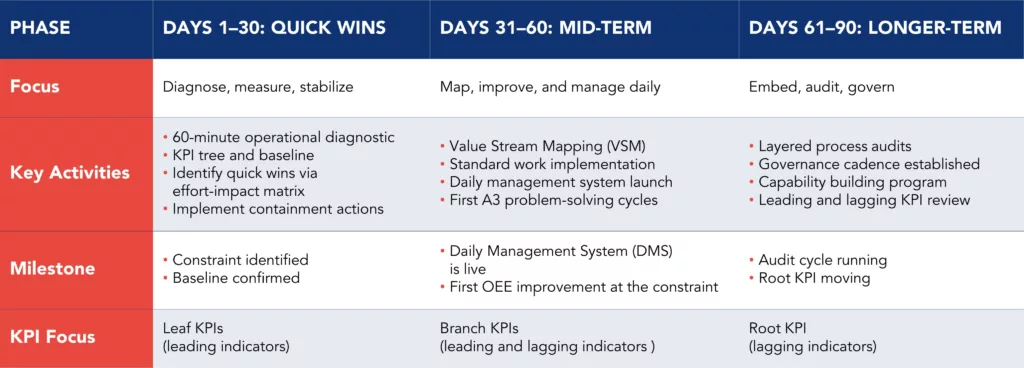
The 90-day structure reflects the minimum time required to move from the current state assessment to a self-sustaining improvement system. The three phases correspond to distinct objectives, and the sequencing matters: attempting to implement governance structures before the constraint is identified, or launching a daily management system before standard work exists, produces fragile results.
Days 1–30: Quick wins
The first thirty days are focused on diagnostic precision and stakeholder alignment. The 60-minute operational diagnostic from Part 1 is conducted, producing the maturity profile, the constraint identification, and the strengths-and-gaps map. The KPI tree is built, and the performance baseline is established within 48 hours of the diagnostic. The VSM of the current state assessment is drawn for the product family that runs through the constraint.
Quick wins are identified using an effort-impact matrix: improvements that require low effort and produce high impact are implemented immediately, without waiting for the full system to be in place. These early results serve two purposes: they demonstrate that improvement is possible within the existing constraints, and they build the leadership buy-in required to sustain the longer-term work.
Containment actions for the most critical deviations at the constraint are implemented during this phase. These are not permanent solutions, but temporary stabilizers that protect performance while the deeper work of standard work and root cause analysis is prepared.
Days 31–60: Mid-term improvements
The second thirty days are focused on improving flow and stabilizing operations. The future state VSM is finalized, defining the specific improvements that will close the gap between current and target performance at the constraint. Standard work is documented, owned by the frontline team, and implemented at the bottleneck and at the process steps that feed it.
The daily management system is launched during this phase. Boards are installed, the tiered meeting cadence begins, and the escalation process is activated. The first cycles of layered process audits are conducted to verify that standard work is being followed and that the board reflects operational reality.
The first A3 problem-solving cycles are initiated for the recurring deviations that the daily management system has surfaced, and that containment has not resolved. These early A3 serve both operational and developmental purposes: they address real problems and build the team’s capability in structured process-improvement thinking.
Days 61–90: Embedding and governance
The third phase focuses on embedding the system and establishing governance structures to sustain it beyond the 90-day window. Layered Process Audits (LPA) are running on a defined schedule, leader standard work is documented and followed, and the governance cadence is in place and functioning (program review meetings, KPI review rhythm, and escalation logic).
The operational excellence maturity model assessment is repeated at the end of Day 90. The maturity profile is compared against the baseline from day 1, the root KPI trend is reviewed, and the future goals for the next improvement cycle are defined. The 90-day plan does not end; it resets, with a new constraint as the focus and a higher maturity baseline as the starting point.
Start your 90-day transformation with a clear understanding of your current state
Leading indicators and lagging indicators: What to monitor and when
One of the most common governance failures in operational excellence programs is measuring only lagging indicators, i.e., output metrics such as revenue, cost, and customer satisfaction that reflect the result of work done weeks or months earlier. By the time a lagging indicator deteriorates, the underlying condition has been present for a significant time, and the opportunity to intervene early has passed.
Effective governance requires both leading indicators and lagging indicators, reviewed at different frequencies. Leading indicators are the leaf and branch KPIs from the KPI tree: cycle time, OEE, first-pass yield, schedule adherence, and number of open A3 actions. These are reviewed daily and weekly, at tier 1 and tier 2 of the daily management system, and they provide early warning of conditions that will affect the root KPI if left unaddressed.
Lagging indicators, the root KPI, and the financial metrics connected to it are reviewed at tier 3, typically weekly or monthly. They confirm whether the improvements made at the operational level are translating into the business outcomes the program was designed to deliver. If leading indicators are improving but lagging indicators are not moving, the causal logic of the KPI tree should be reviewed: either the tree is not correctly structured, or the improvement is occurring in an area that does not drive the root KPI.
The distinction between leading and lagging indicators is also critical for stakeholder alignment. Senior leaders tend to focus on lagging indicators (the financial results) and become impatient when they do not improve quickly. The leading indicators provide the evidence that the conditions for improvement are being created, and they give the governance conversation a basis for confidence before the lagging indicators have had time to move.
Governance: The cadence that sustains the system
Governance in an operational excellence program is not a committee structure or a reporting hierarchy. It is a defined cadence of reviews, decisions, and escalations that keeps improvement visible, accountable, and aligned with the organization’s strategic priorities.
The governance cadence operates at three levels, mirroring the tiered structure of the daily management system. At the operational level (tiers 1 and 2), the daily management board and tiered meeting cadence provide daily and weekly visibility into leading indicators and open actions. At the program level, a weekly or bi-weekly governance review meeting reviews the status of A3 actions, the progress of standard work implementation, and the trend in branch KPIs. At the strategic level, a monthly review connects the operational results to the root KPI and to the future goals defined in the rollout plan.
The monitoring and adjustment discipline is what distinguishes effective governance from ceremonial reporting. At each review, the question is not only “what are the results?” but “what needs to change?” If a leading indicator is deteriorating, the governance review identifies the cause and adjusts the resource allocation or the action plan accordingly. If an A3 is overdue, the review escalates it. If a phase milestone has been missed, the governance review resets the timeline and documents the reason.
Capability building: Making the organization self-sufficient
The most durable indicator of a successful operational excellence program is not the improvement achieved in the first 90 days. It is the organization’s ability to continue improving after the program concludes, without external support, a project team, and the sustained presence of a program sponsor.
That ability is a function of capability. Capability is not awareness (knowing that a KPI tree exists or that A3 is a problem-solving method); it is the ability to apply these tools independently under real operational pressure and achieve results. Building it requires a structured training approach that operates at three levels: conceptual understanding (what the tool is and why it is used), applied practice (using the tool on a real problem with coaching support), and independent application (using the tool without coaching, with validated results).
The training program should be sequenced to match the rollout plan. In days 1–30, the focus is on the diagnostic tools and the KPI tree. In days 31–60, the focus is on standard work, daily management, and the first A3 cycles. In days 61–90, the focus is on layered process audits, governance facilitation, and the ability to run the next improvement cycle independently. By the end of day 90, the organization should have internal practitioners (team leaders, supervisors, and at least one operational manager) who can lead the next 90-day cycle with full autonomy.
Change management and stakeholder alignment
Operational excellence programs fail for technical reasons less often than they fail for organizational ones. The method is sound; the change management is not. Leaders lose interest when results take longer than expected, middle managers resist changes to their established routines, and frontline teams comply during the program and revert afterward. These are predictable responses to change that has not been sufficiently anchored in the organization’s operating system.
Effective stakeholder alignment begins before the diagnostic and continues through every phase. At the outset, the program sponsor must communicate clearly why this work is a priority, what the organization is committing to, and what will be expected of each level. During the program, the governance cadence keeps the commitment visible. At the end of each phase, the milestone review communicates progress and reinforces the case for continuing.
The leadership buy-in required to sustain an operational excellence program is not just a single endorsement at the start, but a pattern of consistent behavior over time: leaders who attend the tier 3 review, who conduct their gemba walks, who close open actions and don’t accept their accumulation, and who treat the daily management board as a management tool rather than a compliance artifact. That behavior, modeled consistently at the top, is what determines whether the system survives the end of the formal program.
Risk management and resilience
No 90-day program unfolds without disruption: equipment failures, demand spikes, personnel changes, and supply chain volatility are normal features of operational life. An operational excellence program that cannot absorb these disruptions without losing its structural gains is not yet embedded.
Resilience in this context is the speed of recovery, not the absence of disruption. An organization with a functioning daily management system, standard work, and an active governance cadence recovers faster from disruption than one without these structures, because deviations are detected early, escalated promptly, and addressed before they compound. The risk management value of operational excellence is not only in the performance improvement it delivers under normal conditions, but in the operational stability it provides when conditions are not normal.
The governance cadence should explicitly include a monthly risk management review: which risks to the improvement gains are present, what mitigations are in place, and what early warning indicators will signal if a gain is at risk of reversal. This review is distinct from the operational KPI review; it looks forward rather than backward, and it is the governance mechanism that prevents the program from being silently undone by operational pressure.
Technology integration and the digital layer
The operational excellence system described in this series is not dependent on technology. The KPI tree, the VSM, the daily management board, and the A3 report can all be implemented with paper, whiteboards, and structured routines. The method works without digital tools.
What technology integration provides is speed, scale, and visibility. A digital daily management board updates in real time across multiple shifts and sites, a connected sensor network feeds OEE data to the governance review without manual data collection, and a digital A3 system tracks problem-solving cycles across the organization and surfaces patterns in root causes that would be invisible in paper-based records.
The sequencing principle is critical: technology should follow the operational system, not precede it. Organizations that invest in digital dashboards before they have a functioning KPI tree, or in connected sensors before they have standard work, tend to produce sophisticated displays of unmanaged data. The digital transformation layer is most valuable when it amplifies an existing management system, not when it substitutes for one that does not yet exist.
The operational excellence maturity model: Measuring progress over time
The operational excellence maturity model assessment introduced in Part 1 is not a one-time diagnostic, but a periodic measurement that tracks the organization’s progression through the stages of operational excellence: from Reactive (Level 1) through Defined, Managed, and Optimized, to Excellent (Level 5). Repeating the assessment at the end of each 90-day cycle provides three things: a quantified measure of progress that can be presented to the governance review and to senior leadership; an identification of the capability domains that have improved and those that remain as constraints; and a definition of the focus areas for the next improvement cycle. The maturity model is the mechanism that converts a single 90-day program into a sustained, continuous improvement trajectory.
Organizations at Level 1 or 2 at the outset of the program should not expect to reach Level 4 or 5 within 90 days. A realistic progression moves one level per cycle in the domains the program has focused on. The goal of the first 90 days is not to achieve operational excellence, but to lay the foundation for sustaining it independently.
Develop the capabilities to drive continuous improvement and operational excellence
Common errors to avoid
Launching all five methods simultaneously
The 90-day plan deliberately sequences the methods. Attempting to implement the KPI tree, the value stream map, the daily management system, and A3 problem solving in parallel overwhelms the organization’s capacity for change management and produces shallow implementation across all methods rather than deep implementation of each in sequence.
Treating the 90-day plan as the endpoint
The 90-day plan creates the foundation: it is the first cycle of a continuous improvement trajectory, not a project with a defined endpoint. Organizations that treat the completion of the 90-day plan as the conclusion of the improvement effort tend to see gains erode within six months as the governance cadence weakens and the daily management system is gradually deprioritized under operational pressure.
Measuring only lagging indicators during the program
If the governance review focuses exclusively on the root KPI (revenue, cost, or customer satisfaction) for the first 60 days, it will see little movement and may conclude that the program is not working. The leading indicators are the evidence that the program is working: OEE at the constraint is rising, first-pass yield is improving, and the number of open A3 actions is declining; these must be the primary focus of the governance review during the first two phases.
Failing to build internal capability
A program that produces results but leaves the organization dependent on external expertise to continue has not delivered sustainable improvement. The training investment is not a cost; it is the mechanism that converts a time-limited program into a permanent organizational capability. Without it, the improvement exists only as long as the external support continues.
Separating governance from operations
A governance structure that operates separately from the daily management system – in different meetings, with different participants, reviewing different data – adds coordination burden without adding accountability. The governance cadence should be directly connected to the tiered meeting structure: the program review should feed from and into the tier 3 review, so that the same data, the same people, and the same accountability logic govern both.
The complete blueprint
This series has traced a single, coherent path from the first 60 minutes of diagnostic work to a self-sustaining system of operational excellence. The constraint is identified, the performance baseline is established, the flow is mapped, and the bottleneck is quantified. The daily routines that keep the constraint under control are in place, the root causes of recurring defects are being eliminated, and the governance structures, the capability program, and the 90-day rollout plan ensure that the gains compound over time rather than eroding.
The methods are proven, and the sequence is logical. What determines the outcome is the consistency and discipline with which the sequence is followed, through the phases where progress is visible and through the phases where it is not yet. Operational excellence is not achieved in a single program; it is built, one 90-day cycle at a time, by organizations that have the governance discipline to sustain the work after the momentum of launch has passed.
Start from the beginning
If you have arrived at this article without reading the preceding parts, the full methodology begins with the operational diagnostic.
Part 1/6: Find the Constraint — The 60-Minute Operational Diagnostic identifies where performance is breaking down and locates the single constraint that limits the entire system. Everything else in the 90-day plan builds from that finding.
Part 1: Find the Constraint — The 60-Minute Operational Diagnostic
Part 2: Build the KPI Tree — Baseline Performance in 48 Hours
Part 3: Map Flow End-to-End — Value Stream Mapping and Bottleneck Capacity (OEE at the Constraint)
Part 4: Stop Firefighting — Standard Work and Daily Management That Sticks
Part 5: Build-In Quality — A3 Problem Solving and Quality Routines
Part 6: Make It Last — Governance, Capability Building and 90-Day Rollout Plan
“The 90-Day Operational Excellence Blueprint” is a six-part series providing a structured methodology for identifying, prioritizing, and resolving the operational constraints that limit performance. Each article builds on the previous one, from diagnostic to implementation.
See more on Manufacturing Operations
Find out more about improving this business area