Case Study
Driving operational excellence across the organization
Goals: improve efficiency, reliability, and capability by deploying the seven Operational Excellence Program (OEP) standards and Lean methodologies across the company


-66%
Unplanned breakdowns
+4.5M
Additional units per year
$250K
Savings from waste and overtime
Continuous improvement lies at the heart of this company’s commitment to innovation, quality, and care. In an industry where agility, reliability, and consumer trust are essential, the company has taken a bold step forward with the OEP (Operational Excellence Program), a comprehensive initiative designed to elevate its manufacturing standards to world-class levels.
By combining cultural empowerment with measurable impact, the organization has achieved breakthrough improvements in efficiency, quality, and collaboration. These accomplishments were recognized with a prestigious industry award for continuous improvement, positioning the site as a benchmark of operational excellence and a symbol of the organization’s long-standing commitment to making incremental progress day after day.
Building a world-class manufacturing culture
The organization is a global leader in the consumer goods sector, serving millions of people across multiple regions through trusted everyday products. With operations spanning the Americas, Europe, the Middle East, Africa, and Asia-Pacific, the company combines science-based innovation with a clear purpose: to enhance the quality of daily life through reliable, accessible, and high-impact solutions.
Within this network, one of the organization’s key manufacturing sites plays a critical role in producing high-volume consumer products for global markets. In line with the company’s commitment to innovation and excellence, the site launched an ambitious initiative to strengthen its manufacturing capabilities and reinforce a culture of continuous improvement. This marked the beginning of the Operational Excellence Program (OEP) — a new way of working designed to embed Lean principles, leadership development, and data-driven decision-making across all levels of the organization.
The initiative directly supports the organization’s vision of advancing executional excellence to accelerate growth in everyday care, translating that ambition into tangible systems, disciplined behaviors, and empowered teams.
Turning opportunities into catalysts for continuous improvement
The initial assessment at the site provided a clear understanding of where operational excellence could be strengthened and where Lean behaviors would create the most value. This diagnostic phase set the direction for the OEP deployment, identifying opportunities to:
1. Enhancing performance visibility and alignment
Daily operations showed strong team engagement but required a more consistent performance management rhythm. Standardizing meetings, KPIs, and escalation processes offered an opportunity to improve visibility, ensure ownership, and align all levels of the organization around shared goals.
2. Increasing efficiency and reliability
While the site demonstrated solid production capability, there was potential to further optimize line efficiency and equipment reliability. Streamlining changeovers, reducing minor stops, and reinforcing maintenance practices would unlock additional capacity and support world-class agility.
3. Standardizing ways of working
Across lines, teams were already applying good local practices, yet variation in procedures made it difficult to replicate success consistently. Establishing clear standards and visual management tools enabled harmonized execution, accelerated learning, and sustained performance over time.
4. Building capabilities and Lean leadership behaviors
The site’s greatest strength—its people—presented a unique opportunity for growth. By deepening lean capabilities and leadership coaching, teams could strengthen their problem-solving confidence, drive continuous improvement, and foster a shared ownership mindset throughout the organization.
5. Leveraging data for smarter decisions
The site had access to valuable operational data, yet analytics were not fully integrated into daily decision-making. Enhancing data visualization and performance tracking would enable faster insights, more proactive actions, and a stronger connection between metrics and behaviors.
These opportunities became the driving force behind the OEP deployment, transforming the facility into a model of operational discipline, collaboration, and sustainable improvement.
From methodology to mindset: embedding operational excellence
The Operational Excellence Program (OEP) at the site represented a structured, multi-level transformation, aligning leadership, teams, and systems around a shared vision of continuous improvement.
Through the deployment of seven core operational standards, the site applied lean and Kaizen methodologies to standardize work, strengthen capability, and embed a culture of ownership and accountability.
Use Kaizen to drive world-class pharmaceutical performance
Performance management – creating alignment and daily discipline
To establish consistency and visibility across all production areas, the site implemented a tiered Performance Management system based on lean daily management principles.
Through visual KPI boards, tier meetings, and a formal Mission Control Room, every level of the organization gained a clear line of sight into performance—from operators to site leadership.
A new Action Card system was introduced to capture deviations, assign ownership, and track resolutions within defined timeframes. These practices were reinforced through process confirmation routines, where leaders verified standards on the shop floor.
By integrating these elements, the site built a rhythm of daily accountability and real-time problem escalation, ensuring that every team contributed to shared objectives.
Changeover optimization – applying SMED for agility
Changeover reduction was a key priority for increasing line flexibility and capacity. The team applied the SMED (Single-Minute Exchange of Die) methodology to identify and eliminate inefficiencies within setup processes.
- Size & flavor changeovers: The target was reduced by 1 hour for size and flavor changeovers through the application of SMED. External tasks, such as cleaning and lab sampling, were moved to pre-changeover activities, while internal steps were re-sequenced to minimize operator and technician interference.
- Flavor changeover: Using the SMED five-step method, the target was reduced by 2.7hours, improving the process flow and reducing unnecessary delays.
- Country code changeover: The target was reduced by 30 minutes with similar process adjustments, ensuring consistent execution.
Maintenance excellence – embedding Total Productive Maintenance (TPM)
Improving equipment reliability and adherence to the Preventive Maintenance (PM) schedule were key focuses at the site. The team implemented Total Productive Maintenance (TPM) principles to address gaps in PM adherence, reduce downtime, and empower operators.
- Training & cleanup: Provided training on organization’s digital maintenance system for better PM and CM (Corrective Maintenance) tracking. Duplicate work orders were also eliminated across key production areas to streamline maintenance processes.
- KPI development: Created Power BI dashboards to track PM and CM adherence in real time, enabling faster interventions.
- Data-driven adjustments: Analyzed breakdown data for a key production area to adjust PM frequency and optimize maintenance schedules.
- AM foundations: Focused on the first three steps of Autonomous Maintenance (AM) to restore machine centers to base conditions, identify Sources of Contamination (SoC), and create CIL (Clean-Inspect-Lubricate) standards.
- Kamishibai boards: Implemented Kamishibai boards to provide a visual management tool for tracking TPM progress, ensuring accountability, and reinforcing adherence to maintenance standards.
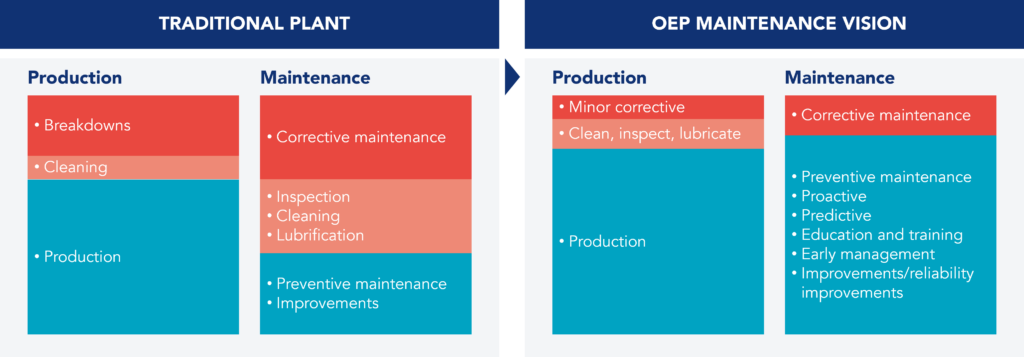
In the OEP Maintenance Vision, operators take ownership of basic maintenance by performing routine inspections and correcting abnormalities directly on the line. This approach empowers them to address issues at the source while allowing the maintenance team to focus on preventive, predictive, and reliability-improvement activities. The result is a more efficient, collaborative, and sustainable maintenance system.
Centerlining – stabilizing process parameters
To reduce variability and ensure consistent product quality, the site deployed a centerlining program to define and maintain optimal machine settings. The team conducted a comprehensive review and standardized centerline parameters to ensure alignment with performance targets and improve equipment consistency.
- Updated centerline values for all product formats, including bottle labeler and casepacker.
- Simplified the centerlining change logbooks and standardized the process for triggering changes to centerline parameters.
- Scaled the centerlining program across lines, expanding the scope of improvements.
- Monitored performance deficiencies and identified discrepancies with the standard values in collaboration with mechanical technicians and generalists.
Root Cause Problem Solving (RCPS) – developing structured thinking
At the site, Root Cause Problem Solving (RCPS) became a foundational approach for addressing both simple and complex operational issues, enabling the team to resolve challenges across different levels of impact. The RCPS methodology was divided into two distinct methods to address problems efficiently and effectively:
- SPS (Simple Problem Solving) – 3C Method for day-to-day operational issues.
- CPS (Complex Problem Solving) – A3 Method for more disruptive, systemic challenges.
SPS – 3C Method (Simple Problem Solving)
At the site, Simple Problem Solving (SPS) was introduced to address day-to-day operational issues quickly and effectively. Using the 3C Method (Concern–Cause–Countermeasure), Team Leaders were trained to identify small recurring problems, define clear triggers for action, and resolve them at the shop-floor level.
A new SPS template and trigger system were implemented and fully integrated into Team Leader Standard Work and performance management meetings, ensuring visibility and accountability. Through coaching across all shifts, Team Leaders strengthened their ability to perform structured problem-solving autonomously, creating a consistent rhythm of continuous improvement on the line.
CPS – A3 Method (Complex Problem Solving)
For more complex problems that involved larger performance losses or recurring failures, the CPS – A3 Method was implemented. This allowed the team to address the root causes of disruptive issues with greater analytical rigor.
For example, in the filler machine center, unplanned downtime was primarily due to bottle supply variability, resulting in performance losses. To tackle this, CPS workshops were conducted with the supplier and internal teams to improve integration and reduce downtime. The team applied A3 Problem Solving using Fishbone Diagrams to identify root causes and implement corrective actions.
Similarly, in the casepacker and bottle labeler machine centers, recurring minor stops due to contamination—such as glue excess or sticky conveyors—were tackled through CPS workshops focused on process simplification. The teams developed and deployed new Standard Operating Procedures (SOPs) and Cleaning Standards, effectively eliminating contamination sources and restoring process stability.
Standard work for optimizing operator and team leader routines
Across the facility, efforts centered on strengthening both Operator Standard Work and Team Leader Standard Work.
For Operator Standard Work, Kamishibais were installed across production lines to provide clear, visual instructions, ensuring consistency and quick onboarding for new employees. Team Leaders conducted periodic checks, resulting in improved adherence and performance across shifts.
For Team Leader Standard Work, tasks were prioritized, and daily process confirmation and Gemba Walks were introduced. Weekly coaching helped team leaders quickly align and improve their presence on the shopfloor, leading to faster issue resolution and more efficient operations.
Turn your Gemba Walks into real improvement opportunities
Knowledge retention and scalability – institutionalizing the OEP model
To ensure the longevity and scalability of improvements, the site created a comprehensive suite of OEP playbooks for each of the seven core standards. These playbooks combined step-by-step methodologies, performance metrics, and maturity assessment tools, serving both as training material and as a governance reference.
Complementary training modules — including Gemba Walks, 5S, and Standard Work — were deployed to strengthen operational discipline and workplace organization.
Through the pull-driven replication approach, site representatives also participated in deployments at other locations within the organization, accelerating cross-learning, preparing internal coaches to lead future rollouts, and fostering consistency and best-practice sharing across the network.
Breakthrough results that redefine excellence
Through the Operational Excellence Program (OEP), the site achieved breakthrough performance improvements, fostered a stronger culture, and built a solid foundation for sustainable, scalable growth:
- OEE improvement: On the pilot line, OEE rose by 15 to 20 percentage points (from a baseline of ~35 %) through speed gains and increased shift output (from 65k to 75k units per shift).
- Production volume uplift: The improvements yielded an additional 4.5 million units annually on that line.
- Machine reliability: Unplanned breakdowns were reduced by 66 %, elevating equipment availability and stability.
- Schedule attainment: Performance improved from 95% baseline to over 98%, reinforcing on-time delivery and operational discipline.
- Cost and waste savings: The site eliminated overtime and waste, achieving savings of over $250,000.
- Capability building: More than 135 employees were trained in the seven core standards, embedding skills in lean leadership, RCPS, coaching, and standard work.
- Standard performance across lines: All six Personal Care business unit lines saw sustained OEE gains ranging from +5 to +15 percentage points.
- Extended deployment: Lessons and tools from the site are now being scaled to other manufacturing facilities across the organization’s network.
Unlock productivity and OEE gains across pharma sites without compromising compliance
From one site to 27: scaling a culture of excellence
The pilot site was never the destination. It was the proof of concept — a deliberate choice to build, test, and validate a system before bringing it to the rest of the network.
With the model established, the OEP (Operational Excellence Program) was extended across the global manufacturing network of 27 sites, replicating the same seven core standards and coaching-led capability program that had transformed the reference site. Through the Pull Forward approach, representatives from the reference site participated directly in deployments at other locations, accelerating knowledge transfer and ensuring consistency across geographies.
Across the network, the results also point to a clear and consistent trajectory of improvement:
- OEE improvement: Across the 27-site network, overall equipment effectiveness rose by 11 to 19 percentage points, mirroring the gains achieved at the reference site and confirming the scalability of the OEP standards.
- Changeover efficiency: Changeover times were reduced by 40 to 60%, building the line flexibility and capacity that the SMED methodology had first demonstrated at the reference site.
- Equipment reliability: Unplanned downtime fell by 30 to 50% across sites, reflecting the sustained impact of TPM principles and autonomous maintenance practices embedded through the program.
- Quality and agility: QA release lead times were cut by 34 to 53%, enabling faster response to market demand without compromising product quality.
- Productivity: Output per site improved by 15 to 30%, driven by the combined effect of performance management, standard work, and capability building across teams.
- Nearly 1,000 people have been trained on the core OEP standards across the network. The first six-site wave delivered $17 million in savings within six months, with a total value unlock of $66 million — a result that reflects not just operational gains, but the power of a shared system applied with discipline and consistency.
Where people, purpose, and process come together
The Operational Excellence Program (OEP) journey at the reference site represents far more than a series of process improvements — it is a story of people, leadership, and cultural transformation. By aligning structured systems with empowered teams and disciplined leadership, the organization turned operational excellence into a shared way of thinking and working. What began as an initiative to close performance gaps has evolved into a living culture of accountability, learning, and continuous improvement.
Today, the site stands as a true beacon of operational excellence within the organization — a benchmark for collaboration, capability, and consistency. Its journey demonstrates what can be achieved when purpose and process move in harmony, when every employee contributes to shaping a better, more efficient, and more resilient organization.
“It’s been 20 months since we kicked off, and the tools and systems have been fully embedded into our ways of working.” – Site Leader
This achievement reinforces the impact of collective effort and demonstrates how meaningful progress emerges when teams commit to improving every day.
We are committed to respecting our clients’ confidentiality. While we have altered or omitted their names, the results are genuine.
See more on Pharmaceuticals
Find out more about transformation in this sector