

Culture of responsible impact
Corporate Sustainability Consulting
Sustainability that lives only in reports hasn’t started yet
Most organizations have sustainability goals, yet fewer have sustainability practices. ESG initiatives are announced, targets are published, and reporting cycles are managed, but the daily decisions about how work is done, how waste accumulates, and how resources are consumed remain largely untouched. The result is a credibility gap that stakeholders, regulators, and employees are increasingly able to spot.
Our corporate sustainability consulting connects ESG goals to the processes where impact is actually created or lost: starting with double materiality assessment and stakeholder input to identify what truly matters, then embedding priorities across environmental, social, and governance dimensions, preparing disclosure-ready reports aligned with CSRD and GRI, and building the internal capability so teams can sustain the work without depending on external support.
When that connection holds, transparency strengthens, waste drops, and environmental and social goals start moving in the same direction as business results. That’s a culture of responsible impact where sustainability isn’t a parallel agenda but part of how the organization creates value every day.
Traditional Approach
Lean Approach
Traditional Approach
Stand-alone ESG strategy

Lean Approach
ESG embedded into corporate strategy
Traditional Approach
Disorganized, unfocused, unsuited efforts
Lean Approach
Sustainability management based on data
Traditional Approach
No measure of ESG metrics
Lean Approach
Sustainability is a growth driver
Rather than developing a sustainability strategy, companies should embed sustainability into their overall business strategy.
Talk to an Expert
Get in touch with us and share your business needs to get a tailored consulting or training approach
Impact
Sales increase
Costs reduction
Talent acquisition and retention
Risk mitigation
Investment attraction
Innovation incentive
Our Solutions
We bring a full range of capabilities to help you integrate sustainability into corporate strategy by identifying critical ESG aspects and implementing breakthrough transformations to achieve sustainable goals
- Create a task force
- Introduction to sustainability
- Stakeholder mapping and listening sessions
- Dual materiality analysis
- Measure and compile sustainability KPIs
- Survey risks and opportunities
- Select sustainability improvement initiatives and conduct a cost-benefit analysis
- Sustainability roadmap design
- Sustainability governance model design
- Select report structure according to chosen standard/guideline (e.g., GRI, ESRS)
- Define and implement a data collection and consolidation plan
- Report content development based on prior analyses (materiality analysis, risk and opportunity identification, gap analysis, sustainability roadmap, indicators, etc.) and gathered data
- Optimize report design and layout
- Validate the final document by the organization
- Reporting to reference frameworks used (GRI, ESRS, etc.)
- Efficient resource management (energy, water, and materials)
- Mitigate emissions and manage climate adaptation
- Implement waste reduction strategies and circular economy
- Develop sustainable products
- Adopt diversity, equity, and inclusion practices
- Develop human capital
- Promote employee health and safety initiatives
- Responsible sourcing and supply chain resilience
- Develop management practices based on transparency, ethics, and anti-corruption
- Support in implementing other sustainability tools (taxonomy, certifications, due diligence, etc.)
- Introduction to sustainability and ESG (Environmental, Social, and Governance)
- Environmental dimension (E)
- Social dimension (S)
- Governance dimension (G)
- Integrate financial dimension
- Approach to implementing a sustainability strategy
- Exercises
- Case studies
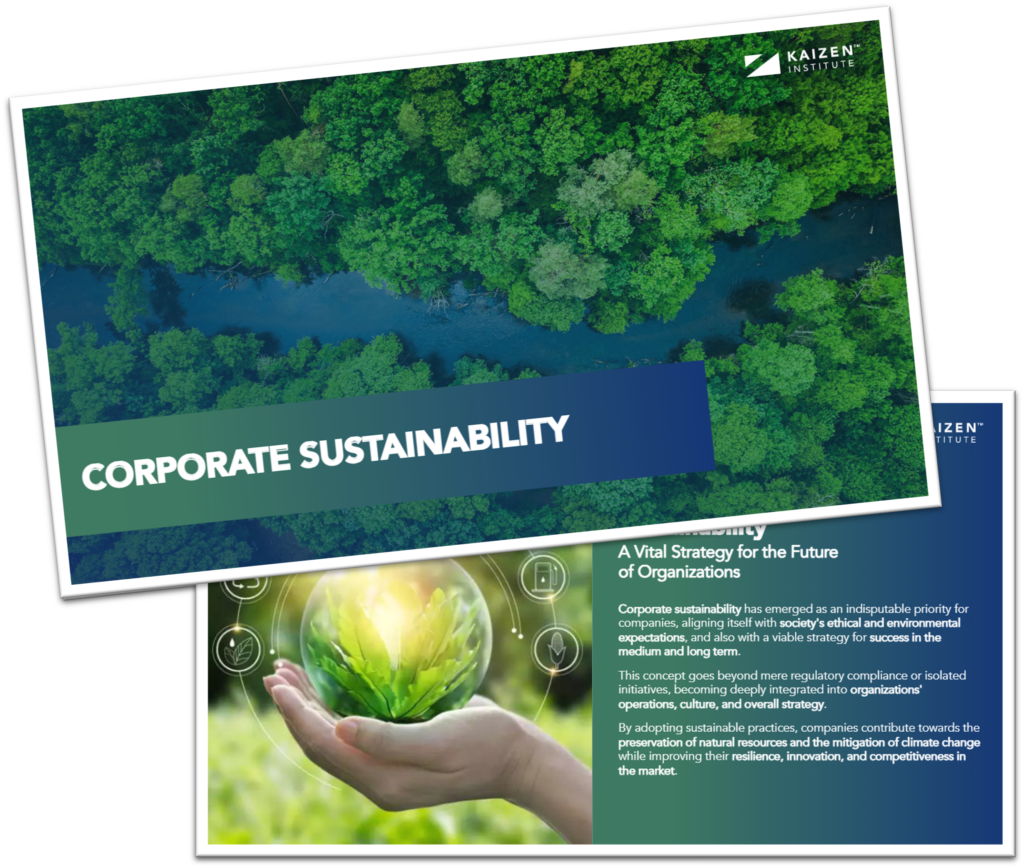
Guide to ESG Performance Excellence
Corporate sustainability has emerged as a strategic priority for businesses to meet society’s ethical and environmental expectations and as a key competitive advantage for long-term success. In this guide, we highlight the importance of implementing ESG practices and detail the three essential steps to achieving excellence in ESG performance:
- Designing the sustainability strategy
- Developing the sustainability report
- Implementing the sustainability strategy
Client results
Learn how to implement it in your organization


Insights


Want to get more insights?
Every industry faces different obstacles
Kaizen Institute works directly with the client teams, with a “Hands On” and “Learning by Doing” approach
Kaizen Institute works directly with the client teams, with a “Hands On” and “Learning by Doing” approach