
Article
Leadership training: skills and programs to develop real leaders


Organizations allocate significant financial resources to leadership training annually, yet the majority of leaders return to their positions unchanged. The certificates have been issued, the slide decks are stored on shared drives, the engagement scores look satisfactory, and six months later, the same problems persist. The team continues to avoid challenging discussions, the strategy remains ineffective in execution, and the new manager persists in assuming a role more aligned with operational tasks than with leadership.
It is essential to address this fundamental issue before delving into discussions of programs, methodologies, or learning content: a significant portion of leadership training does not lead to enhanced leadership skills. This is not due to any inaccuracy in the content, but rather because of an issue with the design. The skills taught in a classroom rarely result in observable changes in behavior at the workplace unless the system surrounding the learner is engineered to reinforce them.
This article will provide a comprehensive overview of leadership training, exploring the various types of training available, the essential skills required at each leadership level, and the most critical leadership competencies. Additionally, it will highlight the key distinctions between programs that genuinely develop leaders and those that merely adhere to a superficial checklist. The model is firmly rooted in practitioner expertise, drawing insights from successful and unsuccessful leadership development initiatives across various industries.
What is leadership training?
Leadership training is the structured development of the skills, behaviors, and judgment leaders need to direct work, develop people, and deliver results. It spans formal programs, coaching, assessment, and on-the-job practice. Effective leadership training is not a single event but an integrated system that combines learning, deliberate practice, and daily routines to build capability where leaders lead.
It is useful to distinguish leadership training from two adjacent terms. Leadership development is the broader discipline: the multi-year progression by which an organization builds leadership capability across the pipeline. Training is one component of development. The other components — assessment, coaching, stretch assignments, feedback systems, and succession processes — work in concert to reinforce what training begins. Training in isolation rarely produces durable change.
Management training focuses on the technical mechanics of running a function: planning, budgeting, performance management, and project execution. Leadership training adds the human and contextual dimensions: setting direction, building commitment, developing people, and navigating ambiguity. The best programs cover both, because real leaders need both. The artificial separation between management and leadership has confused more development programs than it has clarified.
Turn leadership development into a daily practice, not a classroom exercise
Why leadership training matters: the benefits of leadership training
Among the variables an organization can control, leadership quality has the greatest impact on performance. Two units within the same company, with the same processes and market conditions, routinely produce wildly different results because of the leader. The difference is not charisma; it is judgment, discipline, communication, and the ability to develop the next layer of leaders below.
The benefits of leadership training, when well-designed and reinforced, show up in concrete, measurable ways. Engagement and retention rise when people stay with a good manager; productivity rises because problems are surfaced and solved rather than buried; strategic execution improves because leaders translate intent into action; succession risk decreases because the bench fills; and culture stabilizes because behavior is modeled consistently from the top. The cost of poor leadership — disengagement, turnover, missed targets, regulatory and safety failures — is far higher than the cost of training, by an order of magnitude in most operations.
Why leadership training is important becomes especially clear during transitions: a new market, a major change initiative, a generational shift in the workforce, or an integration after acquisition. Organizations with strong leadership benches navigate these moments. Organizations without them stall. Leadership development, in this sense, is not a discretionary investment in human resources; it is core operational risk management. And it applies at every level, from the first-time manager to the chief executive.
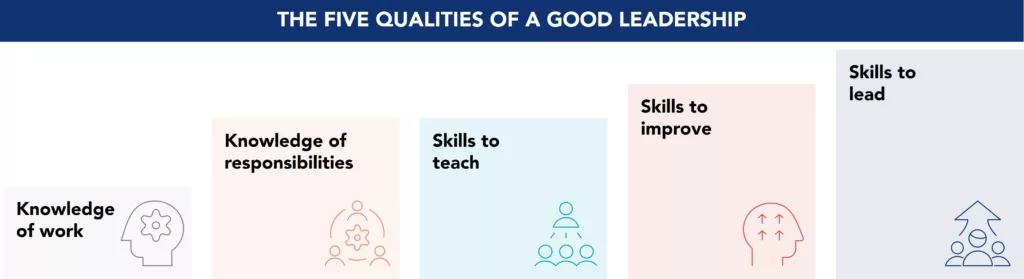
Figure 1 – Overview of the five essential qualities for good leadership
Types of leadership training: programs, modalities, and how they combine
There is no single “best” type. Effective leadership development programs combine several modalities, sequenced and reinforced. The mistake most organizations make is choosing one modality, typically classroom workshops, and treating it as the whole program.
1. Classroom workshops and leadership training courses
In-person workshops remain the backbone of most leadership training programs. They work for foundational frameworks, peer learning, and concentrated practice. They fail when they stand alone. The forgetting curve is real: without structured reinforcement within weeks, most of what was learned dissolves. Workshops should be designed as the launch point of a longer arc, not as the program itself.
2. E-learning, micro-learning, and digital modalities
Digital leadership training courses are convenient and scale efficiently. They work well for content delivery (definitions, frameworks, case studies) and for refresh. They are weak as standalone behavior-change interventions. The strongest digital programs combine self-paced content with cohort interaction and live coaching.
3. Coaching and mentoring
Among the highest-leverage modalities. One-to-one coaching from a skilled coach, tailored to the leader’s actual situation, accelerates development more quickly than almost any other intervention. Mentoring, typically by a senior leader inside the organization, adds context and credibility. Both work because they are personalized, practical, and sustained over time.
4. Action learning and project-based development
Leaders develop fastest when they are wrestling with real problems that matter. Action learning programs assign cohorts to live business challenges, supported by facilitation and reflection. The dual benefit: the organization gets work done while the leaders develop. Done well, action learning surfaces strategic insights that leadership wouldn’t otherwise see.
5. Assessment-based development
Leadership assessment (e.g., 360-degree feedback, psychometrics, behavioral simulations) is not training itself, but it is the diagnostic foundation for training that targets development needs. Without assessment, programs default to generic content. With it, they become specific to the leader. The strongest programs front-load assessment and then design the development arc around the gaps it reveals.
6. Embedded, gemba-based development
The most powerful modality in leadership development is also the most overlooked: development that happens in the leader’s own work, in real time, in the place where the work is done. The Japanese concept of gemba, “the real place”, captures this. A coach observes the leader in action: running the daily huddle, leading the problem-solving session, and conducting the floor walk. Feedback happens immediately, against the leader’s actual behavior, in the actual context. This is how skill is built durably.
The reality is that the best programs blend these modalities. A typical structure for a senior leadership development program might combine a multi-day workshop, a 360 assessment, monthly coaching sessions, an action-learning project, and embedded coaching at the gemba, all sequenced over six to twelve months.
Leadership training by leader level
The same content does not serve the new supervisor and the executive. Leaders face fundamentally different challenges at different levels, and the development response must be matched to the actual transition the leader is making.
Leadership training for managers: the frontline transition
The shift from individual contributor to manager is the most consequential transition in a leader’s career and the least supported. New manager training must address the identity shift first: leaders are no longer rewarded for personal output, but for what their team produces. Without that mental model, new managers default to doing the work themselves and resenting their team.
The core curriculum at this level is operational and behavioral: setting clear expectations, holding people accountable to standards, having difficult conversations, running effective short-cycle meetings, coaching problem-solving on the floor, and managing time across competing demands.
This is also the level where the daily management system becomes the development environment. When a frontline leader runs a structured daily huddle every morning to review performance against standards, identify problems, and assign countermeasures, they are doing the work and developing the skill simultaneously. This is the principle behind Daily KAIZEN™: the leader’s daily routines are not separate from leadership development; they are part of it.
Mid-level leadership development training
Mid-level leaders, those who lead other leaders, face different challenges. They are no longer running a single team; they are running a system of teams, often across functions. The transition that matters here is from operator to architect.
Effective leadership development training at this level emphasizes translating strategy into execution, allocating attention and resources across multiple priorities, developing the leaders below them, managing across organizational boundaries, and balancing operational urgency with longer-horizon work. Mid-level leaders are also the layer most prone to overload, as they absorb pressure from above and below. Training that ignores their actual workload and stamina doesn’t land.
Senior leadership development
Senior leaders — Directors, Vice Presidents, Heads of Function — lead systems, not teams. Their primary work is organizational design, talent allocation, cross-functional alignment, and shaping culture. Senior leadership development must move beyond skill-building into judgment and identity.
The competencies that matter here are portfolio thinking, succession and bench planning, change leadership at scale, and the political navigation required to align stakeholders behind shared direction. Coaching becomes more central at this level: peer coaching, executive coaching, and reflective practice, because the problems senior leaders face have fewer right answers and more trade-offs.
Executive leadership training
Executive leadership training for C-suite and equivalent works differently again. Executives are not learning skills they don’t have. They are sharpening judgment, broadening perspective, and confronting the patterns of their own leadership style that are now showing up at scale.
The most effective executive leadership training is highly contextual: peer learning circles with leaders from comparable roles in other organizations, executive coaching focused on specific challenges, board-level strategic exposure, and sustained attention to the leader’s own development as the enterprise’s symbol-in-chief. At the executive level, the leader’s daily behavior becomes the organization’s culture in compressed form, which means executive development is, in part, the work of consciously shaping what the leader models.
This is also where strategy deployment becomes the development vehicle. Through methodologies like Hoshin Kanri, executives learn to translate strategic ambition into measurable objectives, cascade those objectives through the organization, and lead through the catchball process that aligns intent with capability. The discipline of Leader’s KAIZEN™ strategic breakthroughs led from the top gives executives a structured way to practice exactly this work.
Core leadership competencies and skills that the best programs build
The vocabulary of leadership competencies has proliferated. Different frameworks emphasize different lists. Behind the variation, the practical core converges on a recognizable set.
The leadership skills that consistently differentiate effective leaders fall into four broad domains:
- Strategic and analytical capabilities: strategic thinking, financial acumen, decision-making under uncertainty, systems thinking.
- Operational discipline: execution, performance management, problem-solving, holding standards, prioritization.
- People capabilities: communication, coaching and developing others, conflict management, emotional intelligence, and change leadership.
- Personal capabilities: learning agility, resilience, ethical judgment, and self-awareness.
Leadership styles map onto these competencies. The classic frameworks — directive, participative, coaching, visionary, transactional, transformational, and servant — describe modes of leading rather than fixed identities. Mature leaders develop a range. They read the situation and adjust. The novice leader uses one style for every problem. The seasoned leader has five and selects deliberately.
How to develop leadership skills, in practice, is less mysterious than it sounds. Skills develop through deliberate practice with feedback, repeated over time, in a context where the practice is consequential. Reading about coaching does not produce coaching skill. Coaching real people about real problems, with someone observing and giving feedback, does. Every effective development program is, at its core, a system for engineering deliberate practice with feedback loops.
What effective corporate leadership training actually looks like
Most corporate leadership training programs follow the same outline: select a cohort, run a workshop series, deliver content, and give certificates. The structure is tidy and looks robust. However, it rarely produces durable change.
A program that develops leaders is built differently. It begins with a diagnosis assessment that surfaces specific competency gaps, not generic content needs. It defines a development arc spanning months. It blends modalities, workshop learning, and coaching, with action learning and embedded practice. It engineers reinforcement when the leader’s own manager is involved, the daily work environment supports the new behaviors, and the organization’s systems reward what the program teaches. It measures behavior change, not satisfaction. And it integrates with the management system, so that what the leader practices in development becomes how the leader leads.
Measurement deserves particular attention. The standard Kirkpatrick Model defines four levels: reaction (did they enjoy it?), learning (did they absorb the content?), behavior (did they change what they do?), and results (did the business improve?). Most programs measure level one and stop there. Programs that measure levels three and four by tracking observable behavior changes and tying them to operating metrics are dramatically more effective because what gets measured shapes what gets reinforced.
The integration question matters most.
A leadership development program that runs parallel to the operating system, separate from how the leader plans, reviews, and decides, is structurally weaker than one that becomes the operating system. KAIZEN™ Cycles, for instance, tie leadership practice directly to operational improvement: leaders develop their problem-solving, coaching, and strategic-execution skills by leading cross-functional improvement cycles in their area of responsibility. Each cycle is simultaneously a business outcome and a development experience.
Develop leaders who turn continuous improvement into daily practice
Why most leadership training programs fail (and how to fix it)
The pattern is consistent across organizations and industries. Programs fail for a small number of recurring reasons:
- Training is decoupled from the work. Generic content, abstract case studies, no application context. The leader returns to a job that doesn’t require what was taught.
- Training is a single event with no reinforcement. The forgetting curve does its work.
- The leader’s manager doesn’t model the behavior or, worse, models the opposite.
- The system that produced the development gap remains intact, and the leader is asked to behave differently inside it.
- The organization measures satisfaction, not behavior change. Nobody knows whether anything shifted.
The fix is not better content. It is a better design, i.e., to tie the training to real work. Run it across months, not days; involve the leader’s manager directly; coach at the gemba; measure behavior change, not enjoyment. And embed the new behaviors into the daily management system so that practicing them also does the job.
This is how leadership training stops being an event and starts being a capability.
This is also why leadership development cannot be separated from organizational culture. A leader trained in coaching, returning to a culture that punishes vulnerability, will not coach. A leader trained in problem-solving, returning to a culture that punishes problem surfacing, will not surface problems. Sustainable leadership change requires a KAIZEN™ Culture, an organizational environment where the behaviors taught in training are the behaviors rewarded in practice.
Building leadership through KAIZEN™ training and daily practice
What makes leadership development durable is well established in practice: it must be embedded in the daily flow of work and not separated from it. Leaders develop through what they do every day: the huddle they run, the floor walk they conduct, the problem-solving session they coach, the strategic review they lead. When those daily routines are designed as a development system, the leader practices their craft every day. When they are not, training becomes an occasional disruption to a job that hasn’t changed.
This integration is the foundation of how we structure KAIZEN™ Training. Programs combine formal capability-building with embedded practice in the leader’s own operation. Frontline leaders develop through running structured daily routines. Mid-level and senior leaders develop through leading improvement cycles tied to their actual targets. Executives develop through leading strategy deployment and the catchball process that connects vision to execution.
The result is leadership development that doesn’t fade when the program ends, because the program never ends. The daily routines, the cadence, and the strategic deployment rhythm continue to operate as the operating system. Capability building and leadership development become how the organization runs.
Bridging the gap: from strategic intent to real-world impact
When strategic priorities exist only on paper, the gap between intent and execution widens, leaving teams without clear direction. At Kaizen Institute, we believe sustainable transformation requires leaders who are visibly involved, rather than simply delegating from afar. Our Leaders’ KAIZEN™ Training and leadership effectiveness consulting help top management develop the routines and gemba presence needed to transform strategy into daily action.
Do you want to know more about Leadership Training?
What is leadership training?
Leadership training is the structured development of the skills, behaviors, and judgment leaders need to direct work, develop people, and deliver results. It includes formal programs, coaching, assessment, and on-the-job practice. The most effective leadership training is not a single event but an integrated system that combines learning, deliberate practice, and embedded daily routines.
What are the main types of leadership training?
The main types of leadership training are classroom and workshop programs, e-learning and digital courses, coaching and mentoring, action learning and project-based development, assessment-based development, and embedded gemba-based coaching. Strong programs combine several of these modalities sequenced over months, rather than relying on a single format.
What organizational levels does leadership training cover?
Leadership training applies across all organizational levels: frontline managers, mid-level leaders, senior leaders, and executives. Each level requires a distinct curriculum: the challenges of a first-time manager are not the same as those of a business unit head.
How do you measure the impact of leadership training?
The Kirkpatrick model defines four measurement levels: reaction, learning, behavior change, and business results. Most programs measure only reaction by satisfaction surveys at the end of a workshop. Effective programs measure observable behavior change in the workplace and link those changes to operating metrics such as team engagement, performance against targets, and quality of decision-making. Behavior-level measurement is what separates programs that produce real leaders from programs that produce certificates.
See more on Leaders’ KAIZEN™
Find out more about improving this business area
See more on Capability Building
Find more information about our training offer