Article
Consumer-Packaged Goods (CPG) manufacturing: Process, challenges, excellence


CPG stands for Consumer-Packaged Goods, which are the food, beverage, personal care, and household products that fill retail shelves and get replaced every few weeks. CPG manufacturing is the production discipline behind them, converting raw ingredients and components into finished, packaged goods with the pace and the consistency few other industries achieve. So, what is a CPG manufacturer? It is a company that operates plants designed for constant changeovers, tight shelf-life windows, and thousands of SKUs. The CPG industry, often referred to as Fast-Moving Consumer Goods (FMCG) industry outside North America, competes on razor-thin margins, where a single percentage point of yield or downtime can determine annual profitability. Most guides to consumer products manufacturing stop at definitions and certification checklists. This one goes further, into the plant-floor disciplines, lean and continuous improvement included, that decide who wins on cost and quality.
What Is CPG manufacturing?
CPG manufacturing covers the production processes used to make consumer-packaged goods: physical products sold in retail packaging, purchased on a repeat basis, and consumed or replaced within weeks or months. The category spans food and beverage, personal care, home care, and over-the-counter health products. Unlike durable goods plants, consumer packaged goods manufacturing runs high-mix, high-volume schedules: dozens of SKUs, frequent changeovers, and packaging specifications that shift by retailer and region. Speed and flexibility matter as much as unit cost.
A useful way to frame it: CPG manufacturing is the set of processes, quality systems, and equipment that turn a formulated product, whether a beverage recipe, a skincare formula, or a snack blend, into shelf-ready units at commercial scale, on a schedule set by the retail calendar rather than by the plant. The table below breaks down the core acronyms used throughout this article.
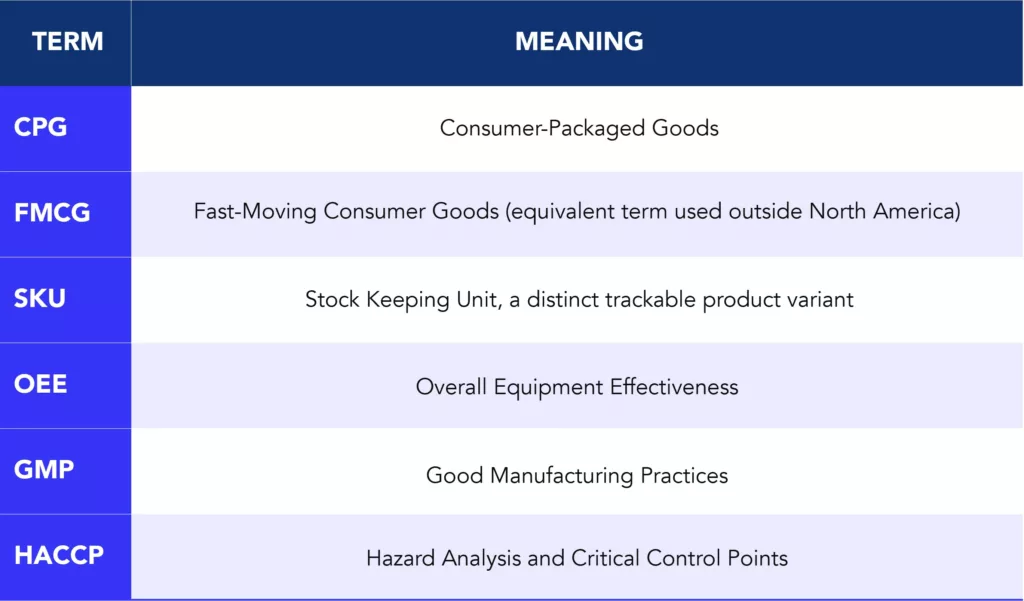
Table 1 – Key acronyms used across CPG manufacturing operations
The CPG manufacturing process, from formulation to distribution
A CPG plant’s process starts before a single unit is produced. Demand forecasting, built from retail sell-through data, promotional calendars, and seasonal patterns, sets the production plan that everything downstream depends on. Get the forecast wrong and a plant either carries excess inventory that ties up working capital or falls short of demand during a promotional spike.
From there, the physical flow runs through five stages: raw material receipt and quality release, formulation or batching, primary production, such as filling, forming, or assembly, packaging and labeling, and warehousing prior to distribution. Each stage carries its own control points. Food and beverage plants add pasteurization or thermal processing steps; personal care plants add mixing and emulsification; household goods plants add chemical blending under stricter handling protocols.
Industry 4.0 technologies, sensors, connected equipment, and real-time data platforms are changing how this flow is managed. Well-implemented digital tools give supervisors visibility into the causes of downtime, changeover durations, and quality deviations as they occur, rather than at the end of a shift. That visibility is what makes root cause analysis possible in the first place, since without a time-to-date record of what happened on the line, teams end up debugging from memory.
Supply chain resilience has become a design requirement rather than a contingency plan. Manufacturers that once optimized purely for landed cost now weigh supplier diversification, nearshoring, and buffer capacity against the risk of a single-source disruption that could halt a line entirely. A supply chain transformation rarely starts with the network map; it starts with knowing which plant-level constraints the network needs to protect against.
Design a consistent operating system for your CPG network
Contract manufacturing, private label, and co-packing
Not every CPG brand owns the plant that makes its product. Three models dominate outsourced production, and choosing the wrong one is a common, expensive mistake. Contract manufacturing is an arrangement in which a brand owns the formulation and specifications, and a third-party plant produces to those specifications under the brand’s quality oversight. Private label manufacturing flips the ownership: a manufacturer develops or holds the formulation, and a retailer sells the finished product under its own store brand. Co-packing sits between the two, typically covering only the packaging and finishing stage, filling and labeling a product a brand has already formulated and often already produced in bulk. The table below compares the three models.
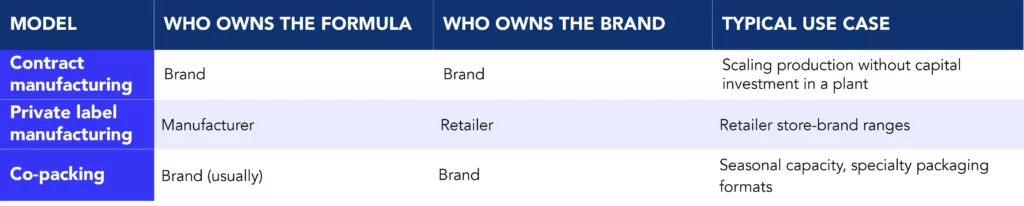
Table 2 – Comparison of outsourced production models
Each model trades control for flexibility differently. A brand that uses contract manufacturing keeps its formulation confidential but assumes the burden of coordinating with a plant it doesn’t operate. A retailer running private label manufacturing captures margin that would otherwise go to a national brand, but only if the manufacturing partner sustains consistent quality across every batch, the kind of consistency documented in continuous improvement at Kenvue, a program built to protect quality at scale.
The plants behind all three models face the same underlying pressure: variable batch sizes and shifting specifications strain equipment and schedules that were not designed for constant change. A global agrifood processor managing dozens of co-packing contracts at once faces a scheduling problem closer to a job shop than a traditional CPG line, and the disciplines that solve it- standard work, layered audits, quick changeover methods- are the same ones covered later in this article.
Quality control and regulatory compliance
Quality control in CPG manufacturing operates on two parallel tracks: product safety and product consistency. A batch can pass a safety audit and still fail to meet consumer expectations if flavor, texture, or fill weight drifts from spec.
Good Manufacturing Practices (GMP) set the baseline: sanitary design, documented procedures, and traceable records that regulators expect as a matter of course rather than as a competitive differentiator. Hazard Analysis and Critical Control Points (HACCP) goes further for food and beverage plants specifically, requiring manufacturers to identify every point in the process where a biological, chemical, or physical hazard could enter the product, then build a monitored control at each one.
Regulatory compliance in CPG extends well beyond food safety. Packaging regulations, including extended producer responsibility requirements, increasingly require manufacturers to report material composition and pay fees tied to packaging volume. Personal care and household goods plants carry their own ingredient disclosure and labeling obligations that shift by market.
Standardizing excellence across a compliance program this fragmented is less about adding inspectors and more about building standard work at every control point, so the same check happens the same way on every shift, regardless of who is running the line. Layered process audits, where different levels of management confirm compliance on a rotating cadence, catch the drift that a single annual audit misses entirely.
As tracked in our food industry trends 2026 analysis, ingredient transparency and clean-label claims are increasingly treated as verification requirements rather than marketing copy, which means quality teams now validate label claims with the same rigor once reserved for safety testing.
Where lean and KAIZEN™ drive plant performance
Lean manufacturing gives CPG plants their sharpest lever against thin margins, because most of the waste it targets- waiting, overproduction, excess motion, defects- stays invisible until someone measures it deliberately. Applied to consumer-packaged goods manufacturing, lean tends to concentrate on three areas: changeover speed, equipment reliability, and first pass yield, the percentage of units that meet specification the first time through the line without rework.
Overall Equipment Effectiveness (OEE) is the metric that ties those three together, measuring the combined effect of availability, performance, and quality losses on a piece of equipment. A line operating at 65 percent OEE has lost roughly a third of its theoretical output to some combination of downtime, slow cycles, and defects, each with a distinct root cause and fix.
Total Productive Maintenance (TPM), an industry term for maintenance strategies that engage operators directly in equipment care, comprises distinct disciplines with different mechanics. Autonomous maintenance trains operators to perform basic cleaning, inspection, and lubrication themselves, catching deterioration before it leads to a breakdown. Periodic maintenance replaces arbitrary calendar-based servicing with schedules tailored to each asset’s actual failure patterns. Predictive maintenance goes further still, using condition data to schedule interventions based on the equipment’s actual state rather than elapsed time. Preventive maintenance, in common industry usage, sits closest to periodic maintenance: planned servicing timed ahead of expected failure rather than after it.
Root cause analysis and Value Stream Mapping (VSM) give plant teams the diagnostic tools to know where to point these maintenance disciplines and where changeover or quality work will pay off fastest. VSM traces the complete flow of materials and information through a process, quantifying waste at each step so that improvement efforts land on the highest-leverage points rather than the most visible ones. The 5S methodology: sort, straighten, scrub, standardize, sustain a work area sounds basic next to predictive maintenance, but a disorganized station is where small defects and near-misses hide longest.
KAIZEN™, the practice of continuous, incremental improvement built into daily operations rather than reserved for periodic projects, is what keeps these tools from becoming one-time initiatives. In our work with consumer goods manufacturing clients, plants that treat improvement as a daily discipline rather than an annual event tend to sustain OEE gains that project-based efforts alone lose within a year.
Operational excellence, in this context, means measuring the right things, fixing root causes instead of symptoms, and maintaining equipment before it fails, applied consistently enough that gains compound rather than erode. That is the discipline behind manufacturing operations consulting engagements built specifically around CPG plant floors.
CPG manufacturing rewards discipline over scale. Plants that stay ahead forecast demand accurately, control quality at the source, and treat maintenance and improvement as daily habits rather than periodic projects. Contract manufacturing, private label, and co-packing all reduce the capital a brand commits to production, yet each still requires the same operational rigor, just relocated to the plant. For CPG leaders assessing where to invest next, the plant floor holds the fastest, most durable gains still available.
Kaizen Institute provides manufacturing operations consulting for consumer products clients, helping CPG plants sustain OEE, changeover, and first pass yield gains through a culture of Daily KAIZEN™ reviewed on the line in every shift.
Sustain OEE, changeover, and first-pass yield gains across every plant
Still have some questions about CPG manufacturing?
What does CPG stand for?
CPG stands for Consumer-Packaged Goods: food, beverage, personal care, and household products that consumers purchase frequently and replace quickly. CPG manufacturing refers specifically to the production processes, quality systems, and supply chains that produce these goods at retail scale.
What is the difference between contract manufacturing and private label manufacturing?
In contract manufacturing, the brand owns the formulation and specifications, and a third-party plant produces to those specifications. In private label manufacturing, the manufacturer typically owns the formulation, and a retailer sells the finished product under its own store brand.
What role does regulatory compliance play in CPG plant performance?
Regulatory compliance, spanning GMP, HACCP, and increasingly packaging-related reporting requirements, sets the non-negotiable floor for operating a plant. Retail network excellence depends on meeting that floor consistently across every shift and every SKU, which is why compliance and continuous improvement programs increasingly run through the same standard work and audit systems rather than as separate functions.
See more on Consumer Products
Find out more about transformation in this sector
See more on Manufacturing Operations
Find out more about improving this business area