Article
Automotive manufacturing solutions: A practical framework


A stamping line that runs three shifts without a single quality escape and a machining cell that breaks down twice a week can be located fifty meters apart in the same plant, running the same corporate improvement program. The difference is usually not the equipment. Rather, it’s about whether the plant has assembled the right automotive manufacturing solutions around the actual failure points, instead of layering technology on top of an unstable process. Automotive manufacturing solutions encompass a wide range of tools and methods, including manufacturing execution systems and predictive maintenance, and Lean fundamentals such as Value Stream Mapping (VSM). Automotive industry solutions that deliver measurable gains in manufacturing efficiency have one thing in common: they target a specific operational problem rather than a general ambition to modernize.
What automotive manufacturing solutions actually solve
Automotive manufacturing solutions are the specific combination of digital tools, quality systems, and Lean methods a plant deploys to remove a named source of waste, whether that is unplanned downtime, quality escapes, changeover time, or blind spots in shop floor visibility. The category spans manufacturing execution systems, predictive maintenance, automotive traceability, and structured methods such as VSM and Overall Equipment Effectiveness (OEE) tracking, applied together rather than purchased as isolated tools.
Operational efficiency in an automotive plant rarely improves as a side effect of buying software. It improves when leadership sequences continuous improvement work first: stabilize the process, standardize the work, then apply the tool that removes the newly visible waste. Plants that reverse this order, digitizing an unstable process before stabilizing it, usually end up with faster, more visible chaos rather than faster output. That sequencing discipline, more than any single technology, is what separates a solution from a purchase.
Automotive operational excellence starts with one conversation
A list of automotive manufacturing solutions, organized by the problem they solve
Most solution pages present this list of automotive manufacturing solutions as a catalog of software categories. The most useful way to read it is against the operational problem each one solves.
A manufacturing execution system integrates work orders, machine data, and quality records into a single record of what happened on the line, replacing paper travelers and spreadsheet reconciliation that slow root cause analysis. Digital work instructions sit on top of that system, giving operators the current revision of a standard at the workstation instead of a binder several engineering changes out of date. Production tracking solutions for automotive manufacturing, built on real-time production tracking rather than end-of-shift counts, close the gap between when a problem occurs and when someone notices it. Shop floor visibility tools aggregate that same data into dashboards that a team leader, a plant manager, and a corporate operations executive can each read at their own level of detail without separate reports. Automotive traceability systems tie a finished part back to its raw material lot, the operator, the machine, and the exact process parameters used, which turns a supplier recall into bounded, targeted containment rather than a plant-wide shutdown.
None of these tools function in isolation. A traceability system without a manufacturing execution system underneath it has no reliable source of shop-floor data to trace, and Automotive supply chain optimization only becomes achievable once internal production data is trustworthy enough to share upstream with suppliers.
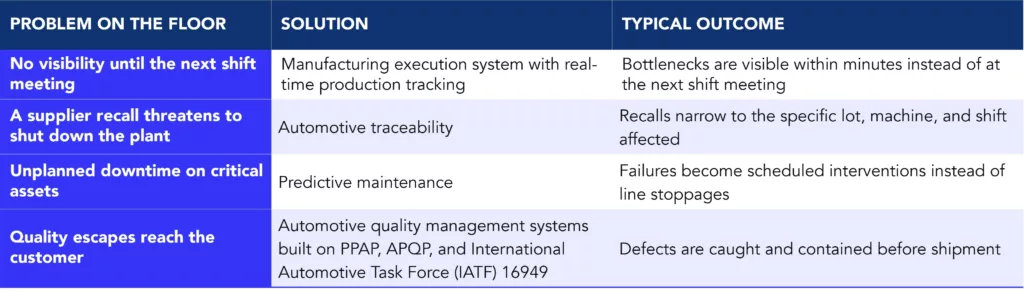
Table 1 – Automotive manufacturing solutions mapped
Automotive digital transformation, automation and AI
Automotive digital transformation is often described as a single initiative, but on the floor it arrives as several distinct technology layers arriving in sequence: connectivity, then data capture, then decision support. Automotive automation historically meant industrial robots welding, painting, and handling materials on fixed cycles, and robotics in automotive manufacturing still performs the heavy, repetitive, and hazardous work that a Lean redesign alone cannot eliminate. What has changed is the layer sitting above the robots.
AI in automotive manufacturing is now concentrated in two areas that produce a measurable return quickly: predictive maintenance automotive systems that read vibration, temperature, and acoustic signals from rotating equipment to flag deterioration weeks before failure, and decision-support tools that pull maintenance history and troubleshooting knowledge to the point of use instead of leaving a technician to search a manual mid-breakdown. Both work directly with data most plants already generate, which is why they tend to pay back faster than a full-line automation retrofit.
In our work with automotive manufacturers, the plants that get the most from this technology are those that deliberately sequence it. AI in the automotive industry performs best against stable, well-instrumented processes, because a model trained on erratic data produces erratic recommendations. Plants that stabilize before they automate get a compounding return; plants that automate an unstable process get a faster, more expensive version of the same instability.
Lean fundamentals that make digital solutions work
Every digital and automation investment above sits on a foundation that has not changed since the Toyota Production System first formalized it: Lean manufacturing removes waste from a process before anyone decides which technology should monitor or accelerate it. VSM is the starting discipline. Walking the physical and information flow from raw material to shipped part, and marking every wait, rework loop, and excess inventory along the way, surfaces the bottleneck capacity constraint that limits output, which is rarely the machine everyone assumes is the problem.
Line balancing then redistributes work content across stations so no single operator or cell is the reason the rest of the line waits, and one-piece flow reduces batch sizes between those stations, so a defect surfaces at the next station rather than an hour or a full shift later. OEE ties this together into a single number by multiplying availability, performance, and quality rate, which lets a plant distinguish a genuine capacity problem from a changeover, staffing, or scrap problem wearing a capacity disguise. Reading production efficiency metrics without the loss breakdown behind them tends to direct improvement efforts to the wrong asset.
In practice, this is where Operational Excellence in Manufacturing separates plants that get lasting gains from plants that get a temporary bump: the ones with lasting results run structured improvement cycles against the specific loss category the data identifies, verify the countermeasure held, and only then decide whether a digital tool should monitor that gain.
Automotive quality management: PPAP, APQP and IATF 16949
Automotive quality management runs on three reference points that get used almost interchangeably in casual conversation but serve distinct purposes. APQP, Advanced Product Quality Planning, is the upfront process a supplier and Original Equipment Manufacturer (OEM) run together during product development to identify risk before tooling is finalized. PPAP, the Production Part Approval Process, is the formal submission at the end of that development cycle that demonstrates a supplier’s process can produce the part to specification at the required rate, using the actual production tooling and operators. IATF 16949 is the quality management system standard that governs how a supplier’s plant runs day-to-day, beyond individual part approvals, covering risk management, internal audit, and continual improvement built into the operating system rather than demonstrated only at launch. As of 2026, IATF 16949:2016 remains the standard in force; a second edition is in development but is not expected before 2027, so current certification and audit work continues against the existing requirements.
Automotive quality control on the floor connects to all three. A control plan derived from PPAP defines what gets checked, at what frequency, and what the response is if a measurement falls outside the limit. Getting this right directly affects quality and productivity in discrete manufacturing: a defect caught at the station where it occurred costs a fraction of what the same defect would cost at final inspection or, worse, at the customer’s dock.
Ready to transform your automotive production?
Sustainable automotive manufacturing
Sustainable automotive manufacturing is frequently framed as a separate program bolted onto operations: energy audits, emissions reporting, a dashboard nobody on the floor uses. The more durable approach treats it as an extension of the same waste-elimination discipline already in place at the plant. Reducing the scrap rate simultaneously reduces raw material and energy consumption. Tightening changeover time through structured changeover analysis, the same thinking that improves scheduling flexibility, also cuts the idle energy draw of equipment sitting in changeover states. Improving OEE reduces the total run time required to produce the same volume, thereby reducing the plant’s energy and consumable footprint per unit without a separate sustainability initiative competing for the same improvement capacity. Sustainable automotive manufacturing succeeds fastest in plants where it is one more measured outcome of the existing continuous improvement system, not a competing program.
Treating automotive manufacturing solutions as an item-by-item shopping list rarely produces lasting results. They function as a connected system, and the plants that sustain year-over-year gains treat digital tools, quality systems, and Lean fundamentals as one connected sequence: stabilize the process, standardize it, then apply the technology that protects and extends that stability. Skipping that sequence, buying a Manufacturing Execution System (MES) or a predictive maintenance platform before the underlying process is stable, tends to produce faster reporting on the same problems rather than fewer of them. This is the sequencing Kaizen Institute applies inside automotive plants, and it is what turns automotive operational excellence into a repeatable outcome rather than a one-time project.
Kaizen Institute provides automotive industry consulting worldwide, working alongside manufacturers to design and implement this exact sequence, from Value Stream Mapping and Lean fundamentals through digital manufacturing solutions, predictive maintenance, and quality systems. As a partner for automotive sector consulting, our automotive consulting services turn operational excellence from a one-time initiative into a sustained competitive advantage.
Still have some questions about automotive manufacturing solutions?
What is included in automotive manufacturing solutions?
Automotive manufacturing solutions typically include a manufacturing execution system for real-time production tracking, digital work instructions, automotive traceability, predictive maintenance, automation and AI-based decision support, and Lean methods, including Value Stream Mapping (VSM), line balancing, one-piece flow, and overall equipment effectiveness tracking, that keep the underlying process stable enough for those digital tools to work.
Where should a plant start if it has no digital systems today?
Start with a VSM exercise to identify the actual bottleneck capacity constraint, rather than the machine assumed to be the problem. Stabilizing and standardizing that constraint first, then deploying a manufacturing execution system or predictive maintenance around it, produces a faster and more durable return than digitizing the whole plant at once.
What is the difference between PPAP and APQP?
Advanced Product Quality Planning (APQP) is the upfront planning process run during product development to identify risk before tooling is finalized. The Production Part Approval Process (PPAP) is the formal submission, completed once development is finished, that proves the supplier’s actual production process and tooling can produce the part to specification at the required rate.
Is IATF 16949 still the current automotive quality standard in 2026?
Yes. IATF 16949:2016 remains the standard automotive suppliers certify against. A second edition is in development, targeting simplification, software quality, and supply chain requirements, but it is not expected before 2027, so current audits and certifications continue under the existing requirements.
See more on Automotive
Find out more about transformation in this sector
See more on Operations
Find out more about improving this business area