
Article
How to reduce Work-in-Process (WIP) and manufacturing lead time


A plant with too much work in progress behaves like a congested highway: every car joining the slip road makes the exit further away, not closer. In order to reduce manufacturing lead time, you must first reduce WIP in proportion to how quickly your bottleneck can process it. This relationship is not subjective; it is a formula. WIP management starts with math, not intuition. This article explains the connection between work-in-progress inventory, throughput and lead time, and then sets out the steps to achieve the fastest measurable reduction in lead time without increasing headcount or capacity.
What manufacturing lead time actually measures
Manufacturing lead time is the total elapsed time from when an order enters your system to when the finished item leaves it, including every minute a part spends waiting, not only the minutes a machine spends working on it. Most operations managers underestimate lead time because they track the value-added minutes, the actual cutting, welding, or assembly time, and miss the queue time sitting between operations. In a typical discrete manufacturing environment, queue time accounts for most of the total lead time, often eighty percent or more. That is why attacking process speed rarely moves delivery performance: the clock keeps running while the part sits still.
Lead time vs. Cycle time
Cycle time and lead time are often used interchangeably on the shop floor, and that confusion drives bad decisions. Cycle time is how long a single unit takes to complete one operation once work starts. Lead time is the full order-to-delivery clock, including every queue between those operations. A machine can post an excellent cycle time while the plant still runs a terrible lead time, because the gap lives entirely in the waiting. Cutting cycle time on a non-constraint machine barely moves lead time; cutting queue time in front of the bottleneck moves it immediately.
The formula connecting WIP, throughput, and lead time
Little’s Law, proved by operations researcher John Little in 1954, states that work-in-process inventory equals throughput multiplied by lead time. Rearranged, lead time equals WIP divided by throughput. That is Little’s Law WIP math in its simplest form, and it is the most useful equation on a factory floor, because it turns a lead-time complaint into a calculation.
You reduce manufacturing lead time by lowering work in process relative to your bottleneck’s throughput rate, following that same relationship. In practice, this means capping WIP with a pull system, shrinking batch sizes through faster changeovers, and protecting the true constraint’s output, not working faster everywhere at once.
The formula holds three lessons most guides mention individually but rarely connect. If throughput stays flat, cutting WIP is the only way to cut lead time; releasing more work to the floor raises queue inventory, not output. The relationship also assumes a stable system, work entering and exiting at roughly matched rates. If WIP climbs faster than the plant ships, the formula still holds, but it is telling you the system is drowning, and that is where lead time variability spikes, since queue time near a saturated constraint stops behaving like a stable average. Throughput itself is set by whichever resource has the least capacity, which is why bottleneck analysis must come before WIP limits, batch sizes, or scheduling rules.
Work-in-process inventory is also the hardest of the three variables to measure honestly. Units on pallets between departments, half-finished assemblies staged for an absent operator, and lots waiting on a quality hold all count as WIP, and most Enterprise Resource Planning (ERP) systems undercount them because they track WIP only at formal transaction points. Before setting any WIP limits, walk the floor and count what is sitting between stations; the number is almost always higher than the system reports.
Find the real bottleneck before you touch anything else
Managers habitually target the busiest-looking machine as the bottleneck, and that assumption is usually wrong. The actual constraint is the resource whose output ceiling sets the ceiling for the entire line: downtime there costs finished units one for one, while downtime elsewhere usually gets absorbed by existing WIP buffers. You confirm a true bottleneck three ways: its queue grows persistently rather than draining at shift change, its daily output tracks the plant’s daily output across multiple shifts, and work that skips that station raises finished output while work that skips other stations does not.
Chasing the wrong machine as your bottleneck?
Map flow end-to-end with a Value Stream Mapping (VSM) exercise before setting a single WIP limit. Guessing at the constraint and capping WIP around the wrong resource starves a non-bottleneck of work while the real constraint keeps queuing. Once data confirms the constraint, everything downstream in this article exists to protect that one resource’s output.
Set WIP limits: Kanban, constant work-in-process (CONWIP), or First In, First Out (FIFO)
Once you confirm the constraint, capping WIP is the fastest, cheapest lever available because it requires no new equipment or headcount. Output is governed by the bottleneck’s throughput, not by how much material sits in front of it; releasing more work than the constraint can absorb only lengthens queue time; it never raises finished output. This is WIP reduction in its purest form: less material on the floor, the same or better output. Three mechanisms enforce a limit, and each fits a different production pattern.
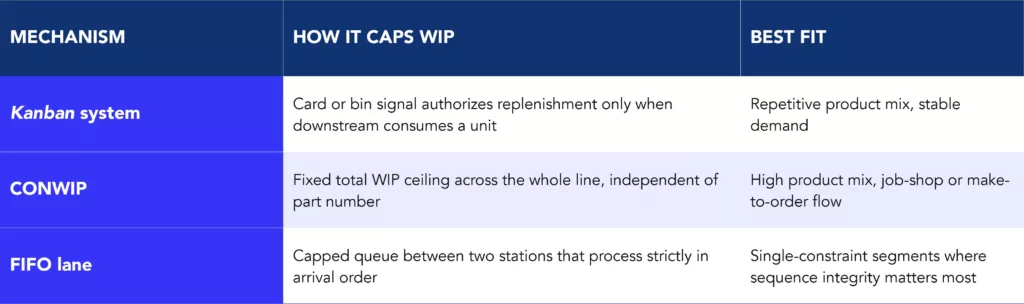
Figure 1 – Three ways to cap WIP
A kanban system suits a line making a narrow set of products at a steady rate, since each card corresponds to a specific part number and replenishment quantity. It gets unwieldy in a high-mix environment where hundreds of part numbers would each need their own card population. CONWIP solves that by capping total WIP across the routing regardless of what is inside it, at the cost of some scheduling discretion that kanban gives you for free. FIFO lanes are the simplest of the three and work well in front of a single confirmed constraint, disciplining the queue and removing the temptation to expedite the wrong lot.
Whichever mechanism you choose, set the limit low enough to hurt slightly. A limit that never gets hit is decoration, not control. Utilization at or above roughly eighty to eighty-five percent of a resource’s capacity is where queue time stops scaling in a straight line and starts climbing sharply, so a limit that keeps the constraint comfortably below that threshold, without starving it, is doing its job.
Shrink batch size through faster changeovers
Large batch sizes exist for one reason: changeovers are slow enough that spreading their cost across more units seems cheaper than running smaller lots more often. That trade-off reflects setup time, not a law of manufacturing. Cut changeover time and the economics of batch size shift with it; economic batch size scales with the square root of setup cost, so a seventy-five percent cut in setup time can roughly halve the batch size that makes financial sense. That is batch size reduction without the capacity penalty manufacturers fear most.
SMED, Single-Minute Exchange of Die, was developed at Toyota to make small-batch production viable. It separates changeover work into internal steps that require the machine to stop and external steps that can happen while it runs, then converts internal steps to external wherever possible. Our SMED Guide walks through the full five-step method; the immediate payoff here is direct: shorter changeover times let you run smaller batches without losing capacity, and smaller batches mean less WIP in queue, less lead time buried in batch-wait, and faster response when a schedule changes. A plant that halves changeover time at the constraint can typically halve its batch size there too, which compounds directly into the WIP limits from the previous section.
Build a pull system and level the schedule
A push schedule releases work based on a plan built days or weeks in advance, regardless of what downstream operations are ready to consume, and the result is overproduction sitting as WIP wherever plan and reality diverge. A pull system flips that logic: it releases work only when a downstream signal calls for it, keeping WIP anchored to actual consumption instead of forecast error. This is the operating principle behind Just-in-Time (JIT) inventory, and it is why a well-run pull system tends to carry far less floor inventory than a push-scheduled line building the same volume.
One-piece flow, moving a single unit at a time between operations instead of batching between every step, is the extreme end of this logic and delivers the shortest queue time per unit where achievable. It is not achievable everywhere; equipment with long, fixed cycle times or shared across product families often needs a small buffer instead. Our documented Pull flow model from a discrete assembly environment shows a pull system and reorganized logistics cutting queue time without a full move to one-piece flow.
Production scheduling still has a role inside a pull system: it needs to level the mix and volume released into the pull signal so upstream capacity and material arrive in a pattern the line can absorb, rather than dumping variation onto the floor and asking WIP limits to cushion the shock alone.
Make the gain stick
None of these levers survive contact with the floor without discipline that outlasts the initial project. Standard work, the current best-known sequence, timing, and method documented for each operation, is what prevents a WIP limit from creeping back up once the team that set it moves to the next priority. Without a written standard, operators default to whatever felt right yesterday, which was almost certainly building ahead of the pull signal, because that feels productive even when it destroys flow. Flow efficiency, the ratio of value-added time to total lead time, is the metric to track here; it rises only when queue time genuinely falls, exposing any change that looks good on paper but does nothing on the floor.
The right order to reduce WIP and manufacturing lead time
That is how to reduce manufacturing lead time without new equipment or headcount, applied in the right order, because each step protects the value of the next.
- Confirm the true bottleneck with data, not assumptions.
- Set a WIP limit around that bottleneck using a Kanban system, CONWIP, or a FIFO lane, whichever fits your product mix.
- Cut changeover time at the constraint and shrink batch size proportionally.
- Convert push releases to a pull system and level the schedule feeding it.
- Document standard work and track flow efficiency so the gain does not erode.
Identify your biggest operational constraint in 60 minutes
Skipping ahead, setting WIP limits before confirming the bottleneck, or shrinking batch size on a non-constraint machine, is the most common reason lead-time projects stall after an encouraging first month. For plants where the constraint shifts across product families, Kaizen Institute Manufacturing Operations consulting support can accelerate bottleneck confirmation with this same discipline, and its Discrete Manufacturing consulting programs apply this sequence across mixed assembly and machining environments.
Still have more questions about reducing WIP and manufacturing lead time?
Does lowering WIP reduce output?
No. Output is set by the bottleneck’s throughput, not by how much inventory sits in front of it. Lowering WIP shortens queue time and lead time while the constraint’s output rate stays the same, as long as the limit keeps the constraint fed.
What is a good WIP limit to start with?
There is no universal number. A workable starting point is the current average WIP at the constraint minus twenty to thirty percent, monitored closely and adjusted based on whether the resource starves or queue time drops.
How is lead time reduction different from cycle time reduction?
Cycle time reduction speeds up individual operations; lead time reduction targets the queue time between them, which usually accounts for most of the total clock. Cutting cycle time on a non-constraint rarely shortens lead time.
Can WIP limits work with high product mix?
Yes, though a single kanban system becomes impractical past a certain number of part numbers. Constant Work-in-Process (CONWIP), which caps total WIP across the routing rather than by part number, is typically a better fit for high-mix, low-volume environments.
See more on Manufacturing Operations
Find out more about improving this business area
See more on Lean
Find out more about improving this business area