Case Study
Transforming aerospace operations: from customer satisfaction to overall operational efficiency
Goals: improve customer satisfaction, optimize productivity, and enhance overall operational efficiency


99%
Direct Labor Efficiency (DLE)
85,8%
Customer On-Time Delivery (COTD)
87%
Productivity
This case study describes the successful transformation of an aerospace business unit through the implementation of improvement practices that enhanced operational efficiency, reduced costs, and increased customer satisfaction.
Leading the way in innovation and operational excellence in the aerospace industry
The company is a global leader in aerospace, defense, and communications technologies, offering a wide range of products and services across several sectors, including aerospace propulsion, aircraft equipment, defense, and aircraft interiors. Within its aerospace propulsion division, it develops systems for commercial, training, and combat aircraft, as well as for rockets, helicopters, tactical missiles, and drones. Its aircraft equipment division complements this by manufacturing vital components such as landing gears, wheels, and brakes. In the defense segment, the company provides optronic, avionics, and electronic solutions, along with software for both civilian and military applications. In parallel, the aircraft interiors division focuses on products like seats, galleys, and other related systems.
Driving transformation and operational excellence
The electrical inserts business unit was formed through the consolidation of the executive line galley insert operations previously based at two different sites. Initially, the workstation design was based on a first-generation “one station does it all” model, reliant on individual expertise and experience. This resulted in inefficiencies, low productivity, poor customer satisfaction, and high attrition rates.
The need for transformation was clear, aiming to increase customer satisfaction as measured by Customer On-Time Delivery (COTD) and decrease customer complaints (Customer Non-Conformance Rate – CNCR), while improving internal metrics such as Overall Labor Efficiency (OLE) and productivity.
Ready to drive operational excellence and transform your aerospace business?
Making a difference through efficiency and innovation
To drive the transformation, the project focused on achieving specific operational goals that would improve efficiency and customer satisfaction:
- Customer On-Time Delivery (COTD): >85%
- Customer Non-Conformance Rate (CNCR): < 500 ppm
- Direct Labor Efficiency (DLE): >98%
These objectives were set to ensure improved performance, reduced defects, and enhanced delivery reliability.
Actions implemented for the transformation
Guided by the principles of improvement, the following initiatives were introduced:
- Streamlined flow: Optimized material flow from incoming goods to packaging and shipping, reorienting all the lines and optimizing the warehouse for inbound and outbound logistics.
- Kitting optimization: Reduced inventory from three weeks to less than three days.
- Storage reorganization: Used heatmaps to optimize picking operations.
- Workstation design: Workstations were ergonomically redesigned to enhance efficiency and provide greater autonomy at each station.
- Linear flow: Transitioned from the “one station does it all” approach to a linear one-piece flow.
- Value Stream Mapping (VSM): Used VSM as a reference for driving improvement projects.
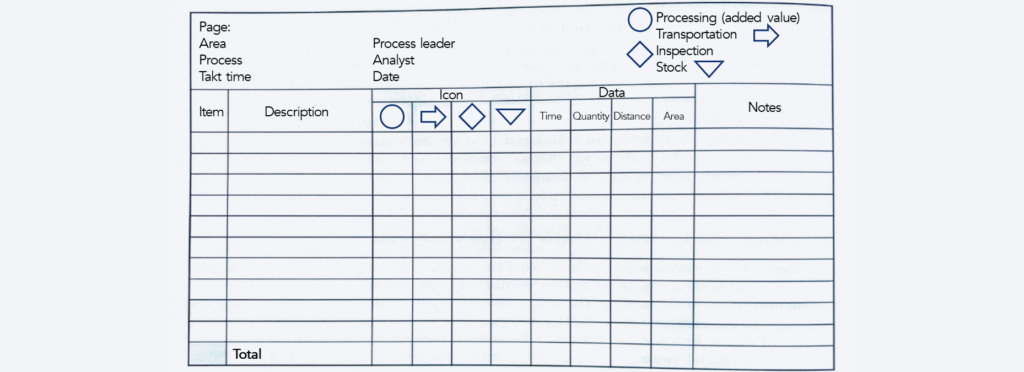
Figure 1 – VSM form example
- QRQC (Quick Response Quality Control) implementation: Daily management philosophy to ensure real-time problem-solving at all levels.
- Customer-centric approach: Focused on aligning KPIs with customer requirements.
- Problem-solving frameworks: Enhanced problem-solving capabilities through structured frameworks and feedback loops.
- Top management Gemba visits: Introduced structured top management involvement with daily shop floor visits.
- Continuous learning: Introduced fundamental Dojo and assembly Dojo to speed up learning curves.
- Kamishibai implementation: Kamishibai was implemented to sustain the improvements.
- Kanban and water spider: Improved material flow with Kanban and water spider (Mizusumashi) systems.
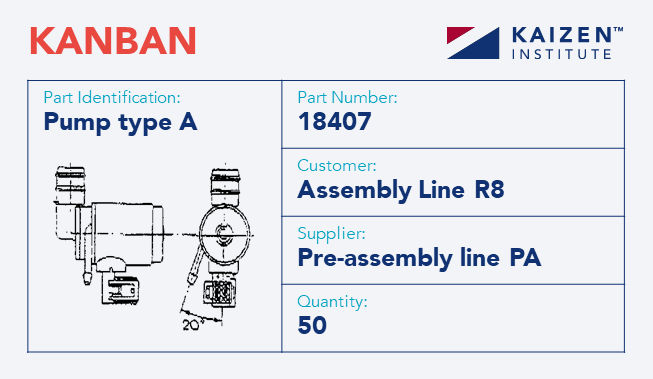
Figure 2 – Example of a production Kanban
- Quality mindset: Empowered operators through the “Check-Do-Check” concept, reinforcing quality ownership and operational autonomy.
- Stop at first deviation: Introduced a “stop at first deviation” philosophy, monitored by supervisors.
- AVIX deployment: Used animated work instructions to improve understanding of value-added (VA) and non-value-added (NVA) analysis.
- Operator versatility and flexibility: Monitored skill levels and enhanced operator flexibility.
- Deskilling critical operations: Applied Job Aids and Poka-Yoke systems to simplify and error-proof critical operations.
- Monthly competitions: Fostered team engagement with competitions for best ideas, problem-solving, and 5S implementation.

Figure 3 – 5S definition
These initiatives, grounded in the principles for improvement, were key to driving the transformation at the organization. By optimizing processes, empowering employees, and aligning operations with customer needs, the business unit achieved higher efficiency, enhanced quality, and greater employee engagement, ultimately positioning it for sustainable success and growth.
Gain valuable insights with our 5S guide and start improving your workspace today
Results that build a successful future
The transformation efforts led to breakthrough results, demonstrating the effectiveness of the improvement initiatives. The following results highlight the significant advancements achieved in operational efficiency and customer satisfaction:
- Manufacturing On-Time Start (MOTS): 99.5%
- Direct Labour Efficiency (DLE): 99%
- Productivity: 87%
- Customer On-Time Delivery (COTD): 85.8%
- Customer Non-Conformance Rate (CNCR): 253 ppm
The company achieved its project goals by transforming its manufacturing processes, improving efficiency, and increasing employee engagement. By focusing on daily improvements and fostering a customer-centric mindset, it has successfully optimized its electrical inserts unit.
This transformation highlights the importance of applying improvement principles to enhance productivity and meet customer expectations while fostering a culture of ongoing improvement throughout the organization.
We are committed to respecting our clients’ confidentiality. While we have altered or omitted their names, the results are genuine.
See more on Aerospace & Maritime
Find out more about transformation in this sector