News
Why KAIZEN™ Is More Relevant Than Ever in Times of Disruption


As business leaders worldwide deal with unprecedented complexity—from geopolitical instability to the rapid advancement of artificial intelligence—the principles of Continuous Improvement have never been more relevant. Ahead of the 7th Global KAIZEN™ Award ceremony in Madrid on November 11, we spoke with Ulrich Wolfers about how the KAIZEN™ philosophy is evolving to meet modern challenges while staying true to its fundamental principles.
The KAIZEN™ Philosophy in a Changing World
Business leaders today face significant disruption—from global tensions to AI transformation happening faster than ever. How does KAIZEN™ provide an effective framework for managing this complexity?
The Continuous Improvement approach is particularly well-suited for times of rapid change. When everything shifts quickly, the KAIZEN™ methodology of taking small, consistent steps becomes even more valuable. Rather than waiting for the perfect moment or implementing massive changes all at once, organizations stay engaged through Daily KAIZEN™ and address challenges incrementally.
This is especially relevant with AI. Before implementing AI, you need to get your processes in order first. If your processes aren’t standardized and optimized, adding AI won’t solve your fundamental problems—it will just automate inefficiency. We’ve been discussing this principle in our recent World Economic Forum contributions.
“The beauty of Continuous Improvement is that it keeps you permanently engaged with change rather than being overwhelmed by it. You’re always making small adjustments that compound over time.”
How is the KAIZEN™ brand evolving beyond its roots in operational efficiency?
We’re not moving away from our foundation. The Gemba—the actual place where work happens—remains absolutely central to what we do. Production and operations will always be core to KAIZEN™. But we are evolving with the times.
We’re actively expanding into artificial intelligence and data analytics. We’ve acquired Analytics by Kaizen, a Portugal-based company specializing in data analytics consulting for industries, as an extension into new domains.
Another concrete example: we recently signed a contract with a fast-food chain in Australia. They asked us to analyze their processes using our tools—Value Stream Analysis and Value Stream Mapping—to determine where digitalization with AI and analytics can be meaningfully deployed, and which existing processes could be replaced. This perfectly illustrates our approach: use proven KAIZEN™ methodologies to understand and optimize processes first, then strategically apply technology where it creates genuine value.
For us, technological developments represent opportunities, not threats. The principles of Continuous Improvement apply just as powerfully to digital transformation as they do to manufacturing processes. We’re also expanding our global footprint, particularly in Asia, as we connect with new partners.
KAIZEN™ in the Digital and Human Age
‘Be Gemba Oriented’ is a fundamental principle. In a world of hybrid teams and remote work, where is the Gemba now?
The Gemba hasn’t disappeared—it’s evolved. Production facilities still exist, and physical workplaces remain important. But Daily KAIZEN™ principles translate beautifully into the virtual world.
We practice what we preach internally. My team is distributed globally—USA, Japan, Austria, Dubai, and other locations. We run our operations using the same KAIZEN™ methodologies we teach our clients. We use digital tools like Microsoft Teams and Planner boards to maintain our Continuous Improvement routines. We track KPIs, use 3C boards to address problems when we’re not on track, and manage projects through SDCA cycles.

Whether you’re on a shop floor or in a virtual meeting, the principles remain the same: regular, structured touchpoints; visual management; problem-solving discipline; and collective ownership of improvement.
There’s a powerful connection between eliminating waste and sustainability. How does this make KAIZEN™ relevant for today’s ESG priorities?
This insight struck us during a recent meeting with the UN Global Compact, where we’re members: what we’ve been doing for 40 years with waste elimination is exactly what the world now calls sustainability and ESG.
“When KAIZEN™ was introduced decades ago, the focus on eliminating waste was fundamentally an environmental and social practice, even if we didn’t use those exact terms.”
Today, we formally advise companies on ESG initiatives. Organizations with mature KAIZEN™ cultures already have much of the infrastructure they need for sustainability reporting and improvement. The mindset of respecting resources, eliminating waste, and creating more value with less input is the foundation of environmental responsibility.
How does KAIZEN™ culture address workforce development in the age of AI and skills shortages?
This connects directly to one of our core principles: Empower People. True KAIZEN™ implementation means giving employees at all levels both responsibility and the tools to improve their work.
In world-class organizations, Continuous Improvement runs through every level—from top management to frontline workers. It’s not top-down directives; it’s collaborative problem-solving where everyone contributes. Management shows commitment by being Gemba-oriented, staying connected to where the work happens. Frontline employees are empowered to identify problems, suggest solutions, and implement improvements.
This creates a learning organization. As people engage in structured problem-solving—using tools like A3 thinking or the PDCA cycle—they develop critical thinking, analytical capabilities, and leadership competencies. In an era where AI handles routine tasks, these uniquely human skills become even more valuable.
Celebrating Excellence: The 7th Global KAIZEN™ Award
What makes this 7th edition in Madrid particularly special?
We’re doing something new: presenting and discussing our latest book, “The KAIZEN™ Culture Paradox.” This represents an evolution in our thinking. We’ve moved from the KAIZEN™ Change Model to what we now call the KAIZEN™ Culture Model, and the book explores this shift in depth.
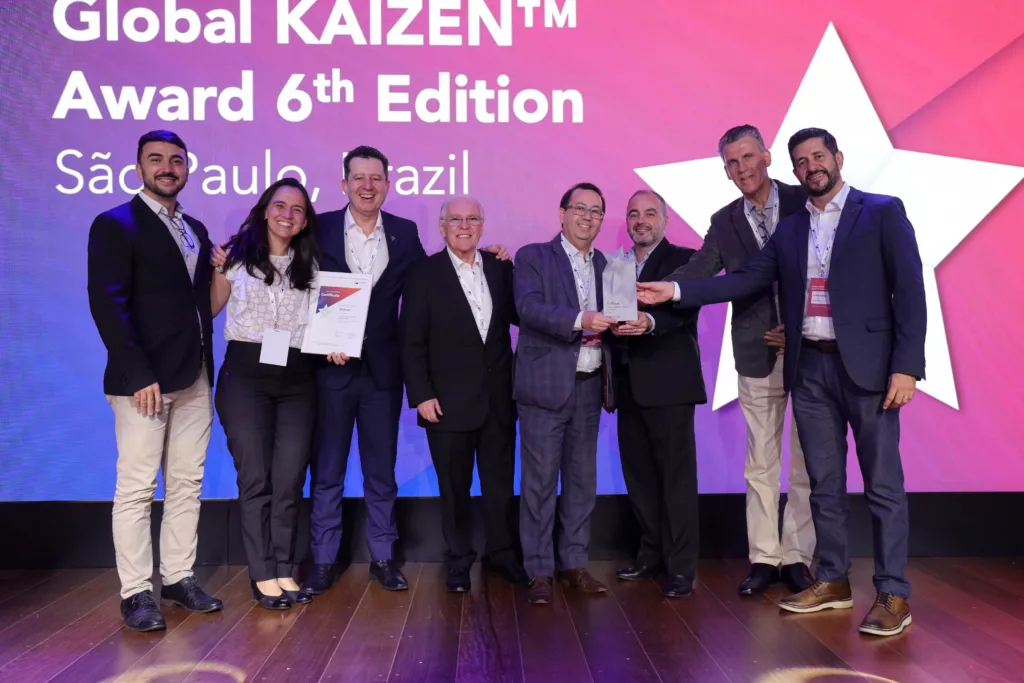
The discussion during the award ceremony will give attendees insights into how KAIZEN™ thinking continues to evolve while remaining rooted in fundamental principles. We’ll also have the previous year’s winner returning to Madrid, creating continuity and enabling knowledge exchange between past and current recipients.
What does KAIZEN™ maturity look like today? What separates good implementation from world-class?
Our judges evaluate nominees based on our five core KAIZEN™ principles, using a sophisticated assessment matrix. World-class implementation requires comprehensive deployment—not just in production, but throughout the entire organization. HR uses KAIZEN™ tools. Marketing uses KAIZEN™ tools. Every department, every hierarchy level.
The other critical factor is top management commitment. You can’t achieve world-class status if Continuous Improvement is just something the operations team does. Leadership must be fully involved and committed, demonstrating their engagement by regularly going to the Gemba and participating in improvement activities.
When these five principles are truly embedded—when KAIZEN™ becomes how the organization thinks rather than just what it does—that’s when you see transformational results. These are the organizations that not only survive difficult times but emerge stronger from them.
What’s the key message you hope leaders take away about the future of KAIZEN™?
KAIZEN™ is an endless journey, and that’s actually its strength. It will remain relevant into the future—not despite digitalization and AI, but precisely because of them. The world will keep changing, perhaps faster than ever, and organizations need a framework for continuous adaptation.
In times of transformation and uncertainty, a culture of Continuous Improvement isn’t optional—it’s essential for survival and success.
What we see in this year’s nominees is that implementing KAIZEN™ methodologies from A to Z—Strat KAIZEN™, Value Stream KAIZEN™, and Daily KAIZEN™—enables organizations to achieve and sustain world-class performance even in turbulent times. Some of our award recipients were companies that faced serious challenges or needed transformation, and KAIZEN™ provided the framework for their turnaround.
The organizations being recognized in Madrid prove that when you commit to these principles fully, the results speak for themselves.
The 7th Global KAIZEN™ Award ceremony took place on November 11, 2025, at the Palacio de Cibeles in Madrid, Spain. Learn more at kaizen.com/global-kaizen-award
Global KAIZEN™ Award Assessment Criteria


Contact
Kaizen Institute, Ltd.
Global Operations – Zug, Switzerland
Email: pr@kaizen.com