Article
How should daily management be structured in a manufacturing plant?


Daily management in a manufacturing plant should follow a connected routine built on a tiered meeting structure. This structure consists of short, tiered meetings held at a fixed time, visual boards that present performance against target, and clear escalation of problems to a level where they can be solved.
Tier meetings: from the frontline team to plant leadership
Daily management is not a set of separate meetings: each one feeds the next. A tier meeting structure links the frontline team to plant leadership, so information flows up and support flows down.
- Tier 1: Frontline teams meet first. They review yesterday’s results against target, today’s plan and new problems.
- Tier 2: Supervisors meet second. They take the problems tier 1 could not solve.
- Tier 3: Department managers meet third. They handle cross-team issues and department KPIs.
- Tier 4: The plant leadership team meets last. They act on plant-wide problems and resources.
Daily meeting cadence and visual management boards
At every tier, the routine rests on two habits:
Short meetings at a fixed cadence
Each tier meeting is short, standing, and held at the same time every day, so the cadence never breaks. It is a daily huddle to agree on actions, not a problem-solving workshop.
Visual management boards
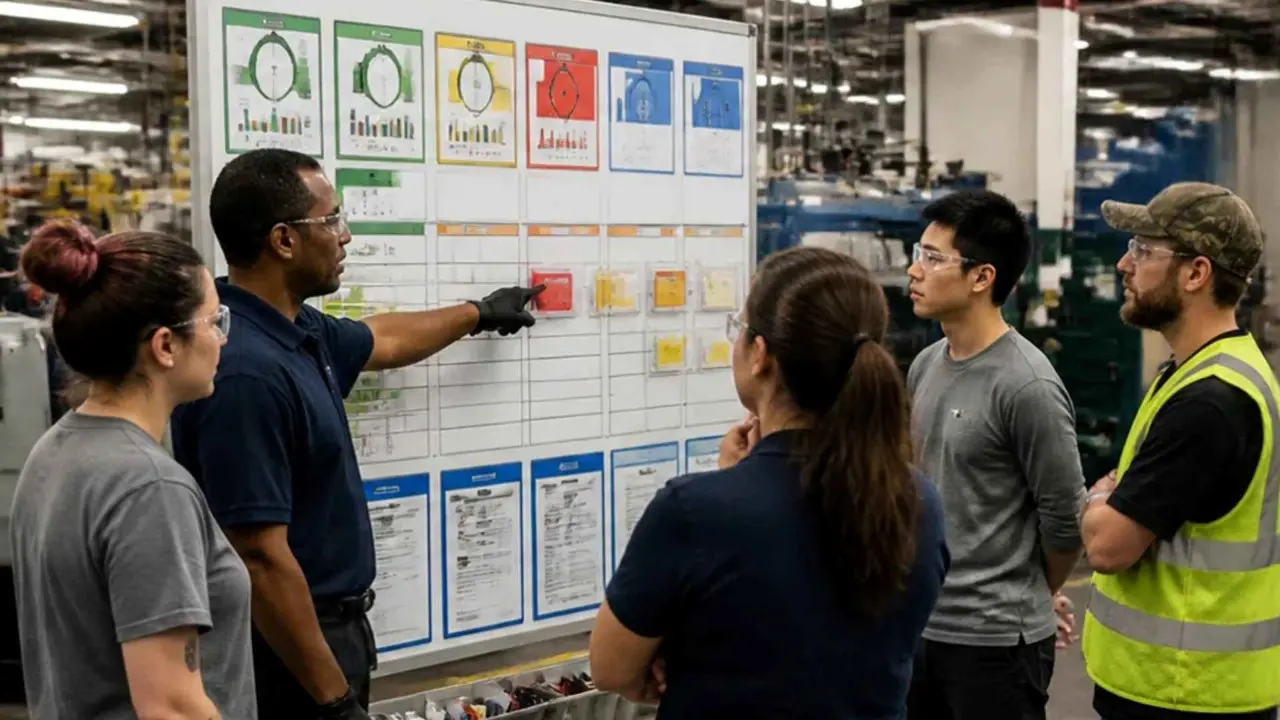
Each meeting runs on a visual board, such as an SQDC board (safety, quality, delivery, cost), that shows performance against target. Anyone can see, at one glance, what is on track and what is not.
Want to set up tier meetings that drive daily action?
The escalation process and KPI-driven action
Seeing a problem is not enough: the routine must move it to someone who can act.
Clear escalation
If a problem cannot be solved at one tier, it moves up to the next tier the same day, with a named owner. Every escalation has someone accountable for it, and the answer goes back to the team that raised it.
KPIs that trigger action
KPIs must trigger action, not just reporting. When an indicator is off target, the team agrees on an action, an owner and a follow-up date, then checks progress at the next meeting.
One connected routine, from the shop floor to plant leadership.
A connected tiered meeting structure, built on fixed cadence, visual boards, and clear escalation, keeps daily management grounded in what is actually happening on the shop floor, so problems move to the right level and KPIs translate into action rather than reporting alone. Kaizen Institute supports this routine across industries, including Discrete Manufacturing and Consumer Products Manufacturing, and through Daily KAIZEN™, helping plants build the habits that keep this routine running day after day.