
Article
Poka-Yoke: meaning and how to make processes error-proof


The search for more robust and efficient processes has led to the development of tools that eliminate human error in operations. One of the most enduring is poka-yoke, developed over half a century ago as part of the Toyota Production System (TPS) and still highly relevant today. Growing demands for quality, reliability and operational efficiency — and the need to prevent failures in increasingly complex environments — only underline its importance.
This article explains the meaning and origin of poka-yoke, its benefits, the three classic methods, practical and everyday examples, best implementation practices and how it integrates with other quality improvement methodologies.
What is poka-yoke? Meaning and definition
Poka-yoke is a Japanese term meaning “inadvertent error prevention”, known in English as mistake-proofing: the practice of designing processes and equipment so that human errors either cannot occur or are detected the moment they happen, before they become defects. You will also see it written as “poka yoke” without the hyphen — both refer to the same concept.
In essence, a poka-yoke is any mechanism, device or procedure that makes a process error-proof. Rather than relying on an operator’s attention, experience or concentration, the process itself prevents the mistake — or flags it immediately — so that performance and customer satisfaction are never compromised. Thanks to digital transformation, poka-yoke has expanded into new applications while keeping its fundamental principles intact.
Origin of poka-yoke: Shigeo Shingo and the Toyota Production System
The approach was formalised in the 1960s by Shigeo Shingo, one of the key architects of the Toyota Production System, to eliminate defects in industrial processes by preventing errors before they occur.
Originally called baka-yoke (literally, “fool-proofing”), the term was changed to poka-yoke as a more respectful choice towards operators. Shingo’s philosophy rests on a simple idea: systems and processes should be designed to prevent errors from occurring, rather than depending solely on employees’ attention, experience or concentration.
The philosophy behind error prevention
Poka-yoke is built on a proactive philosophy: human error is natural, but defects must not be accepted. Instead of intervening after failures occur, processes are designed so that errors cannot happen — or are detected immediately, before they have an impact. This mindset aligns closely with kaizen principles and quality at the source.
The systematic application of poka-yoke reinforces an organisational culture centred on excellence and shared responsibility for quality, built on five core principles:
- Do not produce defects: design processes to get it right the first time.
- Do not pass defects to the next step: implement mechanisms that block or flag failures before advancing.
- Do not accept quality defects: each station takes responsibility for the quality it receives and delivers.
- Do not repeat quality defects: address errors at the root cause and eliminate them permanently.
- Do not accept variability: consistency and compliance go hand in hand.
Instead of blaming people for errors, the focus shifts to the system — driving continuous improvement, collective learning, more engaged teams and more reliable processes.
Advantages of introducing poka-yoke
Mistake-proofing builds more robust, reliable and safe processes by reducing dependence on human factors and preventing errors at the source. Key advantages include:
- Fewer errors and defects in products and services, with greater consistency delivered to the customer.
- Higher customer satisfaction through the reliable delivery of defect-free products.
- Simpler processes and reduced complexity, resulting in greater efficiency and productivity.
- Lower operational costs related to failures, rework, returns and repairs, directly improving profitability.
- Improved workplace safety by preventing accidents caused by human error.
- Greater process stability, better adherence to takt time, and stronger confidence in teams, processes and results.
In short, by eliminating or drastically reducing the possibility of error, poka-yoke systems become a key element in achieving operational excellence.
Expand your knowledge on error prevention
Best practices for implementing a poka-yoke system
For a poka-yoke system to be truly effective, it is essential to follow a structured approach, involve operational teams, and make sure the solution addresses the root cause of the error in a simple, robust and sustainable way.
How to implement a poka-yoke system
Successful implementation requires a structured approach that not only eliminates errors but also ensures the solution lasts. The process can be divided into seven key steps:
1. Identify the problem. Detect the recurring error or defect in the process. This analysis can be based on data related to defects, rework or customer complaints.
2. Analyse the root cause. Identifying the error alone is not enough; investigate the origin of the issue to understand what is causing it.
3. Define the type of poka-yoke to apply. Based on the analysis, determine whether the solution should be preventive (stops the error from occurring) or detective (flags the error immediately after it occurs, before it causes defects).
4. Design the poka-yoke system. Develop the most suitable solution, ensuring simplicity, effectiveness and integration into the process.
5. Test the system. Before scaling the solution, test the device or method under real conditions to confirm it works and effectively eliminates the error.
6. Train employees. Once the solution is validated, train the operators and teams involved so they understand how the poka-yoke works and why it matters.
7. Evaluate performance and measure success. Monitor the solution’s impact using quality, safety and productivity indicators, and adjust where necessary to support continuous improvement.
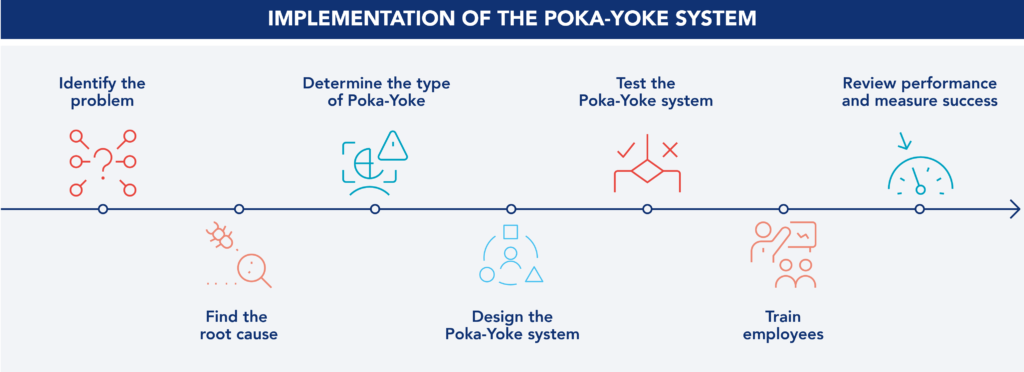
This structured process ensures that poka-yoke systems are effective, sustainable and aligned with the organisation’s quality and operational excellence goals.
When and where to apply poka-yoke systems
Poka-yoke can — and should — be applied in any industry and in any area of the organisation where there is a risk of human error with a potential impact on quality, safety or efficiency.
While its use in production is especially relevant, mistake-proofing is not limited to manufacturing. It works just as well in logistics, maintenance, administrative, financial, commercial and technological environments. The determining factor is not the industry or department, but the presence of errors that could be avoided with a simple solution. What matters most is adopting a preventive mindset and seeking, at every step, simple solutions that either eliminate the possibility of error or detect it before it causes impact.
Practical applications of poka-yoke
The effectiveness of poka-yoke lies in its practical applicability and the simplicity of its solutions. Implementation may take many forms — from physical devices to digital systems — all with the same goal: ensuring the error does not occur, or is detected immediately before resulting in defects.
Main causes of quality issues
The root causes of quality defects are often simple, recurring errors that could be prevented with effective mistake-proofing. The main ones include:
- Forgetting process steps, such as skipping essential checks or operations.
- Operational errors due to unclear instructions, missing standards or insufficient training.
- Incorrect placement, missing or swapped parts and components — positioning mistakes, supply issues, or confusion between similar-looking parts.
- Inadequate equipment movements that affect precision or repeatability.
- Incorrect adjustments, such as out-of-spec machine settings or tool parameters.
- Tool deficiencies that prevent operations from being performed correctly.
These errors highlight the importance of designing failure-proof systems that do not rely solely on human attention or experience.
The three poka-yoke methods: contact, fixed-value and motion-step
Shigeo Shingo defined three classic methods for detecting and preventing errors, and most poka-yoke devices in use today apply one of them:
- Contact method: the physical attributes of a part — its shape, size, weight or other characteristics — reveal the error. If the part is wrong, misaligned or missing, it simply does not fit or make contact, so the process cannot continue.
- Fixed-value method: the process requires a set number of parts, movements or actions. If that number is not reached — five bolts tightened, three components fitted — the device alerts the operator or blocks the next step.
- Motion-step method: the process must follow a defined sequence. If a step is skipped or performed out of order, the system detects it and stops progression.
Alongside the three methods, poka-yoke responses fall into two types. A control poka-yoke (also called a regulatory device) physically stops the process when an error occurs, making it impossible to continue. A warning poka-yoke signals the error — with a light, sound or message — and leaves the response to the operator. Control devices are stronger; warnings are used where stopping the process automatically is not practical. In broader terms, both map onto the same split the methods serve: prevention (acting before the error occurs) and detection (identifying it immediately afterwards, before it moves down the line).
The six principles of mistake-proofing
Mistake-proofing solutions can also be ranked by strength, in order of preference: elimination (remove the error-prone step entirely), replacement (substitute a more reliable process), prevention (make the error impossible), facilitation (make the correct action the easiest one), detection (catch the error immediately), and mitigation (reduce the impact of an error that gets through). The higher up this list a solution sits, the more robust the process becomes.
Types of error-proofing devices
In its strictest form, only devices that completely prevent errors are considered true poka-yoke systems. In practice, a broader interpretation is applied, covering any mechanism that helps avoid or detect errors and contributes to quality at the source.
Devices are designed around the physical or operational characteristics of the process, applying the three methods above through common approaches:
- Weight: the system verifies whether the correct component is used, or the product complete, against specific weight parameters.
- Dimension: only parts with the correct measurements fit or can be placed correctly in the device or workstation.
- Shape: asymmetric geometries or unique profiles prevent reversed assembly or component swaps.
- Sequence: operations must be performed in the correct order, with progression blocked if a step is incomplete.
- Quantity: the number of parts or completed actions is monitored so that no step or component is missed.
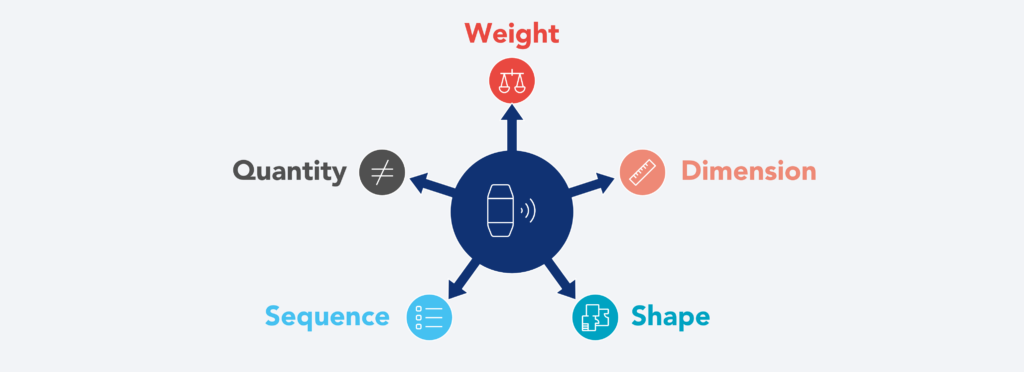
When well designed and integrated into the process, poka-yoke devices prevent errors while also improving safety and productivity.
Examples of poka-yoke
Poka-yoke can be applied to virtually any type of process. Its effectiveness lies in the simplicity of the solutions. Some examples of poka-yoke in industry include:
- Assembly: asymmetric guide pins, specific grooves or unique fittings that prevent incorrect assembly of components.
- Logistics picking and border of line: visual indicators (light signals or LED projections) at picking stations that highlight the correct location of the component to be retrieved.
- Packaging filling: weight or presence sensors that confirm all components have been correctly inserted before the package is sealed.
- Manual operations with power tools: condition-based activation that only allows the tool to operate when it is correctly positioned and the part is in place.
- Contaminant separation: magnets installed in processing lines that automatically remove unwanted metal particles.
- Automated production lines: optical readers or sensors that check the type, position and orientation of parts before the next operation.
- Machine safety: interlocked barriers or safety mats that prevent machine operation when an operator enters a hazard zone.
- Administrative and digital processes: automatic validations with blocking functions that stop tasks moving forward with incomplete, inconsistent or incorrect data (for example, mandatory fields left blank).
Everyday examples of poka-yoke
Mistake-proofing is all around us — much of modern product design is poka-yoke in disguise:
- The UK three-pin plug only fits the socket one way, making incorrect insertion physically impossible.
- A microwave stops heating the moment the door opens.
- A washing machine will not start until the door is locked.
- An automatic car must be in park or neutral before the engine will start.
- A SIM card tray accepts the card in one orientation only, thanks to its cut corner.
These examples show that applying poka-yoke does not require complex technology or high investment. What matters is identifying the critical points where errors are most likely and designing simple, effective, sustainable solutions that ensure quality at the source.
Relationship with other improvement tools and methodologies
Poka-yoke is often used alongside other process optimisation methodologies, as it strengthens process robustness, eliminates sources of variability and contributes to operational excellence.
Poka-yoke and jidoka
The concept of jidoka, also known as “autonomation” or “automation with a human touch”, refers to the ability of machines to autonomously detect abnormal situations and stop the process immediately to prevent the production of defects. For example, a sensor detects a broken tool, the andon system signals the stoppage, and the operator intervenes to correct the problem.
Poka-yoke is one way to implement jidoka, automating error detection. This synergy frees operators from repetitive monitoring tasks, allowing them to focus on higher-value activities.
Integration with FMEA
FMEA (Failure Modes and Effects Analysis) identifies and evaluates potential failure modes in a process or product, scoring them by likelihood of occurrence, severity of effects and ease of detection.
For the most critical failure modes, prevention poka-yoke devices should be implemented wherever technically feasible to eliminate the possibility of error. Where failure cannot be completely prevented, immediate detection should be ensured through poka-yoke systems that stop the error progressing to the next step or reaching the customer. This integration improves quality from the design stage, fostering robust processes aligned with a zero-defects philosophy.
Poka-yoke and SMED
The SMED (Single-Minute Exchange of Die) methodology drastically reduces setup times, enabling quick tool or mould changes. Setup is where human errors — wrong components, incorrect settings, forgotten steps — are often identified, and poka-yoke devices eliminate them, making changeovers reliable and repeatable even under time pressure. Error-proofing the setup reinforces SMED’s efficiency with robustness from the first unit produced.
Poka-yoke in the digital and technological age
With digital transformation, poka-yoke has expanded its scope, integrating with smart sensors, machine vision, machine learning algorithms and MES (Manufacturing Execution Systems). These solutions enable real-time process monitoring, precise deviation detection, more effective operator guidance and automatic traceability of failures and corrective actions.
Enhanced by new technologies, mistake-proofing extends well beyond manufacturing — into logistics, administration, commerce and digital operations — and remains a strategic pillar for organisations aiming for consistent, zero-defect performance.
Request support in implementing Poka Yoke and improve the quality of your processes now
Frequently asked questions about poka-yoke
What does poka-yoke mean?
Poka-yoke is Japanese for “inadvertent error prevention”. In English it is known as mistake-proofing: designing a process so that errors cannot happen, or are caught immediately before they become defects.
What are the three types of poka-yoke?
Shigeo Shingo defined three methods: the contact method (a part’s physical attributes reveal the error), the fixed-value method (a set number of actions or parts must be completed) and the motion-step method (the process must follow the correct sequence).
What is the difference between poka-yoke and FMEA?
FMEA identifies potential failure modes and assesses their risks; poka-yoke prevents or detects those errors through devices in the process. Used together — FMEA to find the critical failure modes, poka-yoke to eliminate or mitigate them — they ensure process quality from the design stage.
What is the difference between poka-yoke and jidoka?
Poka-yoke prevents errors through devices built into the process; jidoka is a machine’s ability to identify failures on its own and stop automatically so the error cannot advance. Poka-yoke focuses on prevention, jidoka on detection and immediate reaction — and poka-yoke is one of the ways jidoka is implemented.
What is the relationship between SMED and poka-yoke?
SMED makes changeovers fast; poka-yoke makes them error-free. Error-proofing the setup steps means tool and mould changes are performed correctly even under time pressure, so speed never comes at the cost of quality.
See more on Discrete Manufacturing
Find out more about transformation in this sector
See more on Quality
Find out more about improving this business area