Article
From strategy to results: The execution challenge facing Thai businesses


Ramesh Raju
Managing Director & Senior Partner
Kaizen Institute Thailand
A few months ago, we brought together three very different teams at the KAIZEN™ Award Thailand, each with a distinct story of operational improvement.
One of these companies operated a manufacturing facility on a 24-hour schedule. Another one was already considered highly efficient. The third one held a research office in a university.
Their challenges were quite different. A closer look at their achievements reveals a striking element.
Three teams, one shared habit
What actually separates these teams isn’t the size of the numbers. It’s whether they can point to the exact habit that produced them: not the report describing the change, but the moment someone decided to do the work differently and kept doing it that way.
Take Essilor Optical Laboratory Thailand, a site where the line doesn’t stop, with 2,050 people running production 24 hours a day, 364 days a year. Nobody there needed convincing that machine downtime was a problem. For years, 68% uptime on the ADB line had been the accepted number. What changed wasn’t the machine. It was a team that stopped accepting “that’s just how it runs” as an answer, traced every stoppage to its actual cause, and built the follow-up checks needed to prevent the problem from coming back. Uptime moved to 92%. Output per operator doubled. None of it came from new equipment.
Get inspired by the success stories behind the KAIZEN™ Awards Thailand
At Kenvue, the same discipline was applied to a line most people would already call efficient. Line L’s OEE moved 16 percentage points, not through a single fix, but through a team that treated every small stoppage as worth investigating. That habit alone unlocked capacity for 9.9 million more bottles a year.
And at KMITL Research and Innovation Services, the friction showed up in processes and paperwork rather than on a production line, but the pattern was the same: small losses everyone had learned to live with. Approval requests were reworked ten times a month before anyone could sign off. Reporting alone took up 36 hours of someone’s time, rebuilding the same numbers every month instead of creating them once. Today, that reporting time is zero because the data lives in one place instead of being reconstructed every cycle. Rework happens twice a month instead of ten.
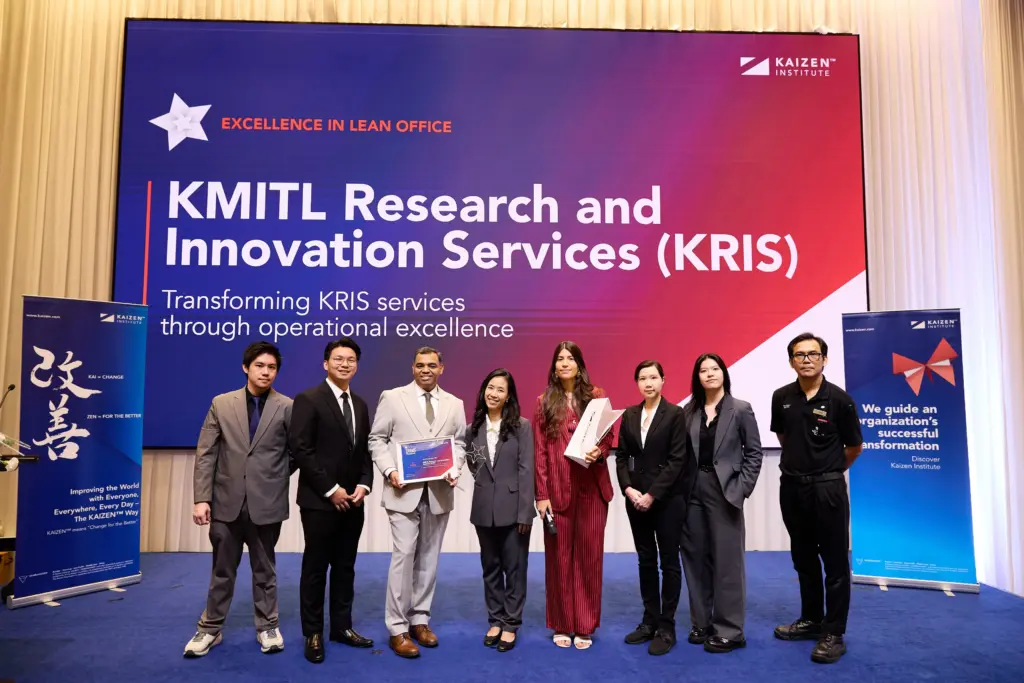
Figure 1 – KRIS-representatives receive the Excellence in Lean Office award
The harder choice behind the results
What stays with me isn’t the percentages.
It’s that each of these teams chose to look closely at how the work was actually being done.
EOLT already had eighteen years of operational excellence and a site that runs 24/7, regardless of who’s watching. Kenvue was already efficient by most standards. KRIS is a research office. Nobody measures how fast an approval moves through a university, and no one would have noticed if it hadn’t changed.
But each team chose to measure it anyway.
They chose to let an outside team stand on their floor, in their office, and write down what wasn’t working before writing down what improved.
That choice is harder to build than any of the tools that followed it.
Want results like these?
Most organizations protect the story they tell about themselves. Improvement starts when a team is willing to look at the real number first, the 68%, the ten reworks a month, and treat it as a starting point rather than something to explain away.
That’s what we’re really recognizing at the KAIZEN™ Award Thailand.
Not simply who improved the most.
But who was willing to look closely enough to find out what needed to change.
That kind of discipline rarely sustains itself; it depends on a culture that keeps choosing to look closely long after the first number improves. This is the territory Kaizen Institute works in through its Leaders’ Strategic Breakthroughs and KAIZEN™ Culture Model consulting, helping organizations turn one team’s habit into something the wider organization sustains.
See more on Leaders’ KAIZEN™
Find out more about improving this business area
See more on KAIZEN™ Culture
Find out more about improving this business area