Article
Lean before AI: Kaizen Institute’s case study session at the Operational Excellence & Business Transformation Summit 2026, Miami


“We tried AI. It didn’t work.”
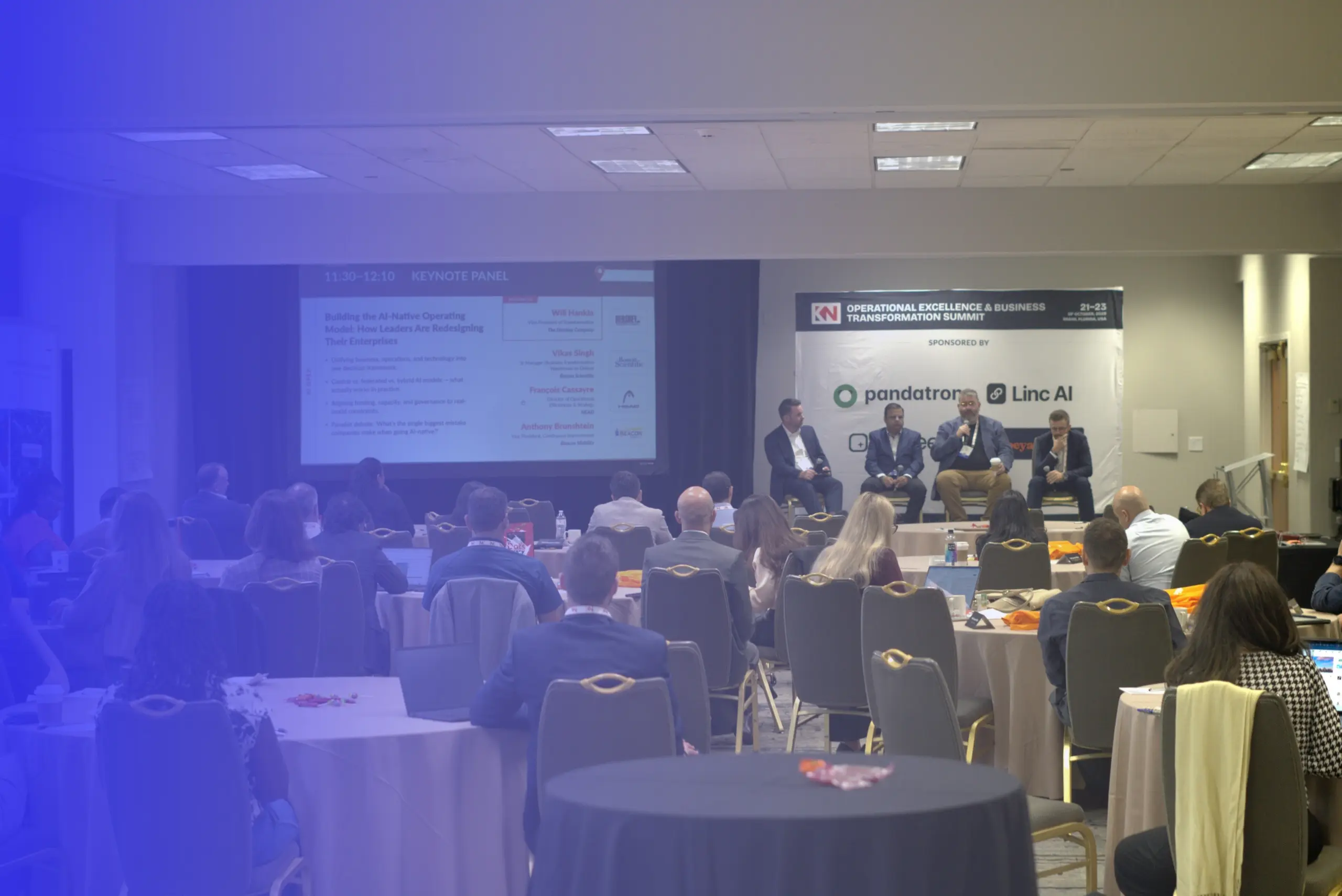
Most operations leaders have heard some version of that sentence: a pilot, a few weeks of enthusiasm, a sponsor who moves on, and a team that quietly goes back to the spreadsheet. This familiar scenario was the starting point for Kaizen Institute’s case study session at the Operational Excellence & Business Transformation Summit, which took place in Miami, Florida, from 21 to 23 October 2026.
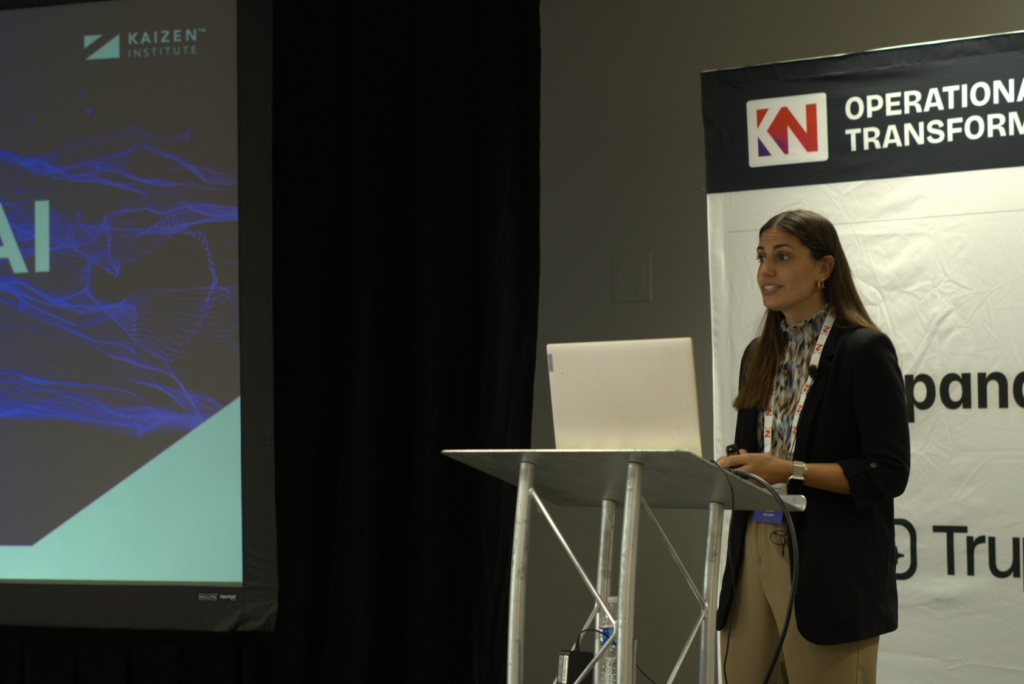
On the second day of the summit, in the Digital Enterprise, Data & AI Automation track, Olga Ballester, Senior Project Leader at Kaizen Institute North America, presented Lean Before AI: The KAIZEN™ Way to Making AI Work. Addressing an audience of leaders in operational excellence, transformation, and continuous improvement, the message was clear: AI amplifies whatever it is applied to, so the foundation must come first.
From adoption to appropriation: Why so few AI pilots scale
The session opened with two guesses for the room: what share of manufacturers use some form of AI today, and what share have scaled most of their AI pilots into production. The answers, drawn from industry surveys cited by Kaizen Institute, frame the problem. Around 94% of manufacturers use some form of AI, yet only about 25% have scaled more than 40% of their AI pilots into production.
Using AI, in other words, is not the same as making AI work. Olga located the gap in a distinction between two words. Adoption is installing the tool. Appropriation is people making it theirs. In the surveys cited, 40% of operations leaders said new digital tools end up used by a few and ignored by most, and the obstacle is often not resistance but indifference.
Turn AI pilots into results that scale
The core of the argument fits in a simple equation: AI × ? = results. Companies do not invest in AI for its own sake; they invest in better results. Because AI multiplies, the outcome depends entirely on what sits on the other side of the equation.
“We don’t invest in AI. We invest in better results. AI is a multiplier. So the real question is: what is it multiplying?”— Olga Ballester, Senior Project Leader, Kaizen Institute North America
When AI lands on an unstable process, Olga argued, it produces three new types of muda:
- Intelligent muda: AI that very efficiently does the wrong things.
- Performative AI: AI used to meet a mandate, with the output then fixed by hand.
- Indifference: tools used by a few and ignored by most.
Put another way, AI × chaos = faster chaos.
The right order: culture, process, then technology
If AI is the multiplier, the KAIZEN™ answer is to make sure there is something worth multiplying.
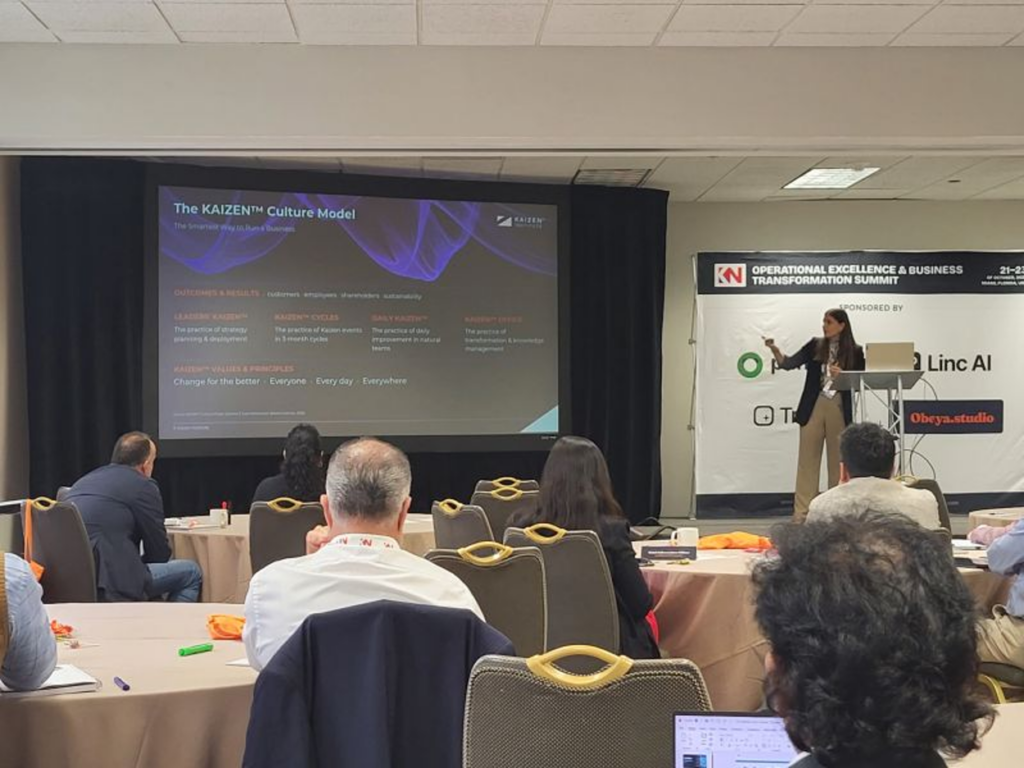
Olga walked through the Modern KAIZEN™ Toolbox, which sets out a deliberate sequence. Foundation tools come first: Value Stream Analysis, standardization and standard work, structured problem-solving, 5S and PDCA. Management systems follow, chosen according to the type of process.
Automation systems and tools come last, and only once the excellence model is in place, to avoid automating waste.
The same logic underpins the path from Lean to Smart: first culture (people and daily routines), then process (value, flow and standards, so there is no waste left to automate), and only then technology and AI on a stable base. The sequence can be summarized as simplify, digitize, automate.
Most companies, she noted, reverse this. Digitizing gets the budget and automating gets the attention, while standardizing is skipped and engagement rarely happens. The figures she shared show the cost: 80% of companies plan heavy smart-factory investment, yet only 5% of AI projects reach enterprise scale.
Keeping “everyone” in continuous improvement
The session also returned to the founding definition of KAIZEN™ given by Masaaki Imai in 1986: ongoing improvement involving everyone, everywhere, every day. That raises a 2026 question: what happens to “everyone” when AI starts running the improvement cycle? According to a Kaizen Institute Global poll of 175 operations leaders, 86% say that losing the human element is their number one concern about AI in continuous improvement.
For Olga, the risk is not AI; it is losing the people. The KAIZEN™ change model shows how appropriation actually happens: change the gemba (working areas and processes), then change behaviors as new ways of working begin to spread, and finally change the culture by reinforcing those behaviors until they become usual. The same applies to AI: it is not integrated until it becomes the way people work.
In practice, that means teams who run a process design, build and adjust its future state, while leaders coach at the gemba: going where the work happens through gemba walks, checking with kamishibai that standards are lived and not just written, and asking the right questions so the team solves the problem. The guiding principle is to redirect people, not cut them.
Kaizen Institute’s own experiment: AI for Daily KAIZEN™
To show the approach in action, Kaizen Institute ran the experiment on itself, applying AI to the design of its own Daily KAIZEN™ projects.
During a live demo, Olga presented the Daily KAIZEN™ Boards app, an internal tool that takes a project from a blank page to a Daily KAIZEN™ system ready to launch: company profile, meeting cascade, KPIs and KPI tree, boards, and coaching and standards. Throughout the flow, AI proposes and people decide.
She explained why this was the right task to digitize. It is recurring, because Daily KAIZEN™ systems are designed project after project. It is standard, because the method (cascade, KPIs, boards, coaching) was defined first. And it remains human, because people still decide which meetings, which KPIs and which standards to put in place. As she put it, AI does not replace judgment; it speeds up the work. The question she left with the audience was a practical one: what would you let AI speed up, and what must your people still decide?
Client examples followed the same pattern. In one case, simplifying the commercial quoting process before adding AI cut the effort to prepare quotes by 97%. In an oil and gas operation, leader routines combined with digital gemba walks delivered $9.6 million in yearly staff productivity. In both cases, process and people came first, and AI came second.
Build the KAIZEN™ Culture that makes AI stick
Lead human. Then AI.
The session closed by solving the opening equation: AI × Lean = smart results. Digital transformation is not the end goal, but a tool to achieve results and sustain continuous improvement, and the KAIZEN™ Culture Model (Leaders’ KAIZEN™, KAIZEN™ Cycles, Daily KAIZEN™ and KAIZEN™ Office) provides the operating system on which it can work.
For leaders at the summit weighing their next AI investment, the takeaway was clear. Before asking which AI tool to deploy, ask whether the process it will run on is stable and whether the people who run it are ready to own it. As Olga summarized it, the smartest way to run a business is also the most human.
Kaizen Institute helps organizations turn continuous improvement into lasting results by combining the KAIZEN™ methodology with practical experience. Through our digital consulting services, we help companies build AI on a Lean foundation: stable processes, clear standards and engaged teams first, then the data and AI tools that multiply their results.
See more on Digital & AI
Find out more about improving this business area
See more on KAIZEN™ Culture
Find out more about improving this business area