
Case Study
Reengineering core processes to support sustainable growth in corporate insurance
Goals: redesign siloed operational processes into unified workflows to support double-digit annual growth without proportional headcount increases


€300K–€1.1M
Savings
20 weeks
Payback period
+120
Improvement solutions identified
A global insurer scaling faster than its processes
The organization is a global corporate and commercial insurance provider, offering Property & Casualty insurance and service solutions to medium and large companies and brokers in over 190 countries worldwide, with total earned premiums exceeding €4 billion in 2025. Supported by a global network of more than 1,300 dedicated professionals, including over 100 risk engineers, the company delivers personalized solutions across Property, Casualty, Engineering, Marine, Aviation, Cyber, and other specialty lines, with Multinational Programs accounting for over 40% of Corporate & Commercial premiums.
Against this backdrop, and with an opportunity to support continued growth in a more structured way, a project was carried out focusing on the company’s French operations — a business unit employing 110 people that has sustained annual growth above 20% for several consecutive years. Having recently implemented a new CRM platform built around individual functionalities, the organization saw an opportunity to evolve this foundation into a more connected, workflow-based way of working, one that could support continued growth while making the best use of existing teams.
The challenge: growth outpacing process maturity
As the business continued to expand, the organization identified an opportunity to bring greater cohesion and visibility to its core processes, ensuring that growth could be sustained efficiently across teams and functions. This called for a structured diagnostic spanning multiple functional areas and lines of business.
Connecting task management end-to-end
The recently implemented CRM had been organized around individual functionalities, creating an opportunity to evolve it toward a workflow-based structure that would make it easier to follow a submission or task from start to finish across teams.
Streamlining data and process flows
Data integration, reporting, and financial flow processes relied significantly on manual work, both for internally generated data and data provided by customers, presenting a clear opportunity for standardization and automation.
Strengthening visibility for growth management
As the business continued to scale, there was an opportunity to introduce standardized KPIs and centralized action tracking, providing management with the structured oversight needed to prioritize improvement efforts as the organization grew.
Is your growth outpacing your processes too?
The approach to process redesign
A structured Process Review & Reengineering (PR&R) methodology was applied, combining process mapping, cross-functional workshops, and a prioritized action roadmap.
AS IS diagnostic across the organization
Eight SIPOC exercises and six process mapping sessions were conducted to establish a complete, factual view of current-state operations. This diagnostic phase was completed within three months and engaged more than 50 participants across the organization.
Structured governance during implementation
A mission control routine was established, meeting every three weeks with more than 30 people to ensure consistent follow-up on improvement actions throughout the project.
Solution identification and prioritization
The diagnostic work led to the identification of more than 120 improvement solutions across all services combined, later prioritized by complexity and resourcing needs: locally implementable actions are expected to free up 6 FTEs, and actions requiring global IT development a further 20 FTEs.
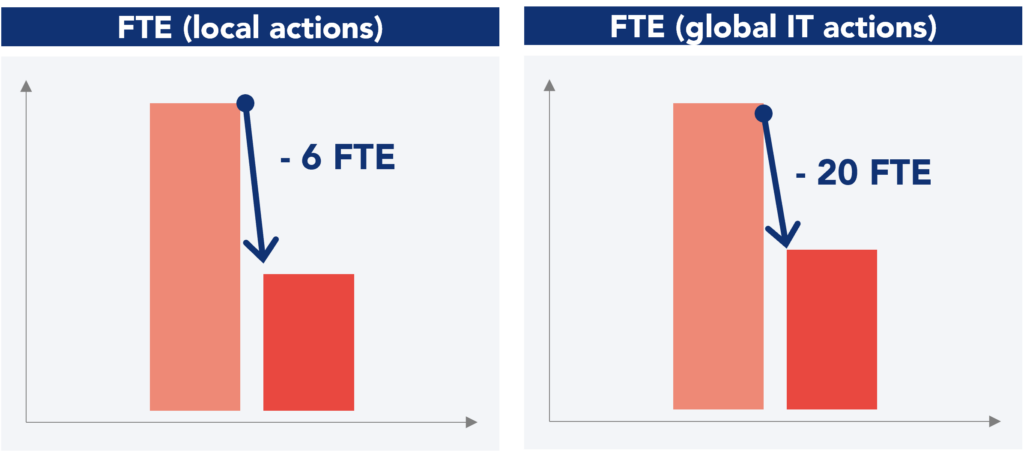
Figure 1 – Two bar charts showing FTE reduction
Technology and workflow enablement
Key solutions included standardizing activities across internally generated and customer-provided data, automating integration, reporting, and financial flow processes through robotics, and introducing AI-assisted data entry into the CRM. A new CRM functionality was also designed to link previously siloed tasks into a single end-to-end workflow, underpinned by structured KPIs and centralized action tracking.
Measurable savings, lasting capability
Quantitative results
The initiative generated savings of between €300,000 and €1.1 million, against an investment of more than €90,000 in IT development, resulting in a payback period of 20 weeks.
Unlock your operations’ full potential with AI-driven redesign
Qualitative results
Beyond the financial impact, the project embedded a lasting continuous-improvement dynamic: weekly mission control routines for internal teams are now fully owned and managed by the internal PMO, which was trained as part of the engagement. Activities were standardized across internal and customer-provided data sources, and new CRM capabilities were developed to sustain workflow-based ways of working going forward.
This project shows what’s possible when a fast-growing insurer stops treating growth and process maturity as a trade-off – turning fragmented, task-based ways of working into a connected, scalable operation. It’s a pattern we see across insurance and banking: strong growth outpacing the systems meant to support it. Through our AI Solutions for Insurance and Banking, Kaizen Institute helps organizations close that gap, pairing process redesign with AI-assisted data entry, robotics, and workflow intelligence to scale without scaling headcount.
We are committed to respecting our clients’ confidentiality. While we have altered or omitted their names, the results are genuine.
See more on Financial Services
Find out more about transformation in this sector
See more on Digital & AI
Find out more about improving this business area